Unistellar eVscope: How a $1,000 Telescope Crowdfunded $2.2 Million
Crowdfunding Analysis · · PledgeRadar Editorial
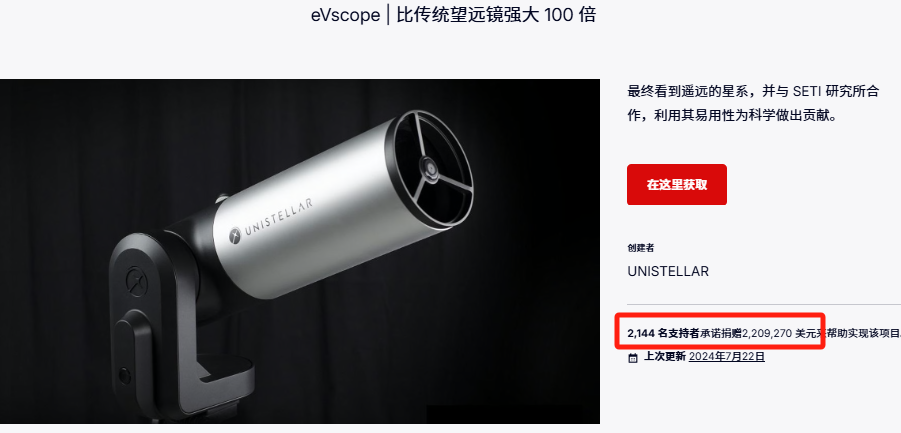
Launched on Kickstarter in 2020, the Unistellar eVscope campaign garnered support from 2,144 backers, raising a total of $2.2 million. Achieving such significant funding for a high-value product underscores its strong appeal and innovative design. By 2024, Unistellar had completed its initial market launch, selling over 25,000 eVscope units globally and subsequently introducing models like the eVscope2 and eQuinox. A notable positive for this project is its successful delivery, avoiding the common pitfall of unfulfilled pledges, although customer reviews on Kickstarter were mixed.
Core Selling Points
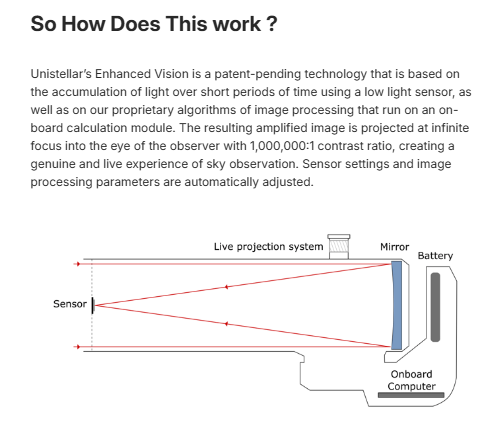
**Enhanced Vision Technology:** The eVscope features a patented Enhanced Vision algorithm. This technology combines a low-light CMOS sensor with real-time image processing to 'stack' faint starlight and reduce noise over short periods. This allows users to observe deep-sky objects like galaxies, nebulae, and comets that would otherwise be invisible to the naked eye. The resulting image is projected into the eyepiece with a million-to-one contrast ratio, eliminating the need for manual exposure or focus adjustments, truly enabling 'intuitive deep-sky observation through the eyepiece.'
**Automated Field Recognition and Simplified Setup:** Utilizing a built-in star recognition algorithm, the eVscope automatically scans the visible stars upon startup. It then compares this data against a 20-million-star catalog to quickly determine its current pointing direction. Coupled with an electronically driven equatorial mount, users simply point the telescope towards a visible patch of sky and initiate alignment; the device handles the rest of the celestial positioning, significantly lowering the barrier to entry for amateur astronomers.
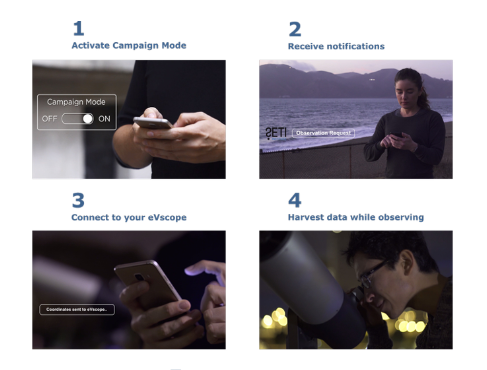
**Citizen Science Mode with SETI Institute:** Unistellar collaborates with the SETI Institute through its 'Campaign Mode,' engaging users in the 'Astronomy Office' program. When sudden astronomical events occur—such as asteroid occultations, supernova explosions, or passing comets—scientists can issue observation requests. eVscope users receive notifications, automatically point their telescopes to the target, and upload real-time data to the cloud, contributing to global citizen science projects and advancing astronomical research.
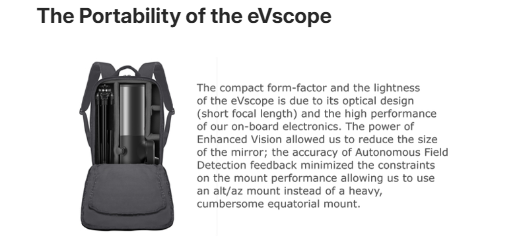
**Portable, Integrated, and Plug-and-Play Design:** The entire unit is constructed from carbon fiber and lightweight composite materials, weighing approximately 4kg (including the camera and electronic modules). It also features a foldable tripod, making it highly portable for field use. Furthermore, the eVscope pairs with a smartphone or tablet via Bluetooth or Wi-Fi for remote control. From power-on calibration to target selection, shutter capture, video recording, and overlaying environmental information (like constellation descriptions), all functions can be completed with a single tap in the accompanying app, eliminating complex manual star-finding, focusing, and long-exposure photography.
**Real-time Observation and 'Infinite Focus' Eyepiece Experience:** The eVscope projects real-time processed images onto an electronic eyepiece equipped with a wireless HD screen. Unlike the 'dim and monochromatic' experience of traditional telescopes, the eVscope outputs colorful, high-contrast, long-exposure nebula images. Users simply look into the eyepiece to see minutes of accumulated starlight presented instantly, akin to watching a 'night sky time-lapse,' significantly enhancing the observation experience and enjoyment.
Brand Background
Unistellar was founded in 2015 in Marseille, France, by a team of astronomical scientists and engineers. Their mission is to 'make deep-sky observation accessible to the public at a low cost' and to bring professional-grade astronomical observation technology into ordinary homes through a 'connected device + cloud collaboration' model.
The founding team members largely hail from NASA, astronomical research institutions, and consumer electronics companies. The company later secured support from venture capitalists like Brighteye Ventures and French innovation incubators. The initial eVscope prototype was showcased at CES 2017 and IFA 2017, earning multiple industry awards for its 'ease of use + image enhancement' technology.
Product Development and Market Feedback
Following its shipment in 2020, Unistellar quickly earned a strong reputation. Over 4,000 units were sold in 2020, attracting a diverse user base including astronomy enthusiasts, educational institutions, and research organizations. The product achieved a DevScore of 54.5 and has already contributed to several scientific discoveries—including 85 exoplanet transits jointly detected by 79 observers and 281 asteroid occultation events recorded—underscoring its citizen science value.
Subsequent models, the eVscope2 and eQuinox, continued this technological trajectory and have also received accolades such as the T3 Platinum Award.

Market Situation Analysis
Demand for consumer astronomical equipment continues to grow, with an expanding community of amateur astronomers. There's a rising call for an 'urban stargazing revival' globally, especially in areas with significant light pollution, where smart telescopes have become a primary gateway for the public to reconnect with the night sky. According to reports, the global astronomical telescope market size is projected to grow from approximately $1 billion in 2023 to $1.5 billion by 2028, at a compound annual growth rate of about 9%.
Concurrently, as more overseas schools and natural science organizations integrate smart telescopes with app-based remote control into their middle and high school astronomy curricula and club activities, these products are gaining widespread popularity due to their ease of operation and quick results.
**Intelligent and Networked Trends:** The shift from cumbersome manual operation to 'instant viewing' is a key trend. Traditional Newtonian or refracting telescopes require years of calibration and manual star-finding, which deters novice users. The eVscope's 'auto-alignment,' 'real-time enhancement,' and 'app control' features meet the public's demand for 'zero learning curve' and 'rapid feedback,' offering a distinct advantage.
**Citizen Science and Community Ecosystem:** By leveraging scientific organizations like the SETI Institute and NASA to promote 'citizen astronomy' projects, Unistellar enables observers to upload data to the cloud, forming a global collaborative network. This model aligns perfectly with the citizen science ethos of platforms like iNaturalist and Zooniverse, further stimulating long-term user engagement.
Future Development Opportunities
**Education Market Penetration:** In lower-tier cities and developing countries, astronomy education in middle schools often lacks funding. If Unistellar could introduce a half-price version or a rental program, it could reach a much larger base of educational users.
**Software Ecosystem and Subscription Services:** As the number of observers grows, cloud-based value-added services such as 'image post-processing,' 'multi-telescope synthetic observation,' and 'astronomy community sharing and analysis' hold high potential for increased Average Revenue Per User (ARPU).
**Astronomy Tourism and Offline Experience Stores:** Unistellar could partner with planetariums, nature parks, and similar venues to offer eVscope experience programs, achieving integrated marketing and monetization through hardware and software.
**Cross-Industry Applications:** Beyond deep-sky objects, the eVscope could also be applied to areas such as 'artificial satellite tracking,' 'aurora and meteor observation,' and 'detailed imaging of solar system planets,' further expanding its market boundaries.
Through 'Campaign Mode,' Unistellar partners with the SETI Institute, allowing eVscope users to contribute real-time data to global citizen science projects, automatically observing astronomical events requested by scientists.