Open-Source AI Hardware Success: OAK Project Raises $1.35M on Kickstarter
Crowdfunding Analysis · · PledgeRadar Editorial
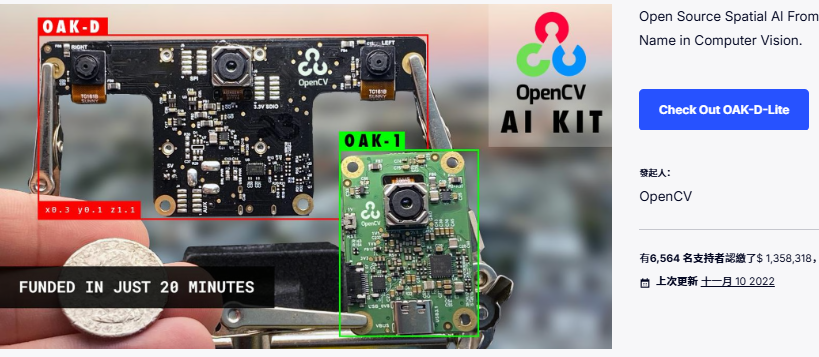
In 2020, the OpenCV AI Kit (OAK) project concluded a highly successful crowdfunding campaign on Kickstarter, attracting 6,564 backers and raising approximately $1.358 million. This significant funding enabled the project to move into productization and mass delivery phases. Following the campaign, hardware manufacturer Luxonis continued to sell OAK-1, OAK-D, and their derivatives (such as OAK-DLite, OAK-4 series) through its official store. This demonstrated a successful transition from crowdfunding validation to sustained commercial operation. The scale of this fundraising was a top-tier performance for open-source hardware and AI tool projects, signaling clear market demand for edge computing vision solutions. However, it appears the project did not fully ship all orders; four years ago, many backers posted comments requesting refunds and inquiring about product delivery. A positive note is that the project team was responsive, replying to every comment.
Core Selling Points
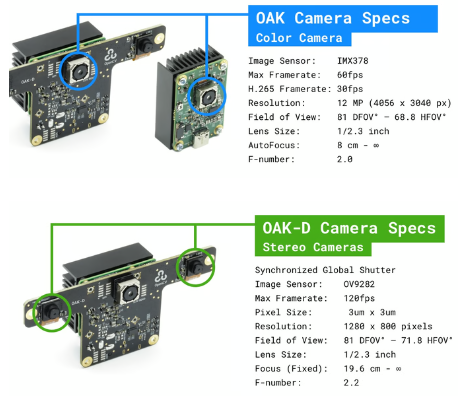
The OAK project distinguished itself with its advanced edge Spatial AI inference engine. The OAK-1 model integrates a 12MP high-resolution camera with a MyriadX VPU acceleration processing unit, enabling direct neural network model execution and inference computation on the device.
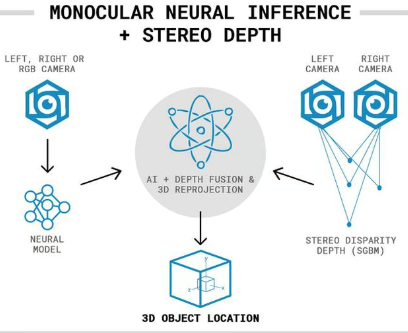
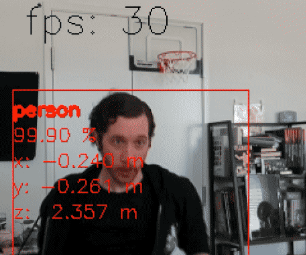
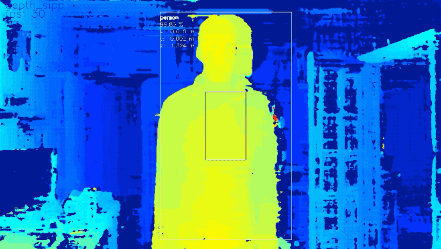
Building on this, the OAK-D incorporates a stereo depth calculation module, providing both 2D feature recognition and 3D spatial positioning information (Spatial AI) simultaneously. This design significantly reduces reliance on cloud services, minimizes network latency, and enhances data privacy.
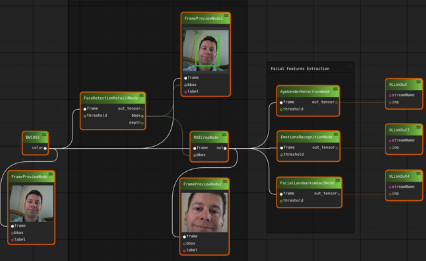
The devices come bundled with pre-trained neural network models for common applications like object detection, facial landmark recognition, pedestrian/vehicle identification, and object classification. The project also offers a visual PipelineBuilder (a node-based workflow editor), allowing developers and researchers to set up and deploy vision processing pipelines to the hardware within minutes, substantially lowering the technical barrier to entry.
Both the hardware and software are released under the MIT license, complemented by Luxonis's DepthAI SDK and the OAK software stack. This open-source nature provides a legal foundation for community contributions and the establishment of a third-party ecosystem, enabling research institutions, educational departments, and enterprise users to directly integrate OAK into their own products and research projects, from prototype validation to full productization.
The devices support 4K/30fps (12MP) video capture and feature built-in H.265 hardware encoding. The MyriadX VPU delivers trillions of operations per second (TOPS) inference performance. OAK supports both stereo neural network inference and monocular-plus-depth spatial AI modes, making it adaptable for diverse applications such as robotics, drones, industrial inspection, and smart retail.
OpenCV is one of the most influential open-source libraries in computer vision, boasting millions of developers worldwide, extensive educational resources, and a vibrant academic competition ecosystem. The OAK project was launched under the umbrella of the OpenCV community, leveraging its broad academic and industrial appeal to promote the concept of open-source spatial AI. Hardware design, manufacturing, and commercialization are primarily handled by Luxonis, a company specializing in edge AI vision hardware. Through the success of the OAK project, Luxonis has expanded its product line to include multiple models and application-specific versions.

Market Analysis
The computer vision and AI vision application markets are experiencing rapid growth. According to a Grand View Research report, the global computer vision market was valued at approximately $20 billion in 2024 and is projected to grow to $500-600 billion by 2030, with a compound annual growth rate (CAGR) of about 15-20%. This expansion is driven by the increasing adoption of applications in automated production, intelligent monitoring, retail analytics, and autonomous driving.
The edge AI market, encompassing inference chips, vision modules, and related hardware, is a particularly strong growth segment. Valued at roughly $20-26 billion in 2024, the global edge AI market is expected to reach $500-660 billion by 2030, with an average annual growth rate of 17-22%. This growth is fueled by continuous demand for low-latency computing, local data privacy protection, and bandwidth optimization.
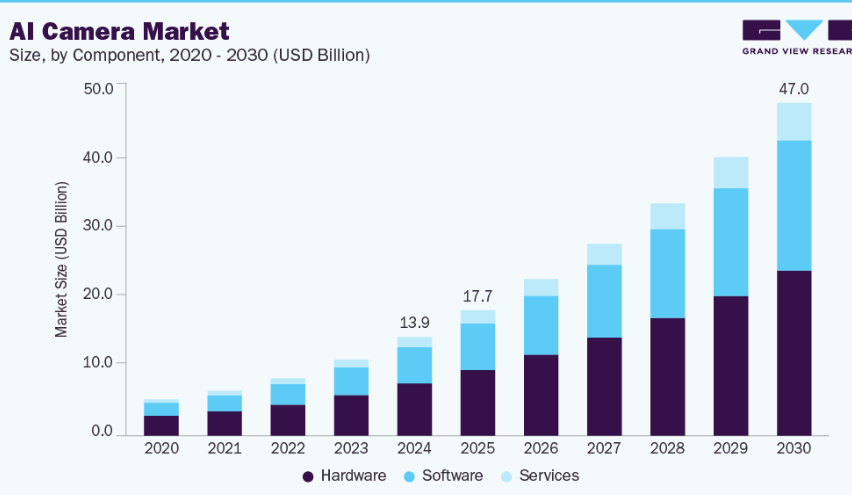
Within the specialized market of edge AI cameras, the segment was valued at approximately $13-14 billion in 2024 and is anticipated to reach $400-470 billion by 2030, growing at a CAGR of about 20%. Scenarios such as smart surveillance, industrial quality inspection, and retail data analysis are driving the widespread deployment of high-performance programmable cameras.
OAK faces competition from various commercial and open-source Edge AI camera solutions in this market. OAK's differentiating advantages include its fully open-source hardware and software stack, deep integration with the OpenCV community, a relatively affordable price point, and a modular application ecosystem. However, long-term competitiveness will depend on factors such as ecosystem maintenance (model library updates, development tool refinement, community support), the stability of VPU chip supply, and the impact of next-generation inference accelerators (NPU, higher integration SoCs) on the market landscape.
Overall, open-source, programmable edge AI vision platforms continue to see sustained market demand in education, research, rapid prototyping, and industrial applications, especially in scenarios that are cost-sensitive, require algorithmic flexibility, and benefit from strong community support.



The OAK project's funding scale represents a top-tier performance within open-source hardware and AI tool categories, clearly demonstrating market demand for edge computing vision solutions.