SPESYNTool3: Precision Handheld Drill Hits Kickstarter, Raises $110K in Two Days
Crowdfunding Analysis · · PledgeRadar Editorial
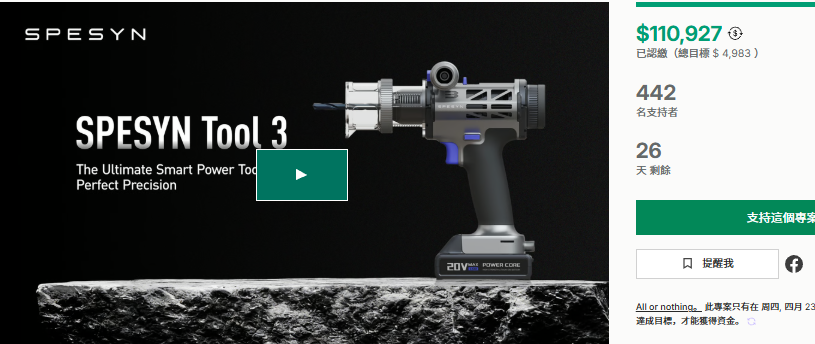
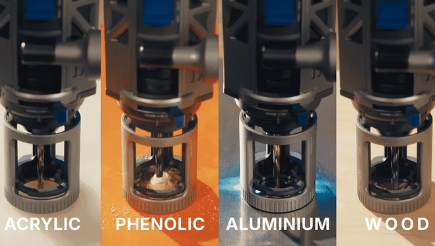
The SPESYNTool3, a handheld tool designed to integrate the precision of a bench drill into a portable form factor, has launched on Kickstarter. Aimed at makers, repair professionals, and DIY enthusiasts, the tool promises 90° vertical drilling, controlled blind hole depth, and stable operation on challenging materials like tile and glass.
Campaign Performance and Backer Concerns
Launched on March 24, 2026, the SPESYNTool3 campaign quickly garnered approximately $110,000 from 438 backers within its first two days. Priced at an early bird rate of $179, the first batch of products is slated for delivery in the third quarter of 2026. A primary concern among backers, as reflected in public discussions, centers on the tool's core claim: achieving true 90° vertical precision in a handheld format.
SPESYN states it is founded by a team with robotics and hardware engineering backgrounds, drawing inspiration from practical workshop scenarios. Team lead Sam Tsai has indicated that the ST3's design addresses the inefficiency caused by repeated rework when using standard handheld tools for precision tasks, a point that appears to resonate with the maker community.
Core Product Features and Engineering
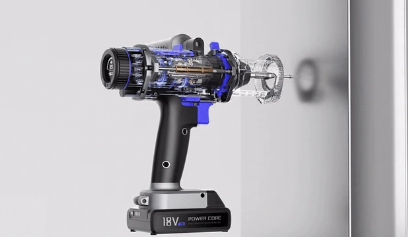
The SPESYNTool3's innovation lies in its proprietary Front Guide Module (FGM) combined with a dual-rail architecture. This system is engineered to tackle the common issues of angled holes and inconsistent depth control inherent in traditional handheld drills. While bench drills or specialized jigs are typically required for perpendicular drilling, the ST3 integrates this capability directly into the handheld unit, using the dual rails to minimize lateral deviation.
The engineering challenge for this mechanical architecture is not the principle itself, but ensuring stable precision in mass production through tight tolerance control. It also requires consistent anti-slip performance and stable entry into various surfaces, including glass, tile, and polished metal.
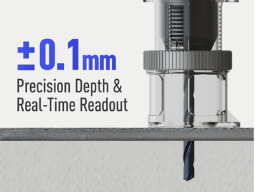
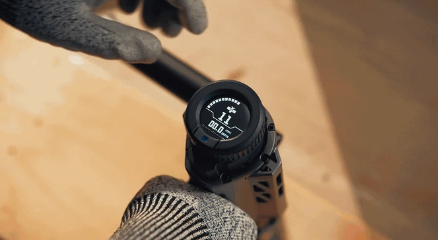
A key feature is the LCD display, which provides real-time depth readings with an accuracy of ±0.1mm. This function is designed to eliminate the guesswork in blind drilling, preventing over-penetration or under-drilling, which is particularly valuable for tasks requiring strict depth control, such as in small metal bracket fabrication, electronics housing modifications, and model making. The integration of depth sensing with an LCD display is a mature engineering path; the critical factors for success are the stability of readings and the display's responsiveness.
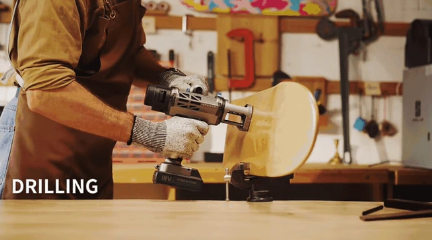
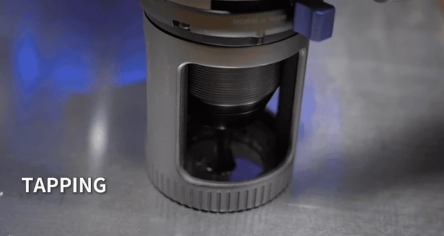
The tool offers three distinct operating modes: drilling, tapping, and screw driving, each with independent control settings. The drilling mode optimizes speed and torque output, while the tapping mode incorporates specific torque limits to prevent stripping or tap breakage. The screw driving mode utilizes an electronic clutch that disengages automatically upon reaching a preset torque. This design aims to reduce tool-switching time and recalibration effort for users performing sequential operations, thereby minimizing cumulative errors.
SPESYNTool3 incorporates a brushless motor and a high-frequency current sampling system (25,000 samples per second) for adaptive torque adjustment. By sampling current in real-time, the tool's MCU can adjust the motor's torque output to prevent over-penetration in softer materials or stripping when driving screws. Brushless motors offer advantages in power density, response time, and lifespan compared to brushed alternatives. This closed-loop control strategy, combined with high-frequency sampling, is technically feasible, with its effectiveness depending on the maturity of the production firmware's control algorithms.
The tool features a modular design, with a detachable front guide module that supports various drill bit lengths and angles. It also includes interfaces for custom jigs. This modularity extends the tool's utility from a single-purpose device to a flexible precision platform, appealing to makers and small workshop users by potentially covering a wider range of tasks with a single investment. However, modularity also demands higher precision in mass production, as consistent interface tolerances are crucial for maintaining accuracy after assembly.
Company Background
SPESYN is a hardware company focused on precision tools, founded by engineers with backgrounds in robotics and hardware development. While specific headquarters information is not extensively detailed on official channels, the brand's website and press materials emphasize the team's long-standing experience in mechanical processing, assembly, and prototype development within workshop environments. Their product development is driven by firsthand operational challenges.
Market Analysis
The cordless power tool market, where the SPESYNTool3 competes, is substantial and growing. Valued at approximately $13.4 billion in 2024, it is projected to reach $31.8 billion by 2033, with a compound annual growth rate (CAGR) of about 10.4%. The drilling and fastening tools segment is among the fastest-growing, exceeding $4.1 billion in 2024 and expected to grow at a CAGR of 11.1%.
Key growth drivers include advancements in lithium-ion battery technology accelerating cordless adoption, the sustained popularity of DIY home renovation, and increasing systemic procurement of cordless and intelligent tools in industrial and manufacturing settings. The shift towards cordless technology is a dominant trend in the industry, aligning well with SPESYN's product positioning.
The market is currently dominated by established players such as DeWalt, Stanley, Bosch, Makita, and Milwaukee, who possess significant advantages in distribution, brand trust, large-scale manufacturing, and after-sales service. New entrants face considerable barriers to entry, especially in competing on parameters like raw torque or battery life. SPESYN's strategy appears to focus on a niche segment: precision handheld operations, a domain where traditional drills have historically fallen short. This addresses the need for drill press accuracy in situations where a bench drill is impractical, targeting makers, repair technicians, and small workshop users who often rely on makeshift solutions. While this niche may be smaller in volume, its users have clear pain points and strong willingness to pay, and traditional manufacturers have yet to introduce direct competitors in this specific area.
Precision handheld tools represent a segment overlooked by major drill brands. If SPESYN can deliver on its promise of accuracy, precision, and stability in mass production, this product category holds clear market potential and long-term growth prospects within the maker, repair, and small workshop communities.
A primary concern among backers, as reflected in public discussions, centers on the tool's core claim: achieving true 90° vertical precision in a handheld format.