Anker's Surging Profitability: A Deep Dive into H1 2026 Financials
Market Trends · · PledgeRadar Editorial
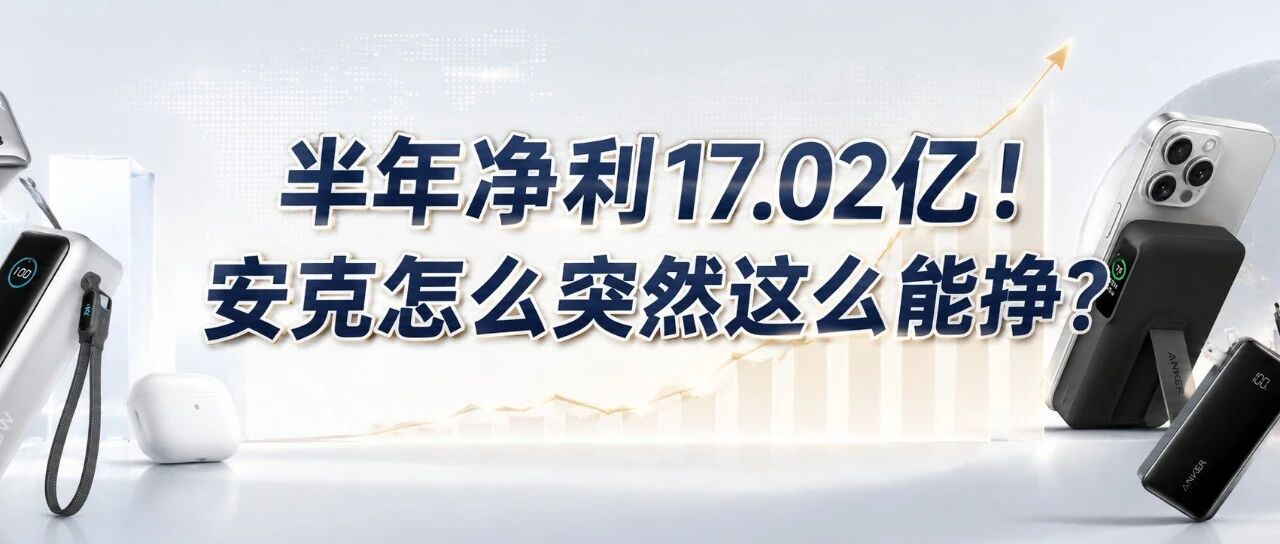
Anker Innovations' latest half-year financial report for 2026 presents a significant departure from the typical performance of traditional cross-border e-commerce companies, showcasing remarkably robust profitability.
Strong Financial Performance and Key Drivers
In the first half of 2026, Anker Innovations reported a total operating revenue of 16.605 billion RMB, marking a 29.05% year-over-year increase. Net profit attributable to the parent company surged by 45.86% to 1.702 billion RMB, while non-recurring net profit grew by 49.65% to 1.439 billion RMB. This substantial profit growth, nearly five times the revenue increase, is particularly striking. Furthermore, the company's operating cash flow reversed dramatically, shifting from a net outflow of 1.132 billion RMB in the prior-year period to a net inflow of 723 million RMB this year. This strong performance is primarily attributed to two factors: product structure upgrades and a significant tariff refund. The overall gross margin for Anker's consumer electronics business reached 49.82%, an increase of 5.09 percentage points year-over-year. The charging and energy storage business, a core revenue pillar, generated 8.93 billion RMB, up 31.02%, with its gross margin soaring by 8.4 percentage points to 49.01%, now contributing over half of Anker's total revenue.
Product Portfolio Evolution
Anker's enhanced gross margins are largely a result of its evolving product strategy. The company has expanded beyond its initial focus on small charging adapters and power banks. Its AnkerSOLIX brand has made significant inroads into the home energy storage market, promoting balcony solar storage solutions in Europe, household energy storage in Australia, and portable energy storage in North America. The first half of the year saw a concentrated release of new products in this series across multiple countries, effectively shifting the company's average transaction value from tens of dollars for accessories to thousands of dollars for high-end systems. Beyond energy storage, Anker's smart innovation business, encompassing eufy security products, robot vacuums, robot lawn mowers, and baby products, generated 4.186 billion RMB, a 28.77% increase. The smart audio and visual segment, featuring audio and projection products, achieved 3.485 billion RMB in revenue, up 24.53%, and boasted the highest gross margin among all business units at 54.78%. This diversification underscores Anker's successful move away from reliance on single blockbuster products, building a broad and high-margin smart hardware ecosystem.
Diversifying Sales Channels
A profound strategic shift for Anker involves reducing its dependence on any single sales platform. While Amazon remains a significant channel, generating 7.699 billion RMB in revenue (up 19.75%), its share of Anker's total revenue decreased from 49.97% in the prior-year period to 46.37%. This indicates that while Amazon sales continue to grow, other channels are expanding at a faster pace. Revenue from other third-party platforms surged by 95.78% to 1.814 billion RMB, independent e-commerce sites grew by 39.19% to 1.837 billion RMB, and offline channels reached 5.255 billion RMB, an increase of 25.37%. Anker, once primarily known as an Amazon powerhouse, has successfully established a presence in major global retailers such as Walmart, Best Buy, Target, and Costco, alongside a robust direct-to-consumer website strategy. Amazon is still its largest sales channel, but it is no longer the sole engine driving growth, though the company has not yet fully detached from its reliance.
Strategic Investments and External Headwinds
Anker's increasingly global operations, with overseas revenue accounting for 94.73% of the total, expose it to complex external environments. Notably, exchange rate fluctuations significantly impacted financial performance. In H1 2026, financial expenses amounted to 145 million RMB, a stark contrast to the negative 36.33 million RMB reported in the same period last year. This increase was primarily due to higher exchange losses from volatile currency markets, coupled with rising interest and fees for convertible bonds. This means that the nearly 46% net profit growth was achieved despite the dual pressures of currency volatility and increased financial costs. Furthermore, Anker's commitment to innovation is evident in its substantial research and development (R&D) investment, which reached 1.869 billion RMB in the first half of the year, a 56.5% increase. This R&D expenditure actually exceeded the period's net profit of 1.702 billion RMB, representing a remarkable 11.26% of total revenue—a figure considered exceptionally high for a cross-border company and competitive even among dedicated technology firms. This demonstrates that Anker's 1.7 billion RMB profit is not a result of cutting R&D or squeezing costs, but rather a product of continuous investment in product innovation.
From Cross-Border Seller to Global Brand
Re-examining this half-year report confirms that Anker has largely completed its transformation from a high-efficiency cross-border e-commerce company to a global consumer brand. The journey began with leveraging the Amazon platform to sell 'Made in China' products worldwide. Now, it boasts a high-margin product matrix that elevates average transaction values, has diversified from single-platform reliance to a full omnichannel distribution strategy encompassing its official website and offline retail, and maintains exceptionally high R&D investment while expanding its scale. While the tariff refund provided a temporary boost to this year's financial figures, the more fundamental change is Anker's successful evolution into a global consumer brand with robust R&D capabilities, strong brand equity, and comprehensive omnichannel reach.
Anker's 1.7 billion RMB profit is not a result of cutting R&D or squeezing costs, but rather a product of continuous investment in product innovation.