US Adults, Especially Youth, Increasingly Anxious About AI Job Displacement
Market Trends · · PledgeRadar Editorial
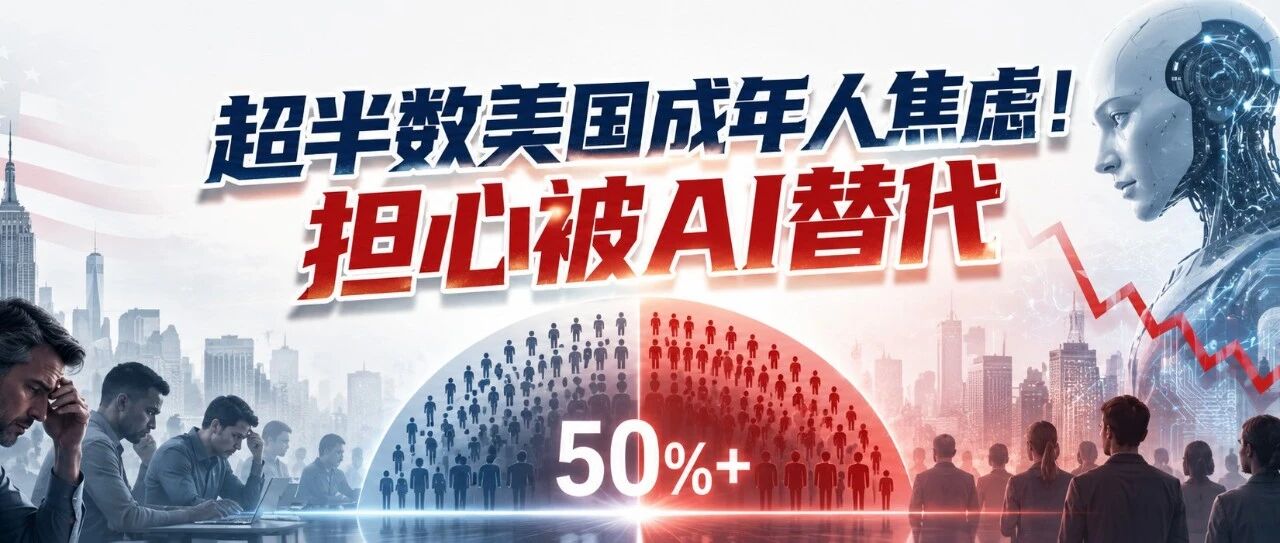
The sentiment of young Americans towards artificial intelligence has undergone a significant reversal in recent years. A new survey released by Pew Research on August 18 indicates that among US adults under 30, 55% feel more worried than excited about AI. This marks the first time a majority in this age group has held a negative view since Pew Research began asking this question in 2021. The survey was conducted from June 22 to 28, with a sample size of 3,488 individuals.
Shifting Sentiments Towards AI
In 2021, the proportion of young adults expressing worry was only 31%, rising to 39% by 2024, and now jumping to 55%. Conversely, the percentage of those more excited than worried has plummeted from 25% five years ago to just 11% today, nearly halving twice.
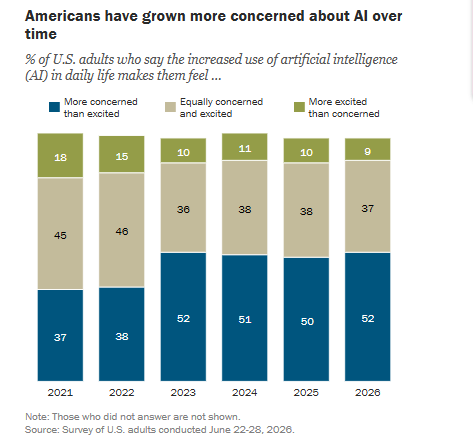
Across all US adults, 52% now express more worry than excitement about AI, a notable increase from 37% in 2021. This trend suggests that the overall American sentiment towards AI has been consistently shifting negatively in recent years, with younger demographics experiencing a more rapid decline.
A primary driver behind these concerns, as with anxieties in any region, is the fear of job loss.
AI and Job Displacement Concerns
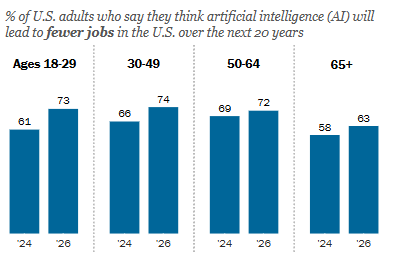
The survey reveals that 73% of respondents under 30 believe AI will lead to a reduction in US jobs within the next 20 years, up from 61% in 2024. Among all US adults, 71% hold this view, compared to 64% in 2024. Interestingly, this figure now places young people and those aged 30-64 at similar levels of concern, challenging the past perception that younger generations are typically more optimistic about new technologies.
Even among the 65+ age group, who are relatively less pessimistic, 63% still believe AI will reduce jobs, also a majority.
This presents a paradox: young people are precisely the most frequent users of AI. The survey notes that the proportion of young people using chatbots is among the highest across all age groups, yet they are also the most concerned about being replaced by AI. The entry-level, repetitive jobs that AI tends to automate are often the first stepping stones for recent graduates entering the workforce. While experienced employees might integrate AI as a tool, newcomers are more likely to find themselves directly competing with AI, especially as general models increasingly surpass the capabilities of new entrants. This dynamic naturally fuels anxiety, with many young people fearing sudden dismissal and an inability to secure their livelihoods.
Corporate Trends and Economic Impact
This anxiety is not entirely unfounded. A study from the Stanford Digital Economy Lab in August 2026 indicated that while no widespread, general AI-driven job displacement has been observed at the overall economic level, in highly AI-penetrated professions, employees aged 22-25 experienced a 19% lower employment rate compared to their peers in less AI-penetrated roles within the same industry. Additionally, a survey by Axios and Generation Lab found that approximately 27% of Americans aged 18-34 believe they or someone they know has lost a job due to AI.
Feedback from corporate recruitment also corroborates similar trends. Many company executives have publicly stated that AI can reduce costs by automating certain job functions, and some recent graduates are already feeling the pressure of a slowdown in hiring. While there isn't complete consensus on whether this is directly caused by AI or a combination of factors like the prevalence of remote work and companies' reduced willingness to train inexperienced new hires, major corporations like Google, Meta, and Amazon have been using AI to boost efficiency, indirectly leading to team reductions.
Broader Societal and Creative Concerns
Anxiety isn't solely focused on livelihoods; beyond employment, young people's negative sentiments towards AI extend to other areas.
The survey reveals that individuals under 30 are the age group most inclined to believe AI will have a negative impact on society and themselves. They generally feel that AI will make human connection and creativity scarcer. Despite most of them using chatbots, the proportion who believe these tools harm their creativity is roughly equal to those who find them helpful, indicating no clear stance. The new generation of young Americans, perhaps like young people in many regions, finds much of their anxiety rooted in future uncertainty and the fear of an economic downturn.
The Paradox of AI Use and Growing Anxiety
From being perceived as the most optimistic generation to becoming the most anxious, the attitude of young Americans towards AI has undergone a significant shift in just a few years. Behind this transformation is the tangible pressure in the job market: on one hand, they are more proficient with AI tools than anyone else, and on the other, they worry that the entry-level positions they rely on to enter the workforce are quietly being replaced by the very same tools.
As for the true extent of AI's impact on the job market, we cannot yet fully assess it. However, what this survey clearly shows is that this anxiety itself has become a widespread and deepening social sentiment.
The sustainability of the US market is also starting to spark discussion among some seller communities. While the US market remains the primary source of profit for sellers, intense competition this year has shown signs of fatigue.
From being perceived as the most optimistic generation to becoming the most anxious, the attitude of young Americans towards AI has undergone a significant shift in just a few years.