Halliday Glasses: AI Eyewear Raises $3.3 Million in Crowdfunding
Crowdfunding Analysis · · PledgeRadar Editorial
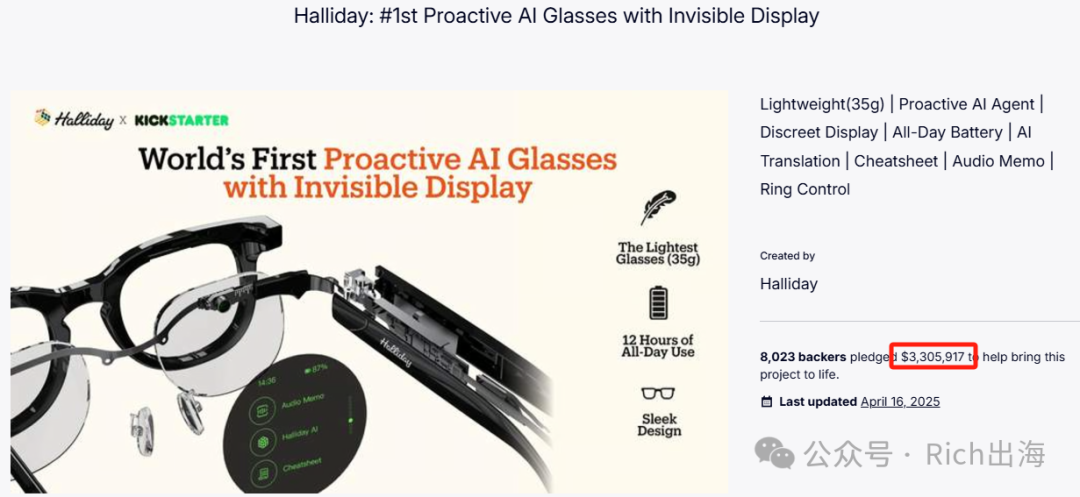
As hardware size and cost continue to decrease, and AI computing power and display technology rapidly advance, AR glasses are transitioning from 'laboratory toys' to 'everyday assistants.' Halliday Glasses, with its unique selling points of 'invisible display + Proactive AI' and cutting-edge waveguide technology, perfectly aligns with this trend. AR glasses are currently making significant strides in sectors like tourism and are seeing expanding consumer demand, poised to open up markets in business, travel, education, healthcare, and consumer entertainment.
Key Innovations
This $3.3 million crowdfunded Halliday Glasses combines a minimalist aesthetic with advanced AI. Featuring a 3.6mm 'DigiWindow™' invisible micro-display, a Proactive AI intelligent assistant, and a suite of practical functions, it offers users a 'glanceable' way to access information. Its ultra-light 35g body sets a new industry benchmark for AR eyewear weight. With over 12 hours of battery life and compatibility with prescription lenses, it offers the everyday comfort of regular glasses while seamlessly transforming into a private screen for meetings, international travel, or fast-paced daily life, aiding in efficient communication, real-time translation, automatic note-taking, and on-the-spot prompts.
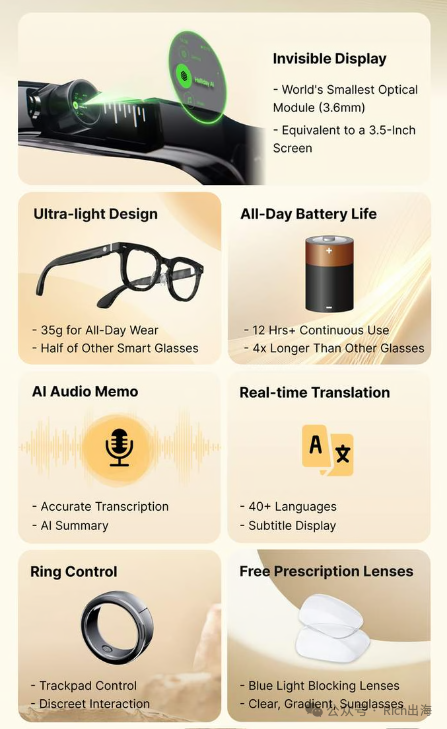
Halliday integrates the world's smallest 3.6mm micro-display module within the frame, projecting directly onto the retina. This provides the experience of a 3.5-inch screen without obstructing your vision or being noticeable to others.
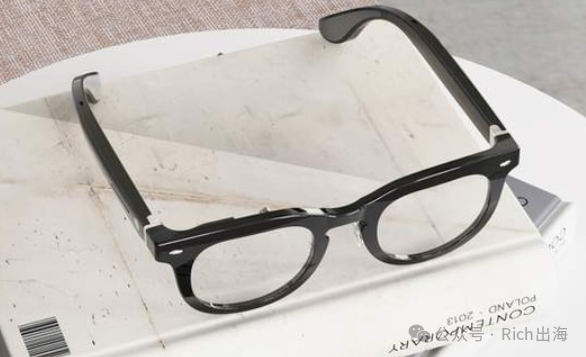
Weighing just 35g, lighter than most conventional glasses, its sleek and stylish design blends retro and modern aesthetics, ensuring no burden on your nose bridge or ears.
Equipped with a 'second brain' AI, it proactively pushes suggestions and information based on your surroundings and conversation context, such as meeting highlights, negotiation data, or next steps.
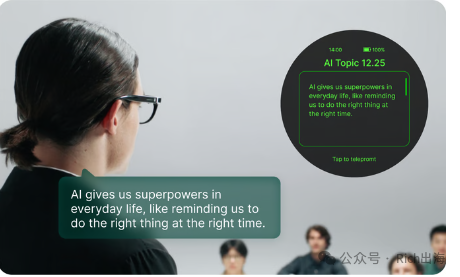
Supporting over 40 languages for real-time translation, it acts as 'invisible subtitles.' During international travel or cross-border meetings, there's no need to look down at your phone or a translation pen.
Upload your speech notes or key points in advance and navigate them with a finger ring or touch control. After meetings, it automatically generates text summaries, allowing you to focus on discussions without worrying about missing crucial information.
Silent gestures, a touch-enabled finger ring, or voice commands can activate functions, eliminating the need to pull out your phone and helping you stay focused and composed.
Normal use supports a full day, with a 45-60 minute fast charge for full power. It also supports custom prescription, sunglass, or myopia lenses to meet various vision needs.
Global AR Eyewear Market Trends
The global smart glasses market reached **$1.93 billion** in 2024, with a projected Compound Annual Growth Rate (CAGR) of **27.3%** from 2025–2030, expected to exceed **$8.26 billion** by 2030.
The AR glasses market specifically is anticipated to surpass **$10 billion** by 2030, driven by parallel growth in consumer and enterprise applications.
Current demand spans multiple application areas: In enterprise and industrial settings, it boosts efficiency and safety through on-site projection for repairs, training, and remote guidance. In medical and education, it enables surgical navigation and remote teaching, making specialized knowledge 'visible.' For consumer and entertainment, it offers immersive experiences in gaming, social filters, fitness, and travel scenarios.
**AI and Edge Computing**: Proactive AI, visual recognition, and low-latency rendering lead to smoother user experiences.
**Display and Optics**: Ultra-small micro-displays, waveguides, and laser projection continue to evolve, achieving 'invisible yet clear' visuals.
**North America**: Dominates the market with leading consumer spending power and technology adoption rates.
**Asia-Pacific**: China, Japan, and South Korea's manufacturing and application innovations are accelerating market expansion.
**Europe**: Focuses on industrial and medical applications, with regulations and privacy protection driving technology standards.
However, the commercialization of AI glasses currently faces several challenges. Firstly, **cost and pricing**: High-end devices come with elevated price tags, necessitating a balance between performance and affordability. Secondly, **user acceptance**: A stylish appearance and comfort are crucial, with invisible micro-displays serving as a key breakthrough. Thirdly, **ecosystem and content**: Deep integration with smartphones, IoT, and cloud platforms is essential to build comprehensive application scenarios.
AR glasses are transitioning from 'laboratory toys' to 'everyday assistants.'