Holographic Photo/Video Frame 'musubi' Launches to Crowdfunding Success, Raising $100K Daily
Crowdfunding Analysis · · PledgeRadar Editorial
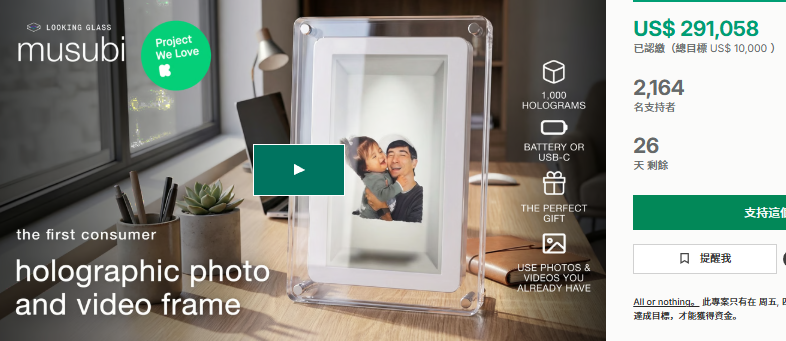
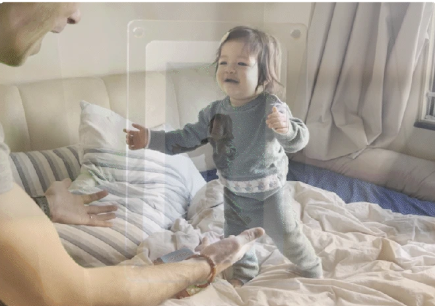
The musubi holographic photo and short video frame is designed for family use and gifting, transforming ordinary photos and videos into glasses-free, three-dimensional floating images. Its accompanying software converts standard media into playable 3D content, making it ideal for displaying cherished memories, family sharing, and unique gifts.
Early Crowdfunding Success and Backer Confidence
Launched on March 11, 2026, musubi quickly secured nearly $300,000 in just three days, attracting over 2,000 backers. With an early bird price of $99, the accessible price point effectively lowers the barrier to entry for holographic display devices.
Initial backer feedback has been largely positive, focusing on the product's innovative concept. Given Looking Glass's track record of mass production and delivery for several previous products, including the Looking Glass Go in 2023, overall confidence in musubi's delivery is high.
Product Core Selling Points
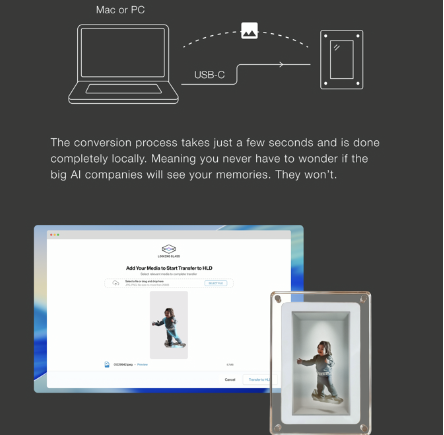
**Effortless Holographic Conversion from Any Photo or Video** musubi's free desktop software utilizes an AI Gaussian Splatting algorithm to automatically reconstruct ordinary mobile phone photos or videos (up to 30 seconds) into holographic files with depth information. The entire conversion process is completed locally on the user's computer, eliminating the need for cloud uploads.
Technically, Gaussian Splatting is a lightweight solution that has rapidly matured in 3D scene reconstruction over the past two years, offering high processing efficiency for single-frame image depth estimation and multi-view synthesis. For offline pre-processing tasks like static photos and short videos, this approach is technically feasible. The key variables for conversion quality depend on the original footage's shooting conditions (subject clarity, foreground/background separation, and motion blur). The manufacturer has focused on common family photos as the primary test scenario, a choice that helps reduce the algorithm's outlier rate.
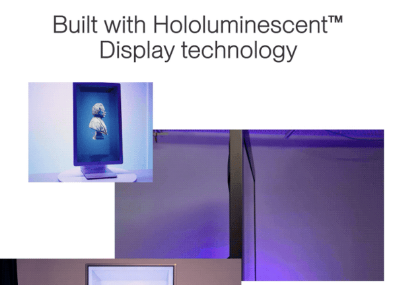
**Hololuminescent Display: Glasses-Free 3D for Multiple Viewers** musubi incorporates Looking Glass's proprietary Hololuminescent Display (HLD) technology. This technology overlays a 2D display layer with a 3D holographic volumetric layer, generating up to 100 simultaneous viewing angles on a single 7-inch screen. This allows multiple viewers, from different positions, to perceive three-dimensional images with genuine depth, all without the need for special glasses or head-tracking devices.
This technology stack has previously been deployed in Looking Glass's enterprise-grade HLD display products, including 16-inch, 27-inch, and 86-inch models. musubi represents its first mass-produced iteration for the consumer market, indicating a fully validated commercialization path for the technology itself. The viewing angle and brightness performance of the 7-inch display in a consumer setting were key engineering trade-offs made during the product's finalization phase.
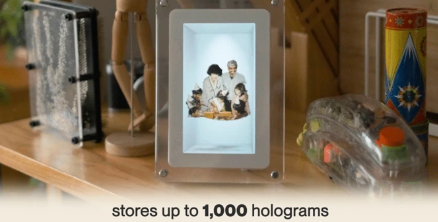
**Local Storage, Offline Operation, and No Subscription Fees** The device's built-in storage supports up to 1,000 holographic files. All content is transferred to the device via a USB-C cable, requiring no Wi-Fi connection. Photo and video data remain entirely offline, never uploaded to servers or used for any model training.
The product operates on a one-time purchase model, free from monthly or annual subscription fees. This strategy is particularly crucial for personal family memories, where users have high privacy sensitivity regarding their photos. The offline, local storage solution directly addresses these concerns.
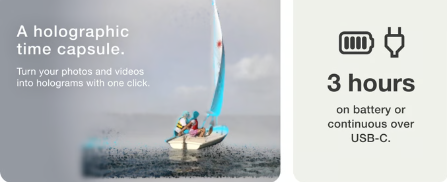
An integrated battery provides approximately 3 hours of runtime, while the included power adapter allows for continuous, all-day playback when plugged in, making it suitable for permanent desktop display.
**Designed for Gifting: Plug-and-Play Simplicity** The product's operational workflow mirrors that of a standard digital photo frame: import photos, convert files, and transfer via USB-C to the device. The entire setup process is designed for users with no technical background.
Priced at $149, musubi hits a 'sweet spot' within the gift-giving market—noticeable but not overly expensive. The official marketing explicitly targets scenarios like holiday gifts and family commemorations. This positioning helps the product transcend early adopter tech enthusiasts and penetrate the broader family consumer market, marking Looking Glass's first direct commercialization attempt to link its holographic technology with the gifting economy.
Behind musubi: Looking Glass Factory's Expertise
musubi is a product of Looking Glass Factory, co-founded in 2014 by Shawn Frayne and Alex Hornstein. Headquartered in Brooklyn, New York, the company also maintains an operations team in Hong Kong. Frayne, an MIT graduate, holds dozens of patents and has received accolades such as the Popular Mechanics Breakthrough Award and Discover Magazine's 'Best Brains Under 40,' establishing him as a seasoned researcher in light field display technology.
Foundry Group led a $10 million Series A investment in 2017 and a $7.5 million Series A1 in 2020. In February 2023, Accenture Ventures completed a strategic investment.
Brad Feld, an early investor in Fitbit, currently serves on the board. His insights into the consumer hardware ecosystem offer valuable guidance for musubi's productization path. Looking Glass boasts deep technological expertise, holding over 30 global patents, and has delivered holographic display products to nearly all Fortune 100 tech companies and tens of thousands of developers. musubi represents a pivotal step in the company's decade-long journey, marking its first foray into the mass consumer market.
Market Analysis: The Emerging Consumer Holographic Landscape
Currently, the holographic display market is in its early stages of transitioning from enterprise to consumer applications. Industry research indicates that the global holographic display market, valued at approximately $1.8 billion in 2022, is projected to exceed $14.2 billion by 2030, with a compound annual growth rate of around 30%. The market is still primarily dominated by B2B scenarios such as corporate digital signage, medical visualization, and exhibition displays. Consumer-grade holographic devices represent a nascent growth market, and musubi stands out as one of the most affordably priced and easiest-to-operate products in this niche.
Regarding the competitive landscape, direct comparable products are scarce. Looking Glass's previous offerings, such as the Looking Glass Go and Looking Glass Portrait, were aimed at developers and had higher price points and operational complexity than musubi. Other competitors in the specific niche of glasses-free 3D home photo frames currently lack mature mass-produced products. Broader competition comes from high-end digital photo frames (e.g., Aura, Meural) and Instax instant cameras. While these products intersect with musubi in the context of displaying family memories, their product forms and visual experiences are distinctly different. musubi's primary challenge isn't direct competition but rather the cost of user education. Consumer awareness of the holographic photo frame category is virtually non-existent, meaning the product's core growth engine post-launch will likely stem from word-of-mouth gift recommendations rather than search-driven active purchases.
Home holographic photo frames hold genuine product value and a first-mover advantage in emotional gifting and home memory display scenarios. If Looking Glass can ensure stable and reliable AI conversion success rates while continuously driving down costs, this category has the potential to become the next consumer display segment to transition from a technological novelty to an everyday essential.
If Looking Glass can ensure stable and reliable AI conversion success rates while continuously driving down costs, this category has the potential to become the next consumer display segment to transition from a technological novelty to an everyday essential.