StackChan: Programmable Desktop Robot Raises $360K in Overseas Crowdfunding
Crowdfunding Analysis · · PledgeRadar Editorial
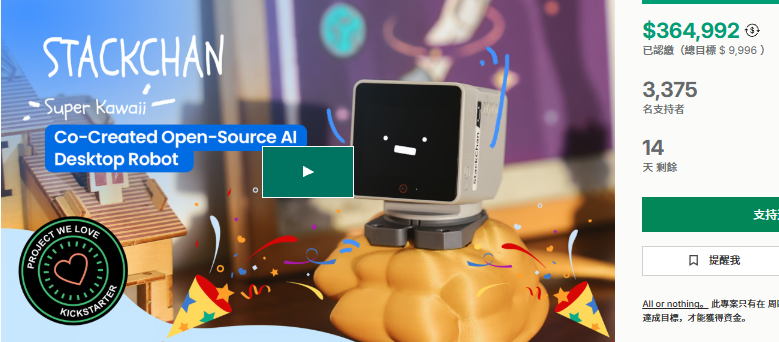
StackChan is a playful and programmable desktop companion designed for desktop environments. It integrates customizable expressions, servo actions, a microphone, speaker, and camera, all built around the open-source hardware platform M5Stack. Positioned as a learning tool, maker platform, family interaction device, and light AI assistant, StackChan emphasizes modifiability and community co-creation.
Crowdfunding Success and Initial Reception
StackChan garnered significant support from the community and maker groups on crowdfunding platforms. Following its launch, the project quickly attracted widespread attention from the open-source hardware community, maker enthusiasts, and tech media. Media reviewers and early testers provided positive feedback on the prototype's experience, widely acknowledging its ease of use, playability, and suitability for educational and maker applications.
Product Highlights
Integrated Hardware and Unified Interaction
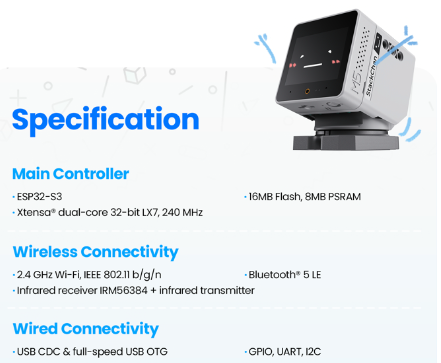
StackChan is based on the M5Stack Core series (featuring the ESP32-S3), integrating a touchscreen, camera, microphone, speaker, servo driver, and Grove interface expansion. This integrated hardware configuration facilitates secondary development and community expansion.
The ESP32-S3 provides foundational capabilities for edge-level AI inference, with a built-in low-power NPU and vector computing unit supporting local offline wake-up and keyword recognition. It can run lightweight neural network models, enabling the device to process basic voice commands and image recognition tasks offline. However, complex multi-turn conversations and large-scale language model experiences still rely on cloud computing power or model distillation techniques for local compression. The integrated hardware design is particularly beneficial for educational demonstrations and maker instruction, reducing setup costs and learning barriers.
Open-Source Software, Hardware, and Modifiability
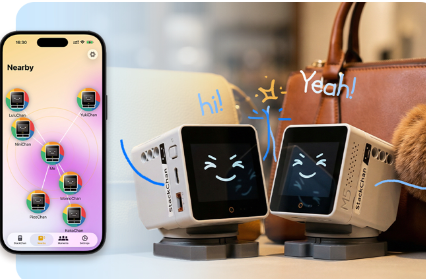
StackChan is built on a fully open-source software and hardware architecture, supporting MicroPython and Arduino development environments. This is a strong draw for the maker and educational markets, allowing users to easily get started with programming, customize functions, modify appearance, and expand applications.
While the open-source architecture fosters the establishment and rapid iteration of a community plugin ecosystem, it also entails maintenance responsibilities. The official team must continuously update firmware, release security patches, and maintain documentation quality to ensure a stable user experience and system security. These are critical factors for the long-term success of any open-source hardware project.
Emotional Interaction and Personalized Design
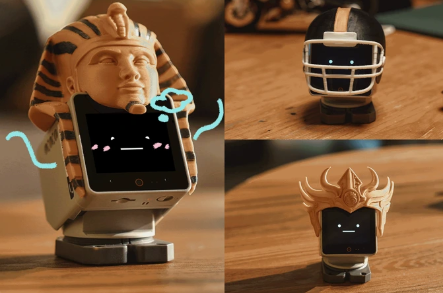
The device achieves emotional interaction through highly customizable expression displays, servo actions, and voice feedback. Users can configure the assistant robot's background and personality, allowing the device to have a unique character and interaction style.
Emotional interaction can significantly enhance the sense of companionship and user stickiness. However, long-term user retention depends on several key factors: the accuracy of voice comprehension, the length of response delays, the fluidity of action execution, and the avoidance of repetitive behaviors that lead to fatigue. If the product can integrate user-defined personas with a community sharing mechanism—for example, by supporting the import/sharing of dialogue scripts, action packs, and behavior configurations—it will help foster a virtuous cycle of user co-creation and long-term engagement.

Educational and Maker Applications
Leveraging the existing M5Stack community foundation and educational resources, StackChan can be quickly integrated into maker courses, university experiments, and training programs. The product's commercialization path can achieve diversified revenue through online courses, paid expansion content, collaborations with educational institutions, and enterprise application development.
M5Stack is a leader in the modular development board ecosystem, with its Core series and extensive expansion modules widely recognized in the maker community and IoT education fields. The company's core competencies lie in modular hardware design, strong community support, comprehensive technical documentation, and rapid prototype-to-product iteration capabilities.
In terms of business model, M5Stack primarily drives growth through product sales and ecosystem services. Historically, the company has launched multiple products via Kickstarter and community collaborations, gradually establishing its commercialization path and user base. As a growth-oriented manufacturer driven by a technology ecosystem and community, M5Stack does not rely on massive external venture capital but achieves steady growth through product value and ecosystem recognition. StackChan represents the company's natural extension of its modular hardware capabilities and open-source philosophy into the desktop AI robot domain.
Market Analysis
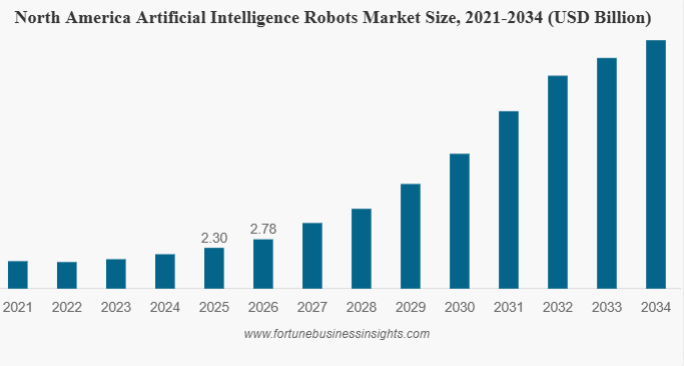
Desktop companion robots occupy a cross-segment market between consumer-grade social/companion robots and educational/maker robots. The broader personal and home robot market has shown stable growth in recent years, benefiting from increasing demand for home automation, remote companionship applications, and elderly/child care use cases. While statistical methodologies vary among research institutions, it is generally believed that this niche market's growth rate will significantly exceed that of the traditional home appliance industry over the next five years.
In terms of direct competitors, Misty Robotics' Misty II series targets developers and enterprises, offering desktop social robots and enterprise-grade SDKs. It overlaps with StackChan in developer-friendliness and customizability but is positioned more towards paid enterprise solutions. Anki's Vector robot, and its revived version continued by Digital Dream Labs, emphasizes a toy-grade AI experience and emotional companionship, sharing a similar desktop companion toy positioning with StackChan, but StackChan places a greater emphasis on open-source developer-friendliness. Educational robot brands like Miko, high-end social robots like Furhat, and SoftBank's Pepper occupy different niches such as children's education, enterprise reception, and high-end emotional interaction, respectively.
StackChan's market opportunity lies in rising consumer acceptance of companion devices (especially in urban single-person households and remote family scenarios), stable growth in demand for programmable hardware in the education and maker markets, and its core differentiated advantage of being open-source and customizable. Risks include managing user expectations, as users will demand increasingly high standards for conversational fluency, continuous updates, and privacy security. Hardware delivery stability and accessory supply capabilities are also critical tests. These factors will determine the project's long-term reputation and repurchase rates.
StackChan received considerable support from the open-source hardware community, maker enthusiasts, and tech media.