One Cable, $660,000: Analyzing RollingSquare's inChargeLife Crowdfunding Success
Crowdfunding Analysis · · PledgeRadar Editorial
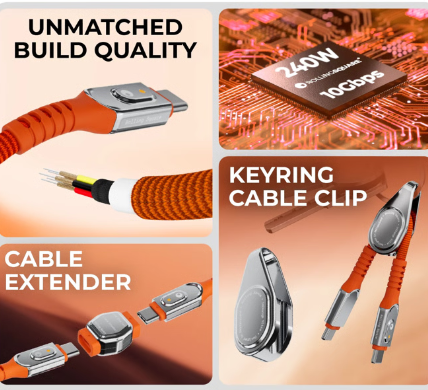
On November 5, RollingSquare launched a crowdfunding campaign for its inChargeLife modular USB-C cable on Kickstarter, quickly raising an impressive $660,000 within just 10 days. The product positions itself as a modular USB-C ecosystem designed for lifetime cable ownership, with core promises including 240W power delivery, 10Gbps data transfer, a variety of interchangeable tips and cable types, and a highly differentiated lifetime replacement service guarantee. The rapid success raises the question: could this single cable break the $1 million mark?
Key Technical Features and Innovations
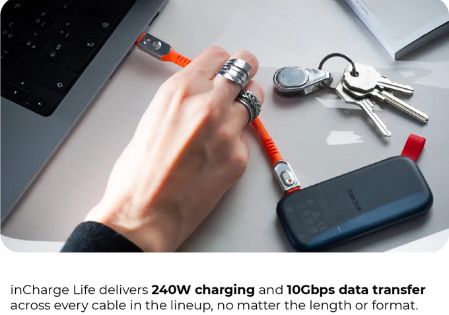
The inChargeLife cable boasts 240W USB-PD high-power charging, supporting the USB-PD 3.1 standard. This capability addresses the fast-charging demands of high-power laptops and mobile workstations. As creator laptops, gaming notebooks, and professional mobile workstations feature increasingly larger battery capacities, fast charging beyond 140W has become a necessity. The 240W support allows a single cable to meet the charging needs of almost all portable devices. However, achieving 240W requires precise control over the cable's conductor cross-sectional area, material purity, and terminal contact resistance. Sustained high-current operation generates heat, making the cable's thermal design and temperature protection mechanisms crucial for ensuring safety and longevity.
Simultaneously, the cable supports 10Gbps high-speed data transfer, meeting the bandwidth requirements for external SSDs, 4K video transmission, and other high-speed peripherals. This specification aligns with the USB 3.2 Gen 2 standard, offering practical value in scenarios where a single cable handles both high-power charging and high-bandwidth data. Nevertheless, high-speed data transmission demands stringent requirements for the cable's shielding design, differential signal integrity, and EMI (electromagnetic interference) control. Factors such as cable length, bending frequency, and environmental conditions can all impact actual transmission stability.
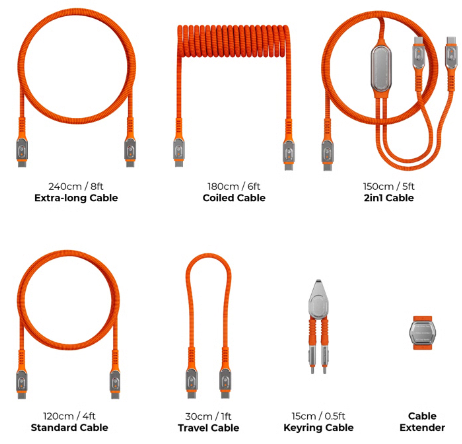
The inChargeLife features modular tips and multi-scenario adaptability. The product employs a base/core cable design with replaceable magnetic tips, offering six cable types or port arrays and various length options. This emphasizes cross-device compatibility, aiming for 'one cable to fit all household electronics.' The primary advantage of this modular design is extending the lifespan of the main cable body; if a specific tip is damaged or a device's interface standard updates, users only need to replace the module rather than the entire cable. However, maintaining contact stability and resistance control during high-power transmission with magnetic connections presents a technical challenge. The mechanical durability and dust/water resistance of the connection points also require long-term validation.
The manufacturer claims robust durability design and compatibility assurance, utilizing wear-resistant materials, braided cables, and reinforced connection points. They also integrate safety protection mechanisms such as overcurrent, overvoltage, and temperature control, ensuring compatibility with mainstream USB-PD protocols and various devices. Durability, however, depends not only on material selection but also on the internal conductor's stranding process, shielding layer coverage density, and plating quality. The most common failure modes observed in actual user scenarios are mechanical fatigue at the terminals and core wire breakage. Whether the reinforced design can effectively extend lifespan will require long-term third-party testing and verification.
The Lifetime Replacement Service Promise
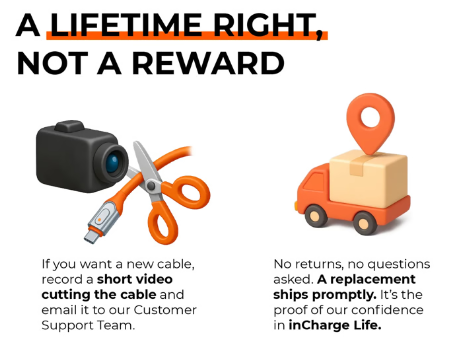
This lifetime replacement service is arguably the brand's most differentiating commercial commitment. It aims to alleviate user concerns about repeatedly purchasing cables due to wear and tear, transforming a one-time purchase into a long-term service relationship. However, this promise also introduces business model challenges: how to balance replacement costs with initial pricing, manage reverse logistics and quality inspection processes, and prevent potential abuse. Users are advised to carefully review the service terms regarding replacement frequency, shipping cost responsibilities, and warranty scope.
RollingSquare (or its inCharge sub-brand) has a long-standing focus on cables and portable accessories, with the inCharge series serving as its flagship product line embodying a sustainable and long-term use philosophy. The brand positions inChargeLife in the mid-to-high-end market, differentiating itself from ordinary low-cost disposable cables through a combination of high specifications (240W/10Gbps), modularity, and lifetime replacement. This strategy targets users willing to pay a premium for reliability, long-term assurance, and cross-device compatibility. The core logic behind this positioning is to transform cables from consumables into durable goods, building brand loyalty and repeat purchases through a strong service commitment.

Market Analysis
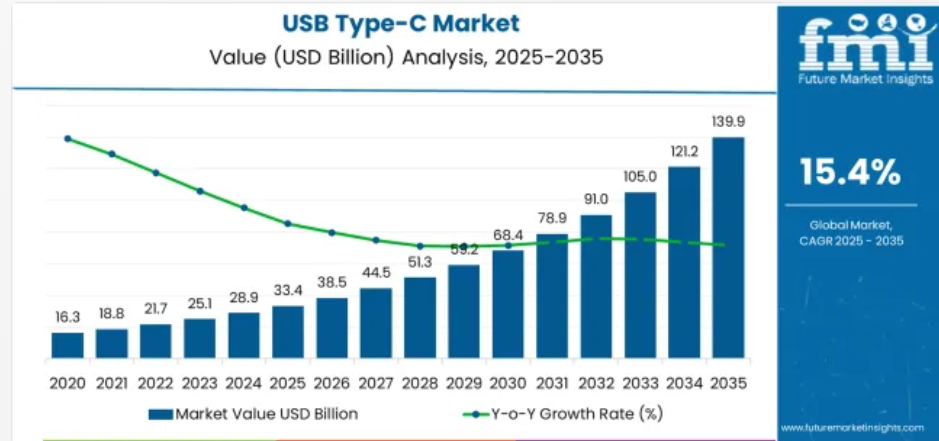
The USB-C market is currently experiencing a period of rapid growth. Market research firms like Technavio predict that the USB-C interface and its related accessories market will maintain a double-digit compound annual growth rate between 2024 and 2029. Key drivers include the widespread adoption of USB-C across laptops, smartphones, tablets, and peripherals, as well as the promotion of high-power standards like USB-PD 3.1. As device demands for charging power and data bandwidth increase, the need for high-specification cables supporting 240W and 10Gbps is expanding.
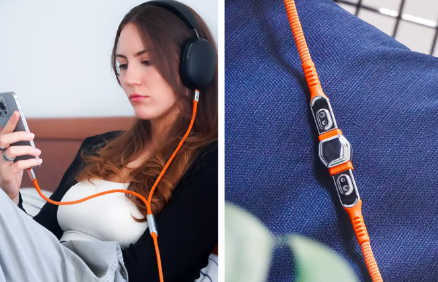
From a market demand perspective, several factors are at play. Firstly, the proliferation of high-power laptops and mobile workstations means creators, engineers, and professional users require single-cable solutions to simplify charging and data transfer processes. Secondly, there's a growing consumer preference for sustainable and long-lasting products; more users are willing to pay a premium for durable, replaceable, and guaranteed accessories, aligning the 'buy once, use for years' philosophy with environmental consciousness and cost control. Thirdly, the increase in travel and mobile work scenarios makes modular tips and multi-cable type adaptability highly attractive to frequent travelers, photographers, and users with multiple devices.
Regarding the competitive landscape, numerous established brands already offer high-specification USB-C cables, including Anker, Belkin, CableMatters, NativeUnion, Zendure, and Baseus. These brands hold advantages in channel coverage, certification credentials, and brand recognition. RollingSquare must establish differentiated recognition through its combination of modularity, lifetime replacement, and 240W capabilities, while consistently delivering on product quality and service fulfillment. The cable market exhibits clear price segmentation: the low-end is dominated by numerous white-label and basic products, while high-end market users are willing to pay for performance and service, though market education costs are higher. The brand needs to clearly define its target user profile and enhance conversion rates through word-of-mouth and content marketing.
The high-specification USB-C cable market has clear growth potential, driven by increasing device power and cross-device compatibility demands. However, competition has evolved from purely performance-based to a product-plus-service combination. The ability to deliver on the lifetime replacement promise will directly determine the brand's long-term market position and user loyalty.

The core logic of this positioning strategy is to transform cables from consumables into durable goods, building brand loyalty and repeat purchases through service commitments.