The Rise and Fall of SpeedX: A $3.16 Million Smart Road Bike Crowdfunding Story
Crowdfunding Analysis · · PledgeRadar Editorial
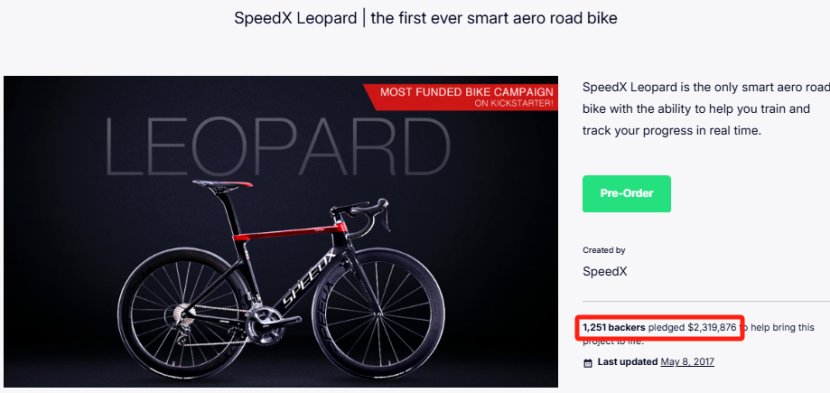
Between March 23 and April 22, 2016, the SpeedX smart road bike launched a crowdfunding campaign on Kickstarter with an initial goal of just $50,000. The market's enthusiastic response far exceeded expectations, ultimately attracting 1,251 backers and raising an impressive $2.31 million—4,640% of its original target. Concurrently, a short supplementary campaign on Indiegogo (April 20-21) also performed remarkably, securing $840,000 from 604 backers in just two days, achieving 1,683% of its goal. Across both platforms, SpeedX garnered approximately 1,855 backers and a combined total of $3.16 million, a stellar achievement that underscored strong market interest and anticipation for the innovative 'smart aero road bike' concept.
Product Highlights: The Smart Aero Road Bike
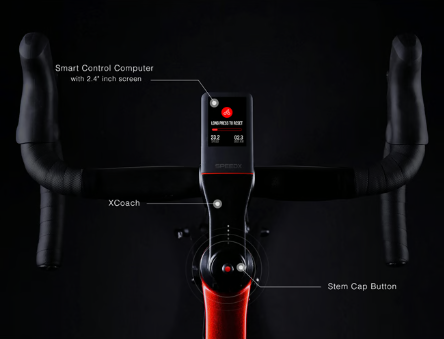
At its core, the SpeedX smart road bike integrated a sophisticated SmartControl computer, featuring a 2.4-inch HD screen that displayed 12 professional real-time cycling metrics, including speed, cadence, heart rate, power, altitude, and temperature. It also offered professional device compatibility, supporting ANT+ connections for seamless integration with various sensors, providing advanced data recording and analysis.
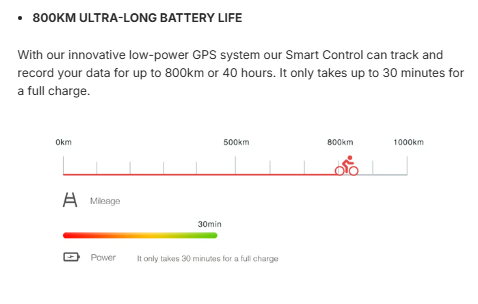
The bike boasted impressive battery life and charging technology, with an innovative low-power GPS system capable of continuously recording up to 800 kilometers (approximately 40 hours) of riding data. Its fast-charging capability allowed for a full charge in just 30 minutes, catering to multi-day training or long-distance rides.
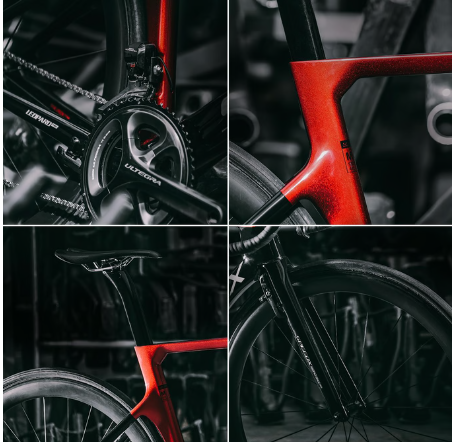
Emphasizing lightweight and aerodynamic design, SpeedX utilized Fibertek® T1000 military-grade carbon fiber, crafted using a monocoque molding technique with 207 layers. This resulted in an exceptionally light frame and seatpost weighing only 1.2 kg, with the fork and seatpost also made from carbon fiber. Aerodynamic optimization included concealed cable routing and a hidden brake structure on the fork, minimizing wind resistance while maintaining an aesthetic appeal.
Technological innovation was a key advantage, with SpeedX becoming only the third bicycle brand globally to achieve fully integrated internal cable routing. The brand also claimed a significant cost advantage, offering comparable or superior aerodynamic performance to high-end competitors like TREK Madone 9.2 and Specialized Venge Pro ViAS, but at a much lower price point.
Company Vision and Early Momentum
SpeedX was founded in December 2014 in California by Tony Li and Jiayang Gao, positioning itself as a 'smart bicycle pioneer.' The company aimed to deeply integrate carbon fiber aero frames with high-tech sensors. In its early stages, SpeedX demonstrated strong growth momentum, claiming an additional $22 million in funding by late 2016, primarily earmarked for accelerating research and development and expanding production.
That same year, SpeedX further expanded its reach by launching pre-sale activities in India and on the JD.com platform, accumulating an additional $1.8 million in pre-orders, signaling the brand's ambitious multi-market expansion strategy.
The Downfall: Operational Hurdles and Technical Obsolescence
However, the brand's trajectory took a significant turn in later years. By 2019, SpeedX's parent company faced severe difficulties stemming from a confluence of operational management and logistics distribution issues. More critically, the product's core selling point—the integrated SmartControl computer system—gradually 'bricked' due to a lack of sustained updates, leading to the failure of user data recording and navigation functions and severely impacting the user experience.
This series of problems ultimately led to the brand's decline and eventual silence, offering valuable lessons for the evolving smart bicycle industry.
The Broader Market Landscape for Smart Bicycles
The global bicycle market is currently experiencing rapid growth. According to Fortune Business Insights, the market size is projected to be approximately $108.74 billion in 2024, increasing to $116.56 billion in 2025, with a compound annual growth rate (CAGR) of 11.2% from 2025 to 2032. Grand View Research provides slightly different figures, estimating the market at $77.01 billion in 2024, expected to reach $84.25 billion in 2025, with a CAGR of approximately 9.9% from 2025 to 2030. Within this overarching trend, carbon fiber lightweighting and aerodynamic technologies are continually driving the growth of the high-end road bike market share.
The smart bicycle sub-segment also shows promising growth. In North America, for instance, the smart bicycle market was valued at approximately $620 million in 2022 and is projected to grow to $1.15 billion by 2028, with a CAGR of about 10.8% from 2022 to 2028. Key drivers for this growth include rising consumer health awareness, the increasing maturity of IoT and artificial intelligence technologies, and the urgent demand for sustainable urban transportation solutions.
The current competitive landscape is diverse. In the global smart bicycle sector, emerging brands like VanMoof, Stromer, Giant, Cowboy, and Gocycle are actively capturing market share through differentiated features such as integrated electric assist, smart battery management, and real-time data analysis. Meanwhile, traditional high-end road bike brands like Trek, Specialized, and Cervélo continue to hold significant positions due to strong brand recognition.
Looking ahead, the further application of 5G communication, artificial intelligence, and cloud computing technologies is expected to make deep learning analysis of cycling data and personalized training program customization mainstream. Concurrently, the deep integration of E-bike electric assist technology with smart functionalities is poised to foster the next high-growth market segment.
More critically, the product's core selling point—the integrated SmartControl computer system—gradually 'bricked' due to a lack of sustained updates, leading to the failure of user data recording and navigation functions and severely impacting the user experience.