Rewindpix: Retro Digital Camera Captures Thousands of Backers on Kickstarter
Crowdfunding Analysis · · PledgeRadar Editorial
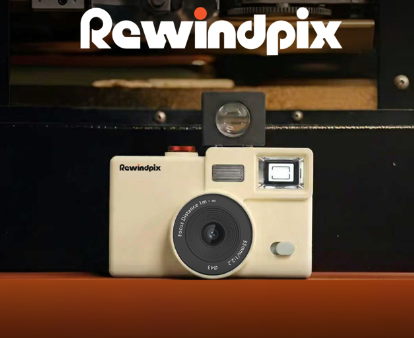
Rewindpix, a retro-styled digital camera, has quickly become a crowdfunding sensation, appealing to creators and travelers who appreciate the tactile experience of film photography, the ritual of shooting, and instant social media sharing. Launched on Kickstarter on March 12, 2026, the campaign rapidly secured over $170,000 from thousands of backers within just two days. With an initial pledge tier around $120, Rewindpix positions itself as an accessible option within the retro digital camera market. Early backer feedback and media reviews praise its aesthetic design and diverse film filters, though some point out minor issues like shutter lag, areas for app UI optimization, and small firmware bugs needing resolution before mass production. Overall, supporters highly resonate with the camera's screenless design, mechanical film advance, and integrated film presets, with the project currently projected to reach around $500,000.
Embracing the Ritual: Screenless Design and Mechanical Film Advance
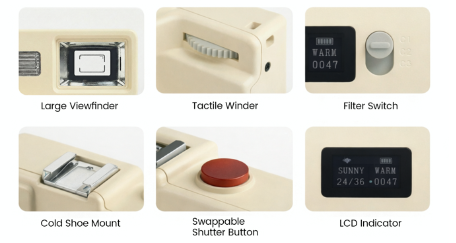
Rewindpix reintroduces the ritual of film photography through its screenless design and mechanical film advance. The camera completely removes the rear viewing screen, retaining only a small LCD to display essential parameters like remaining shots, current preset, and battery level.
Users cannot instantly review photos after shooting; images must be exported via the companion app or USB-C. A mechanical film advance dial on the back requires manual winding after each shutter press, deliberately replicating the physical rhythm of a traditional film camera. This design choice isn't merely a feature stack; it's a conscious effort to alter user shooting habits, encouraging a more deliberate and focused approach to photography, distinct from the digital age's tendency to snap, scroll, and delete. This philosophy strongly aligns with the recent cultural trend of younger generations embracing 'slow media,' forming a core reason for the project's significant media attention.
Authentic Aesthetics: Large Optical Viewfinder and Agfa-Inspired Design
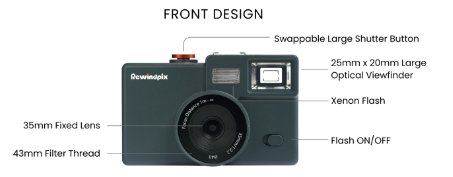
Rewindpix's exterior design draws direct inspiration from the 1970s Agfa Optima Sensor 535, featuring a square, Bauhaus-style body, a xenon flash, and a physical shutter button. It includes a metal interchangeable shutter button and a cold shoe mount for external lights.
The large optical viewfinder is a significant area of design investment. From an engineering perspective, achieving precise alignment with the lens focal plane and effective parallax compensation for such a large viewfinder is a critical factor influencing the actual shooting experience. This engineering precision also serves as a direct differentiator between Rewindpix and other lower-cost retro cameras.
Dual Shooting Modes: CameraMode and FilmMode
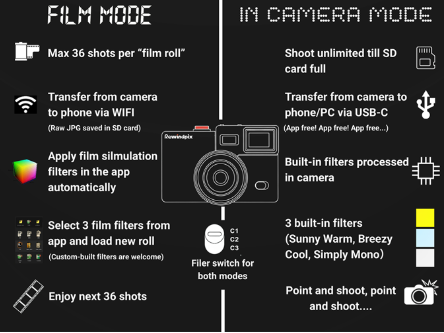
The Rewindpix offers two independent shooting modes. 'CameraMode' functions as a conventional mode, allowing users to select from three built-in style presets for direct shooting without needing a phone connection. 'FilmMode,' conversely, simulates the authentic experience of loading a film roll: once a film preset is chosen, it's locked for an entire 'roll' of 36 shots, preventing style changes during that period and replicating the inherent limitations of analog photography.
The accompanying app provides over 20 film style templates, including tones inspired by Portra 400 and Wes Anderson's color palettes. Users can also create their own custom presets and write them to the camera. This dual-mode architecture enables both instant capture and an immersive film experience. Technically, this relies on a programmable ISP (Image Signal Processor) pipeline within the camera, working in conjunction with the app's color mapping and noise/grain parameter writing. A robust architecture in this area is crucial for a reliable user experience and represents a core component of the product's software engineering.
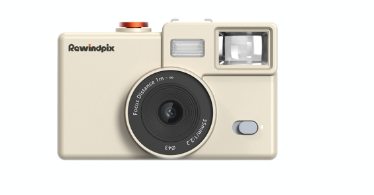
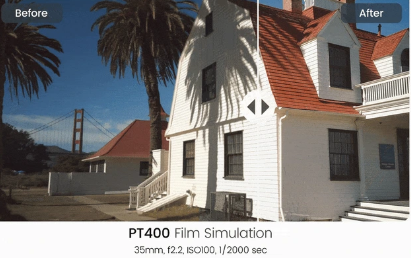
Image Quality: Sony 13MP Sensor and Custom Tuning
Rewindpix incorporates a Sony 1/3.06-inch 13MP CMOS sensor and a 4-group, 2-element lens system. The developers state they have performed specialized ISP (Image Signal Processor) optimization for natural color reproduction, focusing on controlling over-sharpening and color shifts to achieve a low-noise, moderate dynamic range, and true-to-film aesthetic.
While small sensors inherently struggle with noise control in high ISO scenarios, for a product aiming for a film-like texture, a moderate amount of grain can be an aesthetic advantage. The key lies in how the ISP balances noise presentation with the chosen filter styles. The camera includes built-in storage for over 1200 photos and supports more than 300 shots on a single charge, adequately covering typical daily usage needs.

Seamless Workflow: Wi-Fi Direct and App 'Digital Darkroom'
The camera features a built-in Wi-Fi hotspot, enabling direct photo transfer to a smartphone. Its companion app serves as a comprehensive 'digital darkroom,' offering gallery management, filter editing, and custom preset writing functionalities.
For younger users keen on instant social media sharing, this workflow is a critical design element that balances the ritual of shooting with efficient content output. It addresses the dual user need for both slow photography and rapid sharing. From a technical standpoint, implementing a Wi-Fi module with a simple transfer protocol is a well-established and reliable solution. The primary challenges lie in ensuring connection stability and robust cross-device compatibility testing.

Market Analysis: Niche Appeal in a Shifting Landscape
Rewindpix represents a typical individual startup in its incubation phase, with the Kickstarter campaign marking its first public commercial venture, still operating as an early-stage small team. Notably, the project garnered significant pre-launch coverage and hands-on reviews from prominent photography media outlets such as PetaPixel, DigitalCameraWorld, and KosmoFoto. This media endorsement played a crucial role in the startup quickly securing over $100,000.
The broader digital camera market, after years of disruption from smartphones, has recently shown structural differentiation. High-end mirrorless cameras continue to grow driven by professional creative demand, while consumer portable cameras are seeing a resurgence fueled by niche cultural interests. CIPA data indicates that global portable camera shipments increased by 11% year-over-year in January 2025, and overall camera shipments for the first half of 2025 saw a year-over-year increase exceeding 116%, marking the best performance since 2019. The global digital camera market, valued at approximately $9.3 billion in 2024, is projected to grow to $14.4 billion by 2033 at a CAGR of about 4.9%, with the portable compact camera segment leading with an estimated 7.1% CAGR.
Rewindpix occupies a more specialized niche: experience-driven retro digital cameras. Direct competitors include other screenless digital cameras like CampSnap, FlashBackOne, and PaperShoot, as well as products from Fujifilm's Instax series and Lomography. The latter two boast established user communities and strong brand recognition within the instant imaging and film art circles.
While Fujifilm and Lomography possess significant channel advantages and brand presence far exceeding any emerging crowdfunding product, Rewindpix carves out a clear differentiated space in its specific positioning of a screenless design, mechanical film advance, and a software-driven film preset system, for which there are currently no direct, mature market counterparts. The true competitive threat for Rewindpix lies more in consumers' willingness to pay for a camera with intentionally limited functionalities, especially when applying a VSCO filter on a smartphone costs virtually nothing. The core challenge for such products to transcend the enthusiast circle is to make users continuously pay for the experience itself, rather than just a stack of features.
Driven by social media expression and the 'collectible gift' economy, the retro experience camera category still holds considerable premium potential and growth resilience. However, its long-term ceiling is constrained by the continuous substitutive effect of smartphone imaging. Products that aim for lasting success must transform their irreplaceable shooting experience into a lifestyle that users are willing to maintain long-term, rather than just a fleeting nostalgic indulgence.
Products that aim for lasting success must transform their irreplaceable shooting experience into a lifestyle that users are willing to maintain long-term, rather than just a fleeting nostalgic indulgence.