PledgeRadar Analysis: Cordless Visual Soldering Tool Secures $90K in Crowdfunding
Crowdfunding Analysis · · PledgeRadar Editorial
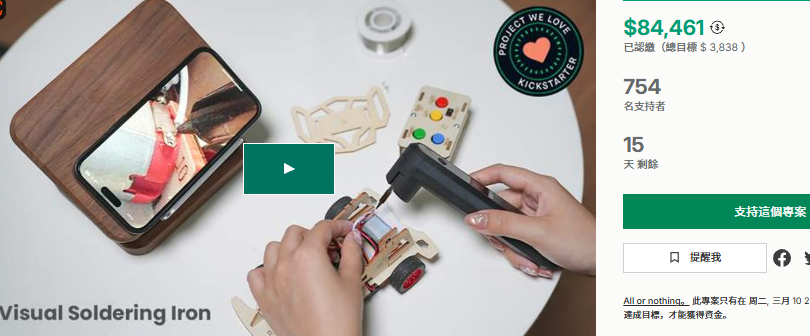
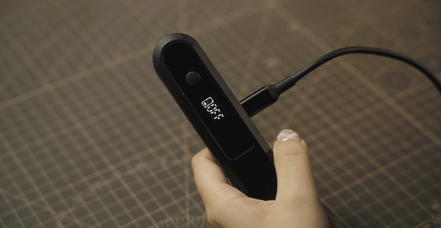
The D01 is a portable, cordless visual soldering iron designed to transform traditional soldering. It features a built-in HD camera and 800-lumen LED illumination, projecting a real-time view of the solder joint via Wi-Fi to a smartphone or tablet. This allows users to solder precisely while sitting upright and viewing a screen, rather than hunching over and squinting. Its primary applications include electronics repair, micro-component soldering, DIY projects, and classroom instruction. The campaign's crowdfunding performance has been moderate, having raised nearly $90,000 from over 700 backers at the time of this report. Backer sentiment in the comments section appears largely positive, with widespread appreciation for the real-time screen mirroring concept. However, several backers have raised concerns regarding potential image latency and battery life, issues that will require real-world testing upon product delivery to fully validate. The D01 is launched by Hong Kong electronics company FusionLab; no further information was available.
50x Optical Magnification + Wi-Fi Real-time Screen Mirroring
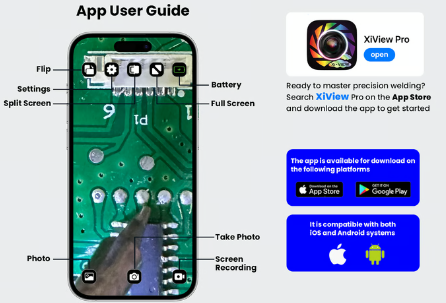
The D01's primary differentiator is its integrated HD camera and LED light source, coaxially positioned at the soldering iron's tip. Soldering visuals are streamed via Wi-Fi to a dedicated iOS/Android app, offering real-time preview with up to 50x magnification. An 800-lumen wide-angle LED provides shadow-free illumination.
This design offers substantial ergonomic improvements, significantly reducing eye strain and neck burden by eliminating the need for users to hunch over solder joints for extended periods. A critical technical variable is image latency; the smoothness required for accurately judging solder joints on ultra-fine components like 0402s, especially in environments with unstable Wi-Fi or network congestion, will need validation in real-world scenarios.
9-Second Fast Heating + Five-Level Precision Temperature Control
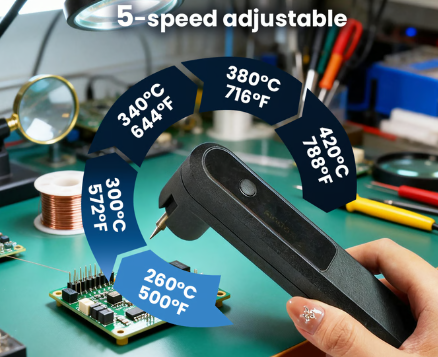
The D01 offers five preset temperature levels, ranging from 260°C to 420°C. Its onboard LED panel supports Celsius/Fahrenheit switching, and the manufacturer claims it heats to operating temperature in approximately 9 seconds.
The rapid heating design is particularly appealing for on-site repairs and impromptu use. While five temperature settings may not offer the continuous fine-tuning of professional soldering stations, they are sufficient for DIY and educational applications.
The stability of temperature control accuracy during sustained high-power output is a critical engineering metric affecting solder joint consistency, and long-term test data will be needed to support these claims.
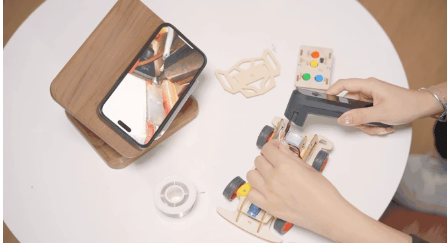
Cordless Portability + 45–60 Minute Battery Life
The device is powered by a 3,000mAh 18650 lithium battery, providing approximately 45 to 60 minutes of cordless operation. For mobile repairs, exhibition demonstrations, or classroom settings, the freedom from power cords offers a significant convenience boost.
Key considerations include whether actual battery life can maintain close to the stated value during prolonged operation at the highest temperature setting, and the impact of heat dissipation and body temperature on user comfort.
Universal Tip Compatibility + Three Included Tips
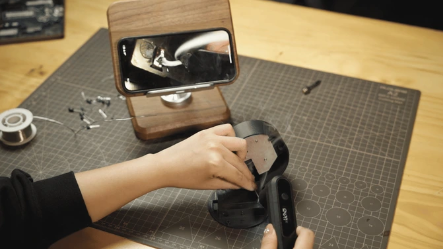
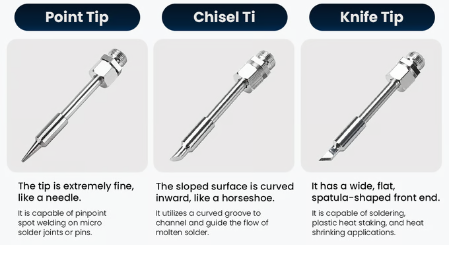
The D01 is compatible with widely available standard soldering tips. The package includes three types of tips: conical, chisel, and knife.
Adopting a universal tip standard is a smart product decision. It reduces migration costs for existing users and avoids the risks of a closed accessory ecosystem, which is often a critical factor in driving repeat purchases for consumer-grade tools.
App Recording and Educational Sharing Features
Beyond real-time preview, the companion app also supports recording, playback, and sharing of soldering footage, adding value for course instruction, repair review, and technical demonstrations.
This feature holds practical significance for online maker education and technical after-sales support. However, details such as data storage methods, video format compatibility, and streaming smoothness remain execution aspects of concern to users.
Market Analysis
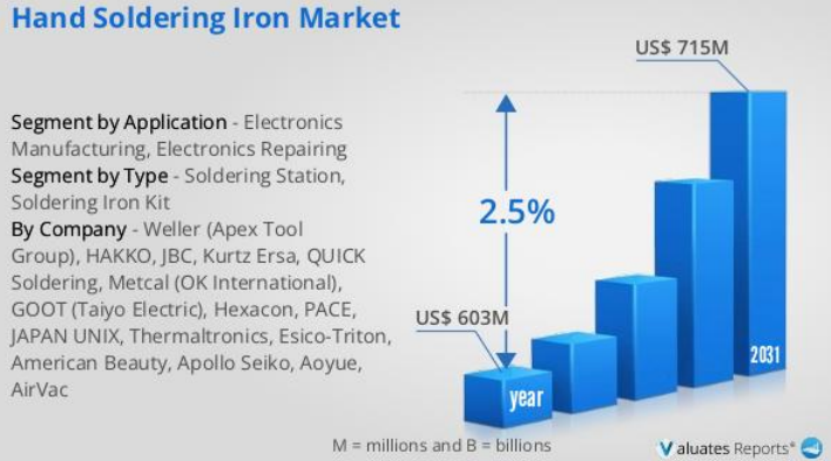
The handheld soldering iron market is a mature segment characterized by stable scale and dispersed demand. According to research firm Valuates, the global handheld soldering iron market was valued at approximately $603 million in 2024 and is projected to grow to $715 million by 2031, representing a Compound Annual Growth Rate (CAGR) of approximately 2.5%. Expanding the scope to the overall soldering equipment market, some agencies estimate the total soldering iron market size to be around $1.2 billion in 2024, expected to reach $1.8 billion by 2033, with a CAGR of approximately 5.2%.
Growth drivers primarily include the continuous expansion of electronics manufacturing demand, the rise of maker culture and DIY enthusiasts, and the increasing demand from online education for visualized skill tools.
In terms of competitive landscape, the professional soldering market has long been dominated by established brands such as Hakko, Weller, Metcal, and JBC. These brands build barriers through temperature control precision, comprehensive workstation ecosystems, and industrial-grade reliability, occupying the mainstream market for repair and manufacturing.
The D01's direct competitors are not these industrial brands, but rather emerging products in the portable soldering iron and DIY tool sub-segments, such as Pinecil and TS80P, which are smart portable soldering irons powered by USB-C. While these products offer strong competitiveness in temperature control algorithms and pricing, none integrate camera screen mirroring. The niche of visual soldering currently lacks mature competitors, giving the D01 an objectively differentiated position. However, this also means it must independently educate users and prove that this feature is genuinely effective in real workflows, rather than just a visually appealing gimmick.
The niche of visual soldering currently lacks mature competitors, giving the D01 an objectively differentiated position. However, this also means it must independently educate users and prove that this feature is genuinely effective in real workflows, rather than just a visually appealing gimmick.