Million-Dollar Robotic Lawnmower Campaigns: Can They Deliver?
Crowdfunding Analysis · · PledgeRadar Editorial
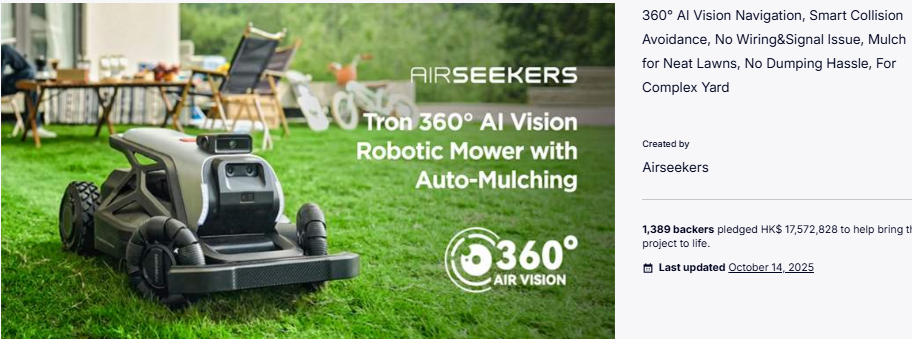
Autonomous lawnmowers that navigate independently, eliminate perimeter wires, and mulch clippings back into the soil have become a recurring multi-million dollar category on Kickstarter in recent years. This product segment has captivated tens of thousands of backers, reflecting a rapidly expanding market for robotic lawnmowers.
The Tron Campaign: Promises and Early Challenges
According to its project page, the Tron robotic lawnmower campaign on Kickstarter secured HK$17.57 million from 1,389 backers. The project reportedly completed mold production and testing, entering pre-production. The team stated that a detailed mass production and shipping timeline would be provided on the Kickstarter page and in updates.
However, the crucial question of whether delivery can be completed remains. Based on current backer comments, the project appears to be encountering some issues.

Key Features and Technology
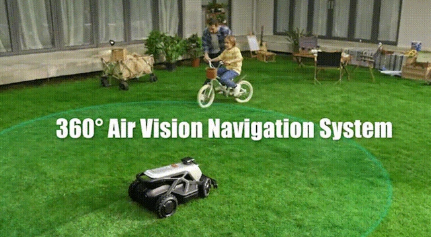
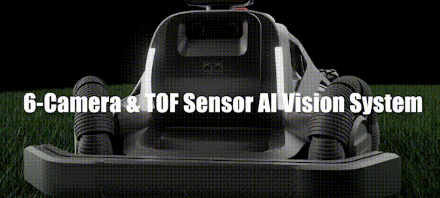
Tron employs six cameras and TOF (Time-of-Flight) depth sensors for comprehensive visual perception. It claims to achieve precise positioning and path planning even with weak GPS signals or in complex terrain, also supporting Visual SLAM (Simultaneous Localization and Mapping). Theoretically, this eliminates the need for traditional perimeter wires or RTK (Real-Time Kinematic) base stations for localization.
Users can define virtual exclusion zones via an app, simplifying setup and lowering the barrier to entry for those who prefer not to lay physical wires.
Clippings are finely shredded and returned to the lawn, eliminating the need for bagging and disposal while acting as natural fertilizer.
Official promotions claim the device can handle slopes up to 65% and features self-rescue logic to automatically free itself if stuck, making it suitable for sloped and uneven lawns.
App binding, geofence alarms, GPS positioning, and PIN unlocking enhance the security of the device during outdoor use.
Behind the Brand: Airseekers and Its Backing
According to public records, Airseekers is a brand under Guangdong Changyao Innovation Technology Co., Ltd. The company has completed two rounds of financing, raising tens of millions of yuan from notable investors including Gree Group, Co-Stone Capital, Oriental Fortune Capital, Blue Ocean Ventures, Sumu Wutong Capital, and Brizan Ventures.
Airseekers promotes an AI vision and wireless mowing concept, with specifications and demo videos available on its official website and crowdfunding pages. The team emphasizes visual navigation as a replacement for traditional perimeter wires or RTK technology. However, based on Kickstarter page updates and backer comments, successful delivery appears to face significant challenges.


Robotic Lawnmower Market Trends
The robotic lawnmower market is experiencing rapid growth, with multiple agencies forecasting high Compound Annual Growth Rates (CAGR) for the coming years. The technological trend is shifting from primarily wire-based/RTK systems towards vision-plus-AI solutions.
Estimates for market size vary significantly across different research institutions. Some reports project the global market for 2024 to be anywhere from hundreds of millions to billions of US dollars. For instance, Grand View Research's higher-end projection sees the market reaching tens of billions by 2033, indicating an overall trend of substantial growth.
In terms of technology and competition, established industry players like Husqvarna, Worx, and John Deere are developing wire-free or RTK/vision hybrid solutions. New entrants are also leveraging visual SLAM and multi-camera systems to capture the home market, which prioritizes ease of installation. While vision-based solutions offer user-friendliness, their main challenge lies in robustness within complex environments, including varying light conditions, obstructions, and interference from mud and grass.
Demand currently spans from small residential to commercial applications, with models ranging from hundreds to several thousands of dollars. Devices like the Tron, featuring multiple cameras and high terrain capability, typically target high-end residential or small commercial users.

Based on Kickstarter page updates and backer comments, successful delivery appears to face significant challenges.