COFFEEJACK V2: Hand-Crank Espresso Machine Raises Over $800K on Kickstarter
Campaign Teardown · · PledgeRadar Editorial

The COFFEEJACK V2 is a fully manual, portable espresso machine driven by planetary gears. It operates without motors, batteries, or coffee capsules, instead using a top handle to drive a high-torque planetary gear set. This converts rotational motion into linear piston movement, generating the high pressure required for authentic espresso extraction. It utilizes a 54mm non-pressurized portafilter basket, accommodates 18g of coffee grounds, and has an official water reservoir capacity of approximately 90ml, capable of producing up to 60ml of coffee. For optimal use, the manufacturer recommends maintaining extraction pressure between 6-8 Bar, with a maximum not exceeding 9 Bar. The device measures approximately 8.4×13cm, effectively condensing the pressure-building process typically found in desktop machines into a portable, purely mechanical device.
Campaign Launch and Delivery Challenges
COFFEEJACK V2 launched on Kickstarter on April 8, 2025, concluding on May 8, 2025. Over its 30-day campaign, it successfully raised approximately $800,000. Initial plans projected shipments to begin in November 2025, with most backers expected to receive their products by early December. However, the actual production cycle was significantly extended. It wasn't until early 2026 that the team announced the start of mass production assembly, adjusting the first large-scale shipments to February 2026. In reality, backer feedback in the Kickstarter comments section indicated that products were only being received gradually by August 2026, with many reporting various issues upon arrival.
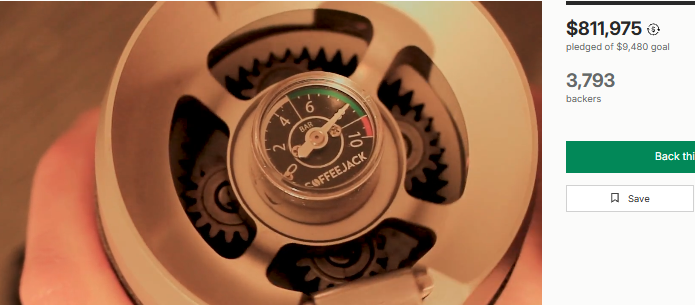
Planetary Gear Pressurization for Stable 6-8 Bar Extraction
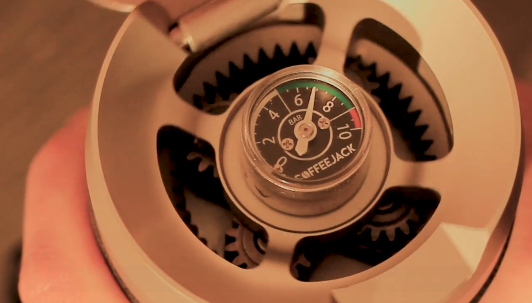
The most significant innovation in the COFFEEJACK V2 is its exposed, high-torque planetary gearbox located at the top. When the user rotates the handle, the gear system amplifies the input torque, converting rotational motion into the downward linear movement of an internal piston. This piston directly applies pressure to the water reservoir, a fundamental departure from the first-generation COFFEEJACK's hydraulic pressurization structure.
While the device is mechanically capable of generating over 9 Bar of pressure, the manufacturer does not encourage consistently maximizing it. The production version's operating guide explicitly designates 6-8 Bar as the optimal extraction range for most coffee beans, stipulating that pressure should not exceed 9 Bar. This indicates that the true objective is not merely higher pressure for professionalism, but rather enabling users to precisely control pressure variations through rotation speed.
Unlike traditional portable machines, which often rely on repeated piston pressing or small electric pumps, the COFFEEJACK V2 more closely mimics the mechanical pressure control of a traditional lever espresso machine, but within a significantly smaller rotating gear system.
Authentic Espresso: Non-Pressurized Portafilter and Standard Dose
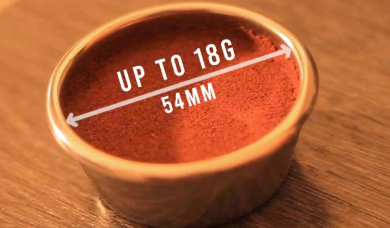
Many portable coffee makers employ pressurized portafilters to lower the barrier to entry. While this design is more forgiving regarding grind size and puck preparation, the resistance generated by the coffee itself is not the sole source of pressure. The COFFEEJACK V2, however, opts for a more traditional 54mm non-pressurized portafilter.
It uses a standard dose of approximately 18g of coffee grounds, allowing for classic espresso recipes with an approximate 1:2 ratio of 18g grounds to 36g liquid. This choice directly defines its target audience. Users are still required to adjust grind size, distribution, tamping, and extraction pressure. The manufacturer even explicitly recommends re-adjusting grind parameters when switching coffee beans. Therefore, the COFFEEJACK V2 is not designed for one-button espresso, but rather to preserve the adjustability of professional espresso within the smallest possible mechanical structure.
Innovative Inverted Puck Water Distribution
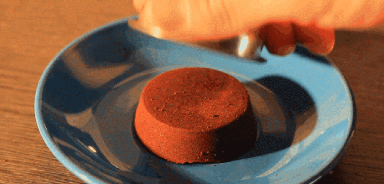
The COFFEEJACK V2 also features a highly unusual design: the coffee puck is installed inverted. For normal use, the user first loads coffee grounds into the portafilter, completes distribution and tamping, and then attaches the entire portafilter upside down to the bottom of the machine.
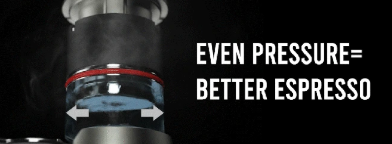
This design is not merely aesthetic. The manufacturer explains that the inverted structure prevents hot water in the reservoir from pre-wetting the coffee grounds before extraction officially begins, thus eliminating the need for additional internal valves to control water flow. Concurrently, water can more evenly saturate the entire coffee puck through the shower screen, rather than concentrating from a localized entry point. For espresso, this design addresses critical practical questions: when should water contact the coffee, and is the initial water distribution across the puck sufficiently uniform?
Double Shot Capacity and Versatile Brewing
The COFFEEJACK V2's water reservoir has a capacity of approximately 90ml. Accounting for water absorbed by the coffee puck, the manufacturer states a maximum coffee output of about 60ml, sufficient for a double shot or a longer lungo. However, it does not require expelling all 90ml each time. For a more traditional espresso, users can pre-rotate the handle about 7 turns to limit the water available to the piston, then extract using the 18g coffee grounds to approximately 36g espresso ratio. After completing the espresso, hot water can be added to make an Americano, or milk for other beverages.
This design avoids adding more modes to the machine, instead leaving all variations to water volume, coffee dose, grind, and pressure parameters.

Durable, All-Mechanical Design and Portability
The V2 operates without batteries or motors and requires no proprietary coffee capsules; only coffee grounds and externally prepared hot water are needed for the entire extraction process. The body incorporates extensive metal construction, with critical components in contact with water and coffee made from stainless steel. In contrast to the first-generation product, which heavily utilized plastic and glass parts, the V2's structure clearly prioritizes durability and mechanical strength.
The manufacturer has designed the primary sealing structures to consist of three user-replaceable seals, with complete seal and maintenance kits currently sold separately on their official website. This is particularly crucial for a purely mechanical product designed to consistently withstand 6-9 Bar of pressure. However, its "portable" designation comes with a caveat. During the crowdfunding campaign, the official weight was stated as approximately 1kg, but mass production reviews by media outlets recorded the total weight at around 1.4kg.
While significantly smaller than a home semi-automatic espresso machine and capable of fitting into a backpack, the COFFEEJACK V2 is noticeably heavier compared to truly lightweight travel coffee devices like the Aeropress or Picopresso.
The COFFEEJACK V2 was not the team's first foray into the crowdfunding market. As early as October 2019, the team launched the first-generation COFFEEJACK. That project initially raised £943,573, becoming a highly successful portable coffee product on Kickstarter at the time. However, the first generation's subsequent delivery experience was not smooth, with COVID-19, mold redesigns, product structure modifications, and supply chain issues leading to multiple delays. Among the feedback from early 2026 users, some machines exhibited noticeable abnormal noises during high-pressure rotation. The team later confirmed this was related to the lubrication solution used for key threads during the mass production phase and provided maintenance kits to users who had already received their machines. Concurrently, some users continued to report difficulties in stabilizing the machine and slow customer service response times.

Global Market Trends and Competitive Landscape
The COFFEEJACK V2 enters a highly mature yet continuously evolving market. Data from Grand View Research indicates that the global coffee machine market size was approximately $7.2 billion in 2025, projected to reach $11.3 billion by 2033. Within this, the espresso machine sub-segment was about $969 million in 2025, expected to grow to approximately $1.544 billion by 2033.
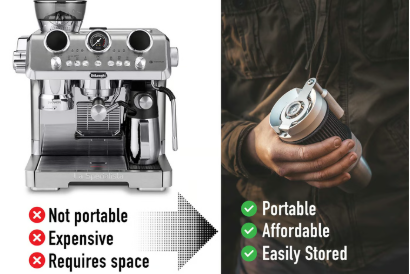
The emergence of products like COFFEEJACK is driven by consumers' expanding demand for espresso, moving beyond cafes into home and mobile settings. According to the National Coffee Association, 66% of American adults drink coffee daily in 2025, with 46% having consumed gourmet coffee on a given day. The daily consumption rate of espresso-based beverages like Espresso, Latte, and Cappuccino also increased from 24% in 2020 to 28% in 2025. Concurrently, the percentage of American households owning an espresso machine rose from 8% in 2020 to 12% in 2025. The COFFEEJACK V2 precisely captures the intersection of two demands: consumers who desire authentic espresso and those who wish to avoid purchasing a large, kitchen-space-consuming machine.
The market already features established manual solutions such as the Wacaco Picopresso, Flair, and Cafelat Robot, meaning COFFEEJACK is not entering an uncontested new category. Its true differentiation lies in transforming the planetary gears into the product's most memorable visual and mechanical symbol. The process of turning the handle, watching the gears rotate, seeing the pressure gauge rise, and then having espresso flow from the bottom not only fulfills the product's function but also lends itself naturally to Kickstarter and short-video promotion.
Reflecting on this nearly £600,000 crowdfunding campaign, the most valuable lesson from COFFEEJACK V2 is not merely that the team created a smaller coffee machine. Instead, it's that after significant issues with the first-generation product, they chose not to merely patch up the original hydraulic structure. They instead sought a new mechanical solution that consumers could instantly grasp. While the first generation sold the idea of a "pocket coffee machine," the second generation truly sold the visible, rotating gears that directly control espresso pressure.
The second generation truly sold the visible, rotating gears that directly control espresso pressure.