DJI VP's Morpho UV Printer Hits $10M on Kickstarter in Under 20 Days
Campaign Teardown · · PledgeRadar Editorial
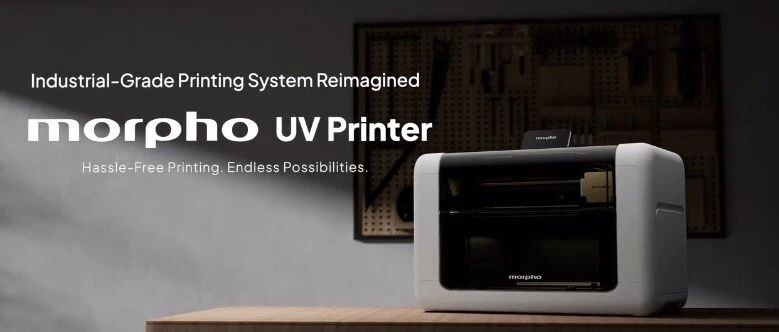
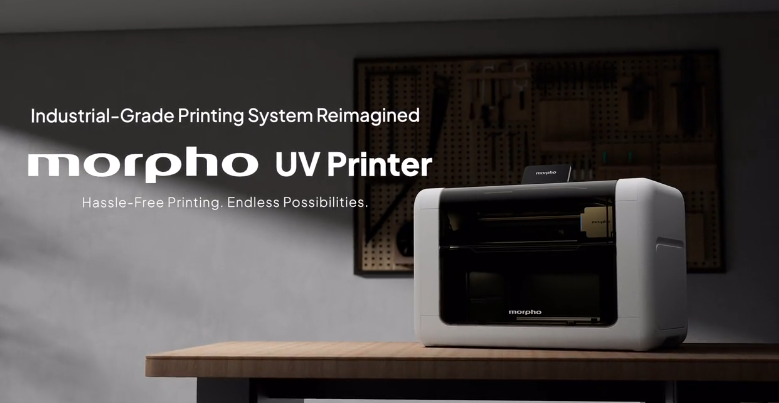
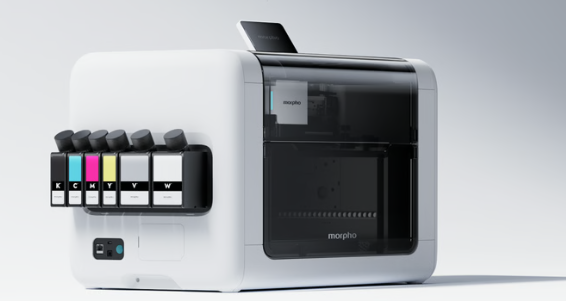
The Morpho UV Printer is a desktop UV direct-to-object printer designed for Etsy sellers, custom studios, and creators. It utilizes an industrial-grade printhead, a moving gantry structure, machine vision positioning, and stackable UV ink layers to directly print color patterns and embossed textures onto finished surfaces such as acrylic, wood, metal, leather, and ceramics.
Campaign Overview and Initial Success
Morpho launched on Kickstarter on August 20, 2026, with a planned end date of October 14. In less than 20 days, the project secured over $10 million, creating a "suction effect" that overshadowed nearly all concurrent projects. Currently, the average pledge per backer is approximately $3,530. Early bird pricing starts at $1,799 for the Standard version, $2,999 for the Pro version, and further bundles like the WorkflowBundle and DeluxeBundle are priced at $3,999 and $4,749, respectively. The Pro version is the primary driver of orders, indicating that many users view this not merely as a hobbyist toy but as a small-scale production device.
Analyzing the marketing timeline reveals that the project's explosive growth was concentrated in the opening phase, attracting nearly 2,000 backers and raising over $7 million within 16 hours of launch. This success was certainly not achieved solely through Kickstarter's organic traffic. The brand conducted a long-term $50 pre-order campaign before the crowdfunding launch. Deposit holders not only received their deposit back but also an additional $200 cashback. This was coupled with ongoing discussion generation through discounts up to 42%, Facebook/Discord communities, live demonstrations at Maker events, and the "Wings" testing program launched after the Kickstarter debut. This strategy closely mirrors that of the eufy Make E1: using extensive pre-launch lists to secure high-value customers, then releasing these pledges on day one to rapidly boost platform rankings and social proof.
FauxHammer received a pre-production i3200 unit for testing before the crowdfunding campaign. On September 4, Make TechCreate also published multi-material test results, printing successfully on cardboard, canvas, faux leather, acrylic, slate, brass, and plywood, and found the software and positioning process relatively easy to use. On the other hand, FauxHammer's tests did not fully corroborate the brand's claims; some prints showed graininess, inconsistent sharpness, and color mixing up close, and the machine vision positioning's stability across different locations was not yet fully mature. However, these observations were made on a test unit still undergoing software and parameter calibration.
Key Product Features
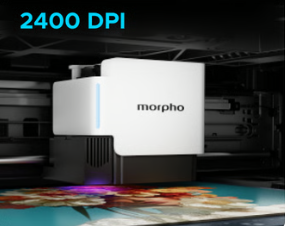
**i3200 Industrial Printhead, 2400 DPI**
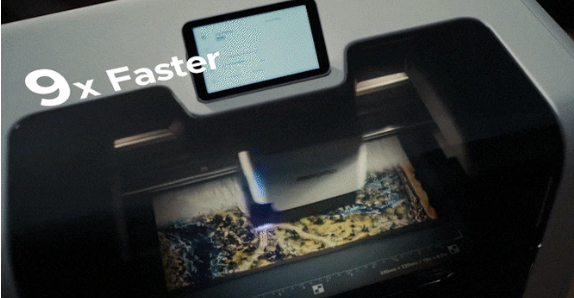
Morpho actually offers two specifications. The $1,799 Standard version uses an F1080/XP600-level printhead, with a maximum resolution of 1440 DPI and a maximum texture thickness of 5mm. Only the $2,999 Pro version features the Epson i3200 eight-channel printhead, boasting 3,200 nozzles, 3.8 pL variable ink droplets, 2400 DPI, and configured with CMYK + dual white ink + dual varnish channels. The brand's claims of 2400 DPI, 9x speed, and 60mm texture primarily refer to the Pro version and should not be directly applied to the lower-priced Standard version.
The significance of the i3200 lies more in its throughput than merely its resolution.
The official statement claims the printhead carriage can reach up to 600mm/s, with white ink + CMYK scenarios potentially up to 9 times faster than typical XP600 solutions, CMYK up to 7 times faster, and texture printing up to 5 times faster.
**Moving Gantry Structure, 330×220×168mm Workspace Fully Enclosed**
Most desktop UV printers rely on the print platform moving back and forth, causing the bed to extend out of the machine when printing large objects, occupying extra desktop space and weakening the enclosed filtration effect. Morpho adopts a fixed print bed with an XY gantry-moving printhead, offering a standard enclosed print space of 330×220×168mm, expandable to 420×330×138mm with an A3 platform.
This design is more practically significant than the "4x space" promotional figure. For phone cases, coasters, signs, and small-batch customization, users can complete more tasks with the door closed, and the machine's footprint does not significantly increase with print bed movement.
**Dual 8MP Stereo Vision for Automated Alignment**
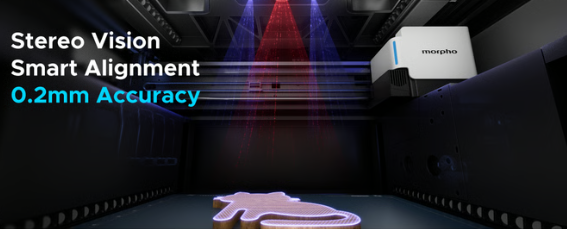
The machine is equipped with dual 8MP cameras, infrared structured light, laser height detection, a 5MP macro camera, and a 2MP real-time monitoring camera. After placing phone cases, coins, or multiple products, the system can photograph the workbench, identify contours and height, allowing users to directly drag and drop designs onto images within MorphoStudio. The official stated positioning accuracy is 0.2mm.
This is crucial for small-batch personalized production, as the most time-consuming aspect of traditional UV printing is often not the printing itself, but rather jig setup and coordinate calibration.
**60mm Ink Layer Stacking for 3D Textures**
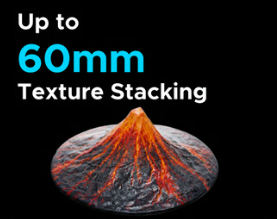
The Pro version can stack UV ink layers up to 60mm, supporting effects such as embossing, faux embroidery, glazed, crystal, microlens, and lenticular. The Standard version is limited to a maximum of 5mm. Morpho also provides over 1,000 preset textures, capable of transforming ordinary two-dimensional images into tactile surfaces.
While branded "FullColor3D," this remains a UV inkjet device that creates height by repeatedly stacking and curing ink, not a resin 3D printer capable of freely constructing arbitrary three-dimensional objects. The official case studies show that a highly立体 resin effect piece, approximately 6×6cm and using 53.5ml of ink, took 3 hours and 34 minutes to print. Therefore, the 60mm stacking is more suitable for high-value artworks and special effects rather than high-efficiency batch production.
**2.5D ReliefScan: Scan Real Textures for Embossed Prints**
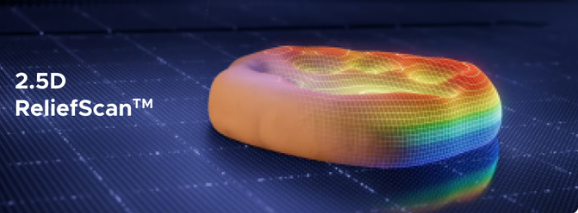
Morpho incorporates ReliefScan with its built-in macro camera, allowing it to scan the surface of real objects, convert their concave and convex details into UV relief data, and then re-print them. This is not merely photographing to reproduce colors but an attempt to digitize surface height information.
For replicating souvenirs, texture samples, artworks, and custom gifts, this feature offers greater expandability than simply adding a few hundred templates. However, the scanning accuracy, the degree of complex texture reproduction, and the stability of the final 60mm stacking currently lack third-party system testing.
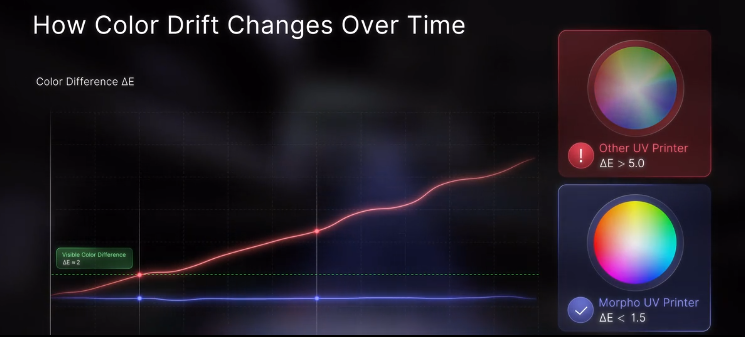
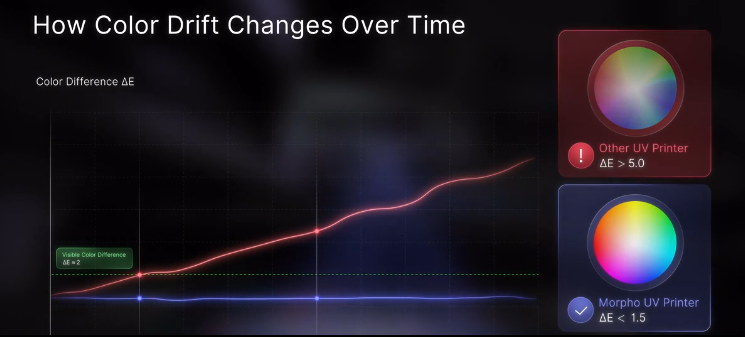
**Built-in Colorimeter for Continuous Color Calibration (ΔE<1.5)**
Morpho includes a built-in spectrophotometer, capable of establishing and updating ICC Profiles. The brand also announced G7 Master ColorSpace certification and a ΔE<1.5 color difference target.
For small businesses offering product customization, this feature is more professional than simply making colors appear vibrant: the ability to maintain consistent colors when reordering the same product months apart directly impacts commercial use.
However, color management and inkjet physical quality are two different matters. Faux Hammer's tests already revealed ink droplet fusion and localized sharpness issues that ICC profiles cannot resolve. Therefore, while the ΔE metric can describe the color management system, it cannot independently prove that every mass-produced piece will achieve the advertised 2400 DPI effect.
**Open Ink System, No Proprietary Cleaning Liquids**
Morpho supports both original factory ink cartridges and refillable cartridges, and offers open jig interfaces and an SDK.
More uniquely, it claims that through white ink stirring, ink path circulation, printhead heating, and automatic nozzle compensation, it does not require separate Cleaning Liquid and Moisturizing Liquid, with the brand stating a maintenance waste ink reduction of over 90%. During the Kickstarter phase, CMYK ink (130ml) is priced at $13.99, while white ink and varnish (290ml each) are $23.99.
This is a crucial aspect of the long-term cost of UV printers, as white ink settling, nozzle clogging, and waste ink generated by automatic cleaning often cause more headaches for small users than the cost of the machine itself. However, the 90% reduction is a comparative result from Morpho internally; there is currently no long-term mass production data to prove that the same level of maintenance can be maintained after several months of downtime or frequent power cycles.
**Low VOC Enclosed Printing for Reduced Odor**
The EcoInk has obtained GREENGUARD Gold certification. Morpho's published test results claim its VOC emissions are only 10%-25% of some similar desktop UV inks. Coupled with the enclosed cabin and internal filtration system, this directly positions the ability to use a UV printer in a home studio as a product selling point.
The community, however, remains most cautious about this. While users who have seen the machine in person report a noticeably lighter odor, Reddit still has many potential buyers concerned about long-term use of UV inks in living rooms, offices, or other non-dedicated workspaces.
Market Landscape and Competitive Positioning
Mordor Intelligence's latest report indicates that the global UV printer market grew from $1.02 billion in 2025 to $1.1 billion in 2026, with projections to reach $1.58 billion by 2031, representing a CAGR of approximately 7.59% from 2026-2031. Within this, small and medium-sized equipment is expected to grow at 7.65%, slightly faster than the overall market, primarily driven by UV LED curing, short-run custom packaging, direct-to-object personalization, and an increasing number of small businesses shifting from outsourced printing to in-house production.
This category is also becoming increasingly crowded. In 2025, the eufy Make E1 ultimately secured $46.76 million from 17,822 backers, becoming the highest-funded project in Kickstarter history. LONGE RePrint later raised approximately $4.29 million, and the currently crowdfunding HeyGears G1 has already surpassed $15.9 million. Desktop UV printers are mirroring the early trajectory of laser engravers and consumer-grade 3D printers, where industrial equipment once costing tens or even hundreds of thousands of dollars is rapidly being compressed into the thousands.
Currently, the eufy Make E1 retails for approximately $2,359-$2,409, offering 1440 DPI and a maximum 5mm texture. The xTool O1 starts from $2,199, with the advantage of integrating multiple processes like UV, DTG, and DTF. The Procolored A3 UV machine is around $5,999. Moving towards traditional professional equipment, the Roland BD-8 MSRP reaches $11,595, and the Epson SureColor V1070 is currently about $9,299. Morpho's $1,799 Standard and $2,999 Pro versions are positioned precisely between consumer-grade and traditional professional machines. The Pro's choice of the i3200, built-in color calibration, open ink system, and large enclosed space clearly targets small businesses looking to upgrade from hobbyist use to production.
Its biggest risk also stems from this rapidly changing market. The eufy Make is already available for immediate purchase, xTool is expanding multi-material printing, and HeyGears is even bringing full-color 3D material jetting to the desktop. If Morpho's current parameter advantages are delivered a year late, they could quickly be matched. Conversely, if the i3200 print quality, automatic alignment, low-maintenance ink path, and open consumables can all stably perform in the mass-produced version, it won't just be another UV machine that prints cups, but a machine priced around $3,000 that begins to approach the logic of small-scale production equipment.
The core question of whether Morpho can transform this over $10 million crowdfunding success into a long-term product hinges on its ability to simultaneously deliver on print quality, automatic alignment, low maintenance, and high-intensity continuous production once mass-produced.
The Pro version is the primary driver of orders, indicating that many users view this not merely as a hobbyist toy but as a small-scale production device.