Former DJI Engineers Launch AI Bird-Tracking Telephoto Camera, Raises $360K in 10 Days
Campaign Teardown · · PledgeRadar Editorial
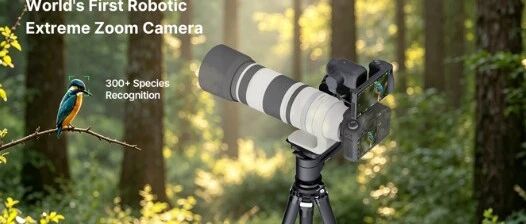
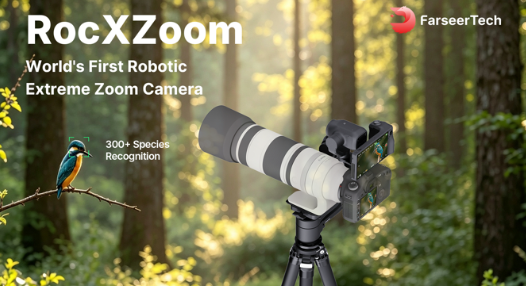
Farseer has launched RocXZoom, a robotic super-telephoto camera designed to integrate long-distance subject recognition, automatic tracking, and shooting into a compact 400g device. Featuring 20x optical zoom, a two-axis mechanical gimbal, and AI vision tracking, it targets birdwatchers, wildlife enthusiasts, sports photographers, and outdoor long-range shooters.
Campaign Launch and Early Performance
RocXZoom launched on August 27, 2026, with a 30-day campaign ending September 26. The project secured $360,000 in just 10 days, a remarkable start for a new brand camera priced at several hundred dollars. Its competitive pricing was a key factor in its rapid funding. The brand employed a classic marketing strategy, using $1 VIP deposits to pre-lock users, showcasing the device at CES 2026, highlighting its former DJI engineer team, and offering early bird discounts of up to 50% off.
RocXZoom is more than just a crowdfunding render. The product was publicly demonstrated at CES 2026 earlier this year, where media experienced its AI tracking firsthand. The team attached a fake bird to a remote-controlled car, and the RocX successfully rotated its body to keep the bird continuously in frame, demonstrating its robotic tracking logic in a short demo. However, a crucial question remains: tracking a remote-controlled fake bird indoors is vastly different from tracking small birds suddenly taking flight in a forest. Its performance amidst obstructions, backlighting, complex backgrounds, and high-speed changes lacks sufficient independent field testing.
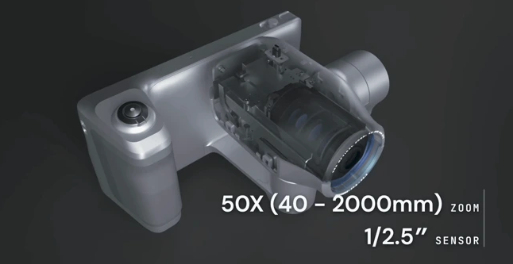
The biggest debate isn't about its zoom capability, but what "2000mm" truly signifies. The project FAQ clarifies that the actual optical focal length is an equivalent 40-800mm, with 800-2000mm achieved through digital/hybrid extension, not a true 2000mm optical lens. The camera uses a small 50MP, 1/2.5-inch sensor. While this helps keep the telephoto lens compact, it inherently involves trade-offs in low-light performance, dynamic range, and extreme telephoto detail.
Core Product Features
**40-800mm Optical Zoom in a 400g Body**
The RocXZoom offers 20x optical zoom, equivalent to approximately 40-800mm full-frame focal length, further extended to 2000mm via digital processing, creating what the company calls 50x Hybrid Zoom. The camera body weighs only about 400g, significantly less than traditional super-telephoto cameras or mirrorless cameras paired with telephoto lenses.
Its true value lies not in outperforming professional lenses on focal length numbers, but in lowering the barrier to portability. The 800mm optical range is sufficient for many birdwatching and wildlife scenarios. However, the 2000mm is a digital extension and cannot be directly compared to the resolving power of a true 2000mm optical lens.
**Robotic Auto-Tracking: The Camera Itself Follows the Subject**
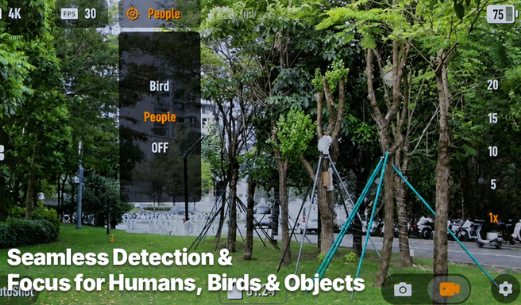
The RocXZoom's most significant product differentiator is its "Physical AI." Computer vision first identifies birds, people, or other targets in the frame. Then, a two-axis motorized mechanism directly alters the camera's horizontal and vertical orientation to recenter the subject, adjusting zoom based on the target's state. This means the entire camera actively moves to follow the subject, rather than just adjusting focus.
The brand claims a minimum system response time of 0.01 seconds and the ability to track targets moving at approximately 10-20 m/s. However, these figures are primarily from official tests. Obstructions, branch interference, and similar birds entering the frame in a real forest environment pose much greater challenges than laboratory demonstrations.
**Two-Axis Gimbal and EIS for Super-Telephoto Stability**
One of the biggest challenges with telephoto lenses is that even slight hand movements are magnified significantly as the focal length increases.
The RocXZoom integrates a two-axis mechanical gimbal directly into the camera, combined with Electronic Image Stabilization (EIS), to create a dual stabilization system. This allows users to perform handheld observation and video recording at longer focal lengths without necessarily needing a tripod.
This distinguishes it from traditional bridge cameras. While cameras from brands like Nikon typically rely on lens or sensor stabilization, the RocX allows its lens components to actively rotate via a mechanical structure, with stabilization and tracking leveraging the same robotic capabilities.
**300+ Bird Species Recognition: A Telephoto Camera as an Electronic Birding Tool**
The device features built-in AI recognition, with official claims of real-time identification for over 300 bird species, alongside support for human and other target recognition.
This feature further targets the birding community. While identifying bird species might not be critical for professional photographers, for casual birdwatchers, seeing a distant bird, having the camera automatically track it, identify it, and capture a photo offers a far more complete experience than just owning a telephoto camera.
However, the contemporary GoBirding VisionMaster already offers offline recognition for over 1,500 bird species and over 10,000 when connected online. This suggests that the bird AI database itself isn't RocX's strongest long-term barrier; robotic tracking is.
**Integrated 5-inch OLED Screen for Aiming, Tracking, and Viewing**
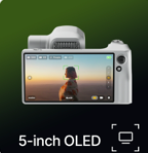
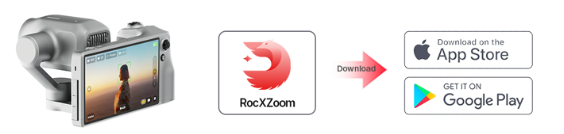
The camera body integrates a 5-inch OLED display on its front and supports remote control via a smartphone app. Official specifications claim a maximum battery life of approximately 4 hours. The body features an aluminum alloy structure with an IP54 protection rating, capable of withstanding outdoor dust and general splashing.
This design makes it function more like a combined electronic telescope, camera, and gimbal device, rather than an accessory that requires a smartphone to operate. However, the 4-hour battery life is based on official lab conditions, and real-world endurance when simultaneously running 4K recording, AI recognition, mechanical tracking, and the OLED screen has not been independently tested.
**RocXZoom Pro: Enabling Auto-Tracking for Professional Telephoto Lenses**
The RocXZoom also offers a highly interesting expansion option.
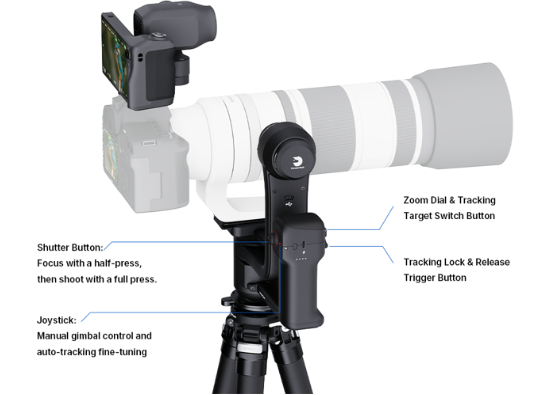
The ProKit adds a large two-axis robotic gimbal, supporting camera and lens combinations up to approximately 5kg. Users can mount the RocX as a visual reconnaissance camera onto their existing mirrorless or DSLR systems. The RocX identifies targets and then controls the larger gimbal below, directing the professional telephoto camera towards the target.
This expands the RocX's utility beyond its small integrated sensor. For those who already own Sony, Canon, or Nikon bodies and telephoto lenses, it theoretically transforms into an automated photography robot.
However, the initial Pro mode primarily supports tracking of people and birds, with other tracking subjects like vehicles, animals, and aircraft planned for future free firmware updates. It's important to note that future OTA features promised during the Kickstarter phase should not be equated with already mass-production-validated functionalities.

Farseer: The Team Behind RocXZoom
Farseer, the company behind RocXZoom, is a smart imaging robotics startup based in China, with core team members hailing from DJI. The company states that its team members previously participated in the R&D and mass production of DJI Inspire, Osmo Pocket, and Ronin 4D products. These product lines inherently involve imaging, mechanical gimbals, visual algorithms, and motion control, all highly relevant to RocX's technological approach.
Market Analysis and Competitive Landscape
Data from Grand View Research projects the global digital camera market to reach approximately $8.8 billion in 2026, growing to about $10.3 billion by 2030, with a compound annual growth rate of roughly 5.3% from 2024-2030. This growth isn't driven by competing with smartphones for casual photography, but by niche segments like professional imaging, content creation, telephoto photography, and AI-driven automatic recognition—areas where smartphones struggle to fully compete.
The super-telephoto market, where RocX operates, already features highly mature products. The Nikon COOLPIX P1000, priced at $1,099.95, offers a true 24-3000mm equivalent 125x optical zoom, extendable digitally to 6000mm. The Kodak PIXPRO AZ653, at just $419.99, provides 65x optical zoom.
Solely based on reach, the RocX, priced between $449 and $799, doesn't even have a parameter advantage. Its true competitive edge lies in robotic tracking, a feature absent in traditional super-telephoto cameras.
Meanwhile, the emerging GoBirding VisionMaster, with an early bird price of approximately $649, offers 30x optical zoom, 120x Hybrid Zoom, 4K video recording, and AI bird recognition. This essentially proves that smart birdwatching devices are forming a new, small market segment. RocX is thus positioned between three categories: traditional super-telephoto cameras for long-distance viewing, smart birding scopes for identification, and RocX aiming to add the layer of autonomous tracking.
This positioning is highly marketable. However, the 1/2.5-inch sensor means it's unlikely to match the pure image quality of professional telephoto mirrorless cameras. The portion beyond 800mm heavily relies on digital processing, and if the AI frequently loses targets in real outdoor environments, the robotic structure could become a source of cost and complexity rather than an advantage.
Conversely, if it can consistently perform discovery, locking, turning, tracking, and zooming in scenarios involving flying birds, sports, and wildlife, users won't be buying just a cheaper telephoto camera. Instead, they'll be acquiring an automated system for operations that previously required a photographer's manual skill.
The core variable for RocXZoom's market viability, in our view, isn't the advertised 2000mm figure, but whether it can more stably keep a fast-moving, distant target centered in the frame in real outdoor environments than a human operator.
Its true value lies not in outperforming professional lenses on focal length numbers, but in lowering the barrier to portability.