GL.iNet's CometQ: The First USB-C KVM for Mobile Devices Targets $1M on Kickstarter
Campaign Teardown · · PledgeRadar Editorial
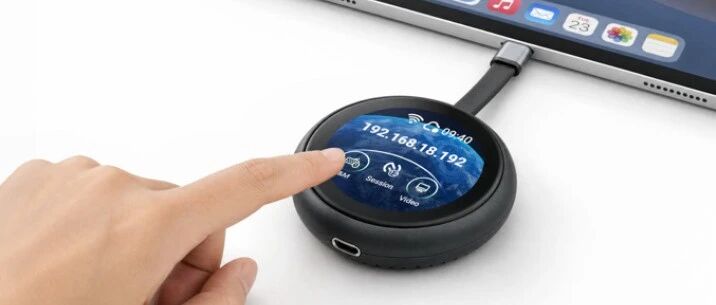
GL.iNet has launched CometQ, the world's first remote KVM device designed for mobile devices, connecting via a single USB-C cable. This innovative solution consolidates control signals, video transmission, power delivery, and file transfer, eliminating the need for drivers or network configuration. Users can remotely wake, unlock, and operate laptops, smartphones, tablets, and Mac minis with USB-C DP output directly from a web browser, making it ideal for IT administrators, remote workers, software developers, and professionals managing multiple devices. Launched on Kickstarter in early June 2026, CometQ quickly surpassed $400,000. This marks GL.iNet's fourth Kickstarter campaign, following the success of its predecessor, CometPro (a Wi-Fi 6 desktop KVM), which raised approximately $1.03 million from 5,671 backers, establishing a strong foundation of community trust for CometQ. Coverage from CNXSoftware, GL.iNet's official forums, and tech media has highlighted CometQ's mobile device compatibility and driver-free browser control, with the professional technical community noting its underlying architecture based on a Buildroot Linux system and dual-core ARM processor.
Product Core Selling Points
CometQ's core design integrates all functionalities into a single USB-C cable, simultaneously handling control signals, video output, device power, and file transfer through one physical connection. This significantly reduces deployment complexity compared to traditional KVM devices that require multiple cables for HDMI, USB, and power. This feature set relies on the target device supporting USB-C DisplayPort Alt Mode, which includes most modern laptops (e.g., MacBook, ThinkPad, Surface). However, some Android phones and older devices may have compatibility limitations, so users should verify target device specifications before purchase.
Unlike software-based remote access tools such as TeamViewer or AnyDesk, CometQ operates at a hardware level, eliminating the need for the target device to be powered on or network-connected. Even if a laptop is in sleep mode, logged out, or has lost network connectivity, CometQ can still wake the device via its USB-C physical connection and perform BIOS-level operations. This is a critical feature for scenarios requiring remote restarts of crashed servers or system troubleshooting, where software solutions are ineffective. The actual effectiveness of the wake function depends on the target device's BIOS/firmware support for USB-C wake signals, which can vary between brands and models.
CometQ features a built-in Wi-Fi 6 wireless module, allowing users to view the target device's real-time screen and perform keyboard/mouse operations from any browser connected to the same Wi-Fi network, without installing software or drivers on the control device. The device runs on a Buildroot-based Linux system, equipped with a dual-core ARM processor, 512MB RAM, and 512MB NAND Flash, providing the hardware specifications for stable, low-latency video streaming. Actual latency and display fluidity depend on Wi-Fi signal quality and network bandwidth; for enterprise use, a stable 2.4G/5G dual-band network is recommended.
The device integrates a 1.8-inch touch LCD screen, directly displaying the current IP address, device status, and basic configurations on the unit itself. This eliminates the need to connect to a computer or open an app to confirm connection parameters, offering practical convenience during initial setup or network troubleshooting by removing guesswork about network connectivity and IP assignment.
CometQ claims support for all major operating systems, including Windows, macOS, Android, and iPadOS, provided the target device offers USB-C DisplayPort Alt Mode output. This broad cross-OS compatibility is a significant differentiator from traditional KVM devices, which typically focus on desktop PCs and servers with minimal to no support for smartphones and tablets. Actual compatibility may be affected by variations in how different operating systems implement the USB-C DP protocol; some Android devices, for instance, have inconsistent DisplayPort Alt Mode support. This is a technical detail potential buyers should verify against their specific device list.
Company Background
Founded in 2010, GL.iNet (Guanglian Zhitong) maintains its primary R&D and manufacturing teams in Shenzhen, with additional offices and distribution centers in the United States, serving over 120 countries globally. The company initially gained recognition for its OpenWrt routers, with notable products like the Slate travel router and Mudi 4G/5G mobile router, earning a CES Innovation Award nomination and a Hong Kong ICT Smart Business Award. Starting in 2025/2026, GL.iNet strategically shifted its focus from routers to remote infrastructure control, with the Comet series becoming a core product line in this transition. GL.iNet operates its own manufacturing facilities, employs approximately 55 staff, and currently has no public external institutional funding, relying primarily on product sales and crowdfunding. The previous CometPro's crowdfunding success, raising over $1.03 million, serves as a strong market validation for CometQ's current launch.
Global Market Analysis
The KVM over IP device market is a stable professional segment experiencing continuous growth driven by remote work trends and data center expansion. In 2024, the global KVM over IP market was valued between $138 million and $1.52 billion (varying widely based on scope, from pure KVM switches to broader remote management devices). Multiple agencies project a Compound Annual Growth Rate (CAGR) between 6.2% and 10.1%, with the market size expected to reach $260 million to $3.2 billion by 2033-2034. This growth is fueled by the widespread adoption of hybrid work models, distributed IT architectures, data center scaling, and increasing demand for operational automation.
The traditional KVM over IP market has long been dominated by enterprise-grade brands such as ATEN, Legrand, Vertiv, Adder, and BlackBox. Their products, typically priced from hundreds to thousands of dollars, primarily target data centers and server rooms for out-of-band management, with little to no coverage for mobile devices like laptops and smartphones. Open-source/maker-oriented alternatives, including PiKVM (a Raspberry Pi-based DIY solution), TinyPilot, and BLIKVM, have gained traction within homelab and IT enthusiast communities. However, these solutions predominantly rely on traditional HDMI+USB interfaces and also offer limited support for mobile devices. While GL.iNet's own CometPro targets desktop devices, CometQ currently faces no mature direct competitors in the specific niche of mobile devices (smartphones, tablets, and USB-C laptops), indicating an existing market gap. The primary market risk lies in the non-universal compatibility of USB-C DisplayPort Alt Mode; the brand must continuously maintain a verified list of compatible devices, as any significant compatibility failures could erode professional user trust.
The demand for remote hardware-level device control is a professional need that continues to expand with the trends of distributed work and IT automation. Leveraging the brand trust established by CometPro and CometQ's first-mover advantage in the mobile device segment, GL.iNet has secured a position in a market that is not yet saturated. Its ability to become a standard tool will hinge on the completeness of its actual USB-C device compatibility list and the stability of its low-latency video transmission in complex network environments.
CometQ currently faces no mature direct competitors in the specific niche of mobile devices (smartphones, tablets, and USB-C laptops), indicating an existing market gap.