GORDIX: Muherz's Rail-Free 3-in-1 Portable CNC Approaches $1M on Kickstarter
Campaign Teardown · · PledgeRadar Editorial
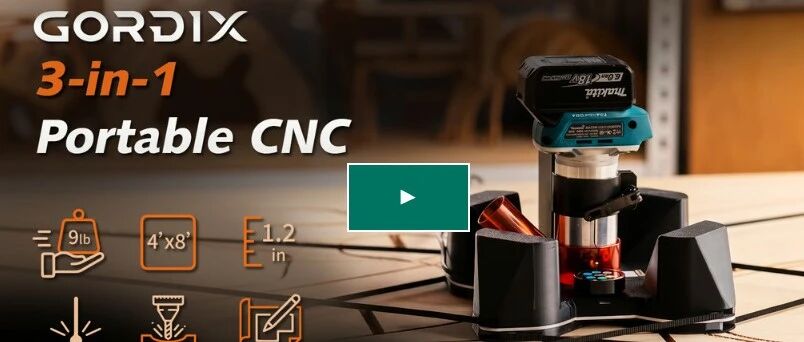
GORDIX, developed by Taiwan's Muherz team, is a rail-free portable desktop CNC machine. It replaces traditional fixed rails with an 8-belt-driven free-moving mechanism, enabling three processing modes—CNC cutting, laser engraving, and drawing pen—on any flat surface. This design targets home woodworkers, makers, small studios, and users without dedicated space for conventional CNC equipment.
Campaign Momentum and Team Reputation
This marks Muherz's fourth crowdfunding campaign on Kickstarter, with all previous projects successfully delivered, fostering significant trust within the maker community. GORDIX launched on May 19, 2026, and quickly surpassed $800,000 in under a week, attracting 434 backers. BackerTracker's trend prediction suggests the campaign could ultimately exceed $2.3 million.
With an average order value of approximately $2,000, GORDIX represents a high-consideration purchase within the maker tool crowdfunding category. This indicates that the campaign is attracting serious users with genuine processing needs and existing familiarity with the Muherz brand. The project has also earned Kickstarter's 'Project We Love' badge.
Innovative Design and Versatility
The core innovation of GORDIX is its 8-belt rail-free free-moving mechanism, which allows it to operate on any flat surface, effectively removing the work area limitations imposed by machine size. Traditional desktop CNC routers are constrained by fixed rails, meaning the processing area is directly tied to the machine's footprint, making it impossible to work on materials larger than the device itself.
GORDIX's robotic 8-belt drive system replaces fixed rails, allowing the machine body to move freely across the material's surface. Theoretically, this enables processing of any size board, provided the underlying surface is flat. This fundamental structural difference directly addresses the common dilemma of machines being too large to house or too small for the desired material. However, belt-driven systems typically offer lower precision than rigid ball screw guides. The repeatability under high cutting force conditions (e.g., hardwood, soft metals) is a critical engineering variable that will influence professional users' assessment of the machine's capabilities.
GORDIX supports three independent work modes: CNC cutting, laser engraving/cutting, and drawing. When fitted with a 65mm trim router (user-supplied), it performs CNC cutting on materials like wood and soft metals. Installing the laser module (an optional add-on) enables laser engraving and cutting, capable of piercing 3mm MDF. With the drawing pen accessory (also optional), it transforms into a precision plotter.
These three modes leverage a single mechanical platform, allowing users to switch modules based on their task without needing to purchase three separate devices. Users should factor the cost of the optional laser module, drawing pen, and a self-supplied trim router into their total investment.
The rail-free structure also enhances portability and storage. GORDIX can fold into a toolbox for storage and be deployed on any workbench or floor when needed. This flexibility is a significant advantage for makers without dedicated workshops, such as those working in living rooms or rented spaces, a capability traditional CNC solutions cannot offer. During operation, clamps are required at the four corners of the work surface to prevent machine displacement. The reliability of these clamps on various material types and thicknesses is a practical consideration for use in outdoor or non-standard environments.
Software Integration and Muherz's Track Record
GORDIX utilizes Muherz's established CubiioApp control system, enabling Wi-Fi connectivity for processing path setup and parameter adjustment via smartphone or tablet. It also supports the GRBL standard protocol, ensuring compatibility with third-party CAM software like Lightburn, allowing users to integrate their existing design workflows.
Existing Cubiio ecosystem users will experience a low migration cost, while new users can benefit from the tutorials and project templates available within the Cubiio community. The seamlessness of the software experience and GRBL compatibility with GORDIX's unique rail-free mechanism will require user verification post-delivery.
Muherz, founded in Taiwan (New Taipei City, Xizhi District), was established by three students from National Chiao Tung University with the support of Professor Mason Hung. The team began with the Cubiio handheld laser engraver, which received a Red Dot Design Award in 2016. Subsequent iterations, including the Cubiio2 and CubiioX series, have built strong brand recognition within the global maker community. GORDIX represents a significant technical evolution of the CubiioX's mobile CNC concept. Muherz has cumulatively raised over $3.5 million across its crowdfunding campaigns, successfully delivering all four projects, establishing it as a highly trusted brand in the Kickstarter maker tools category.
Market Analysis and Competitive Positioning
The desktop CNC equipment market is substantial and growing. VerifiedMarketReports estimates the global desktop CNC market at approximately $1.2 billion in 2024, projected to reach $2.4 billion by 2033, with an 8.7% CAGR. Dataintelo and WiseGuyReports offer a broader valuation, estimating the overall desktop CNC market at around $936 million in 2024, forecasting growth to approximately $2.5 billion by 2035 at a 9.3% CAGR. Growth is driven by the accelerating global adoption of maker culture and DIY manufacturing, the integration of digital fabrication into STEM education, increasing demand for rapid prototyping tools from small and medium-sized enterprises and independent designers, and decreasing equipment costs making CNC more accessible. The hobbyist and home-use segment is the fastest-growing application category, with a 7.5% CAGR.
In the competitive landscape, Carbide3D and Inventables are major players in the consumer desktop CNC router market, building their positions on fixed-rail designs, stable processing precision, and mature user communities. Their mainstream products are priced between $1,000 and $4,000, with work areas fixed within the machine's frame. Meanwhile, xTool and Sculpfun have rapidly emerged in the laser engraving sector, capturing maker market share with high cost-effectiveness and user-friendly app experiences.
GORDIX's differentiation strategy is not to directly compete with high-precision machines like Shapeoko. Instead, it aims to fill a niche unmet by traditional fixed-frame CNCs through its combination of rail-free mobility, 3-in-1 functionality, and foldable portability. This targets users without a fixed workbench, those needing to process materials exceeding machine dimensions, or those requiring a mobile solution for different locations.
This position currently has few mature competitors, suggesting GORDIX is defining a new sub-segment rather than directly vying for existing users. The primary risks for the product appear to be the upper limits of processing precision for its rail-free belt mechanism. Whether the trade-off in precision is acceptable to professional users accustomed to rigid CNC routers, and if novice users can independently complete initial setup and calibration without in-person guidance, will directly determine the product's long-term reputation.
The core dilemma in the desktop CNC market is that larger machines offer better performance but are harder to accommodate. GORDIX directly tackles this contradiction with its rail-free, mobile mechanism. The viability of this new product category hinges on whether the belt-driven processing precision can meet user expectations in real-world woodworking and metal cutting scenarios.
The core dilemma of the desktop CNC market is that the larger the machine, the better it performs, but also the harder it is to accommodate. GORDIX directly tackles this contradiction with its rail-free, mobile mechanism.