ZeTime Smartwatch: A $5.3 Million Kickstarter Success and Cautionary Tale
Crowdfunding Analysis · · PledgeRadar Editorial
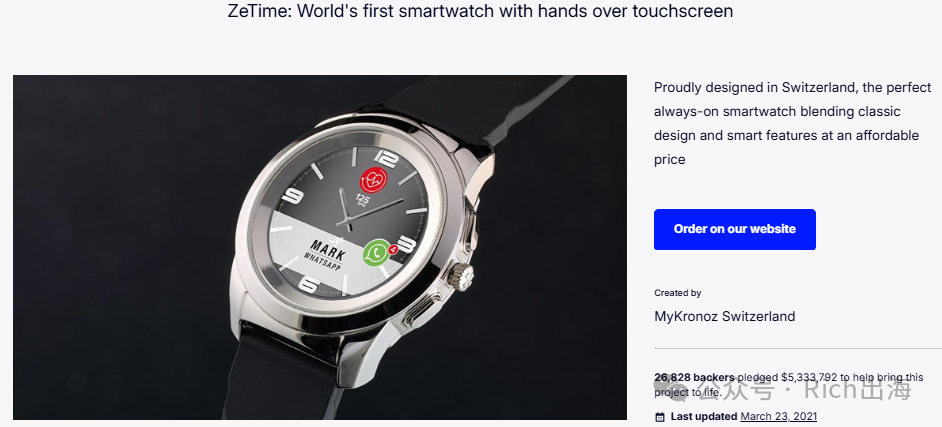
We revisit an older crowdfunding project to glean insights from its trajectory. The ZeTime hybrid smartwatch, launched by Swiss brand MyKronoz in 2017, achieved remarkable success on Kickstarter, raising over $5.3 million and becoming one of the most popular hybrid smartwatch projects of its time.
The Promise and the Pitfalls
ZeTime offered a breakthrough concept of a "no-compromise" hybrid watch, blending traditional aesthetics with smart features. However, it significantly lacked in product maturity, ecosystem experience, and after-sales support. The strong performance of brands like Apple Watch, Garmin, and Fitbit in software ecosystems and specialized sports features led many backers to ultimately choose more stable and feature-rich smartwatches or sports watches.
The ZeTime case underscores that in the wearable device sector, conceptual innovation alone is often insufficient to retain users long-term; system fluidity, functional depth, and brand ecosystem are paramount. The project's failure to deliver on its ambitious promises is reflected in over 17,000 comments on Kickstarter, with backers reporting issues ranging from non-receipt of goods to receiving products that did not match the description.

ZeTime's Core Selling Points
ZeTime's initial appeal stemmed from several core selling points:
**Innovative Mechanical and Touchscreen Integration:** It was touted as the world's first smartwatch to combine mechanical hands with a full-round color touchscreen. This was achieved by creating a central aperture in the TFT display, allowing the mechanical hands to pass through, blending traditional watchmaking with modern technology.
**SmartMovement Technology:** A patented feature designed to automatically move the mechanical hands out of the way when notifications or information appeared on the screen, enhancing user experience.
**Extended Battery Life:** Claimed up to 30 days of battery life for the mechanical hands when smart features were off, and approximately 3 to 4 days with smart features enabled, surpassing many contemporary smartwatches.
**Premium Materials and Design:** Featuring a stainless steel case, sapphire glass, and 30-meter water resistance, combined with traditional Swiss watchmaking craftsmanship for a stylish and durable appearance.
**Comprehensive Smart Features:** Supported heart rate monitoring, step counting, sleep tracking, notification alerts, music control, remote camera control, and compatibility with both iOS and Android systems.
**Diverse Personalization Options:** Offered in 44mm and 39mm case sizes, with various strap materials and colors to cater to different user preferences.
Factors Behind Its 2017 Success
Several factors contributed to ZeTime's significant crowdfunding success in 2017:
**Innovative Product Addressing Market Gaps:** At the time, the market lacked products that combined the aesthetic of a traditional watch with smart functionalities. ZeTime filled this void, attracting a large audience who preferred classic watch designs but desired smart features.
**Perceived Strong Brand Background and Technical Prowess:** MyKronoz, as a Swiss brand, leveraged the heritage of Swiss watchmaking with modern technology, which boosted the product's credibility and appeal.
**Active Community Engagement and Feedback Integration:** During the crowdfunding campaign, MyKronoz actively interacted with backers, incorporated user suggestions, and offered limited-edition engravings and special straps, fostering a sense of participation and loyalty.
**Accessible Price Point:** With an initial starting price of $139, the project offered a seemingly high-value proposition, lowering the barrier to entry for backers and contributing to its $5.3 million achievement.
Subsequent Attempts and Lessons Learned
In 2021, the brand reportedly attempted to organize another crowdfunding campaign, but it was met with widespread backlash and ultimately fizzled out. This incident, along with the ZeTime experience, highlights a period from 2015 to 2019 where many "concept-only" projects, often failing to deliver on their ambitious promises, managed to raise substantial funds.
In the wearable device sector, conceptual innovation alone is often insufficient to retain users long-term; system fluidity, functional depth, and brand ecosystem are paramount.