Anycubic Photon P1 LCD Resin 3D Printer Surpasses $1.5 Million on Kickstarter
Crowdfunding Analysis · · PledgeRadar Editorial
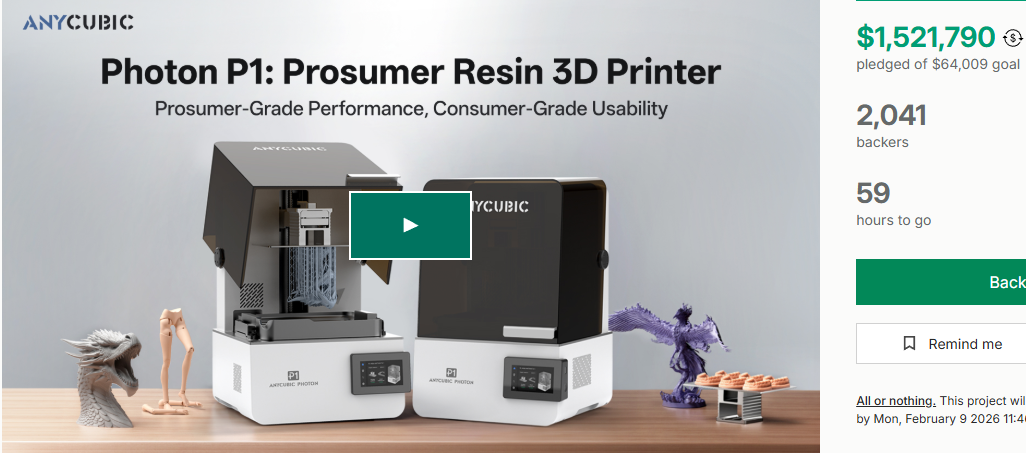
We're taking a closer look at a project that has captured significant attention from investors and product developers within a specialized niche. The Anycubic Photon P1 is positioned as a semi-industrial LCD resin 3D printer, designed to bring industrial-grade printing capabilities—such as precise figurines, functional elastomers, and dental prosthetics—to the consumer desktop. It achieves this through an intelligent dual-resin vat system, ultra-high viscosity resin compatibility, and precision temperature control, aiming to meet the multi-material production needs of professional users. As of early February 2026, the campaign has successfully raised over $1.5 million from more than 2,000 backers, with an average pledge of approximately $750. This places the Photon P1 in the mid-range segment for resin printers. Compared to entry-level models typically priced at $200-$300, users are clearly willing to pay more than double for its dual-material printing and industrial-grade precision. As a project from Anycubic, a well-established hardware manufacturer, the risk of non-delivery is exceptionally low. However, some reviewers have raised specific concerns regarding the potential for resin cross-contamination during dual-material printing.
Core Product Innovations
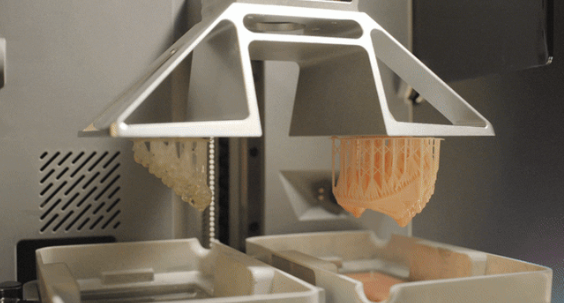
**Dual-Material/Color Printing and Ultra-High Viscosity Compatibility** The Anycubic P1's primary breakthrough lies in its optional dual-material printing kit. Utilizing physically separated resin vats and sophisticated software control algorithms, the device allows for the simultaneous use of two colors or two different materials within a single print job. For instance, users can directly print flexible elastomer parts onto a rigid resin base. While the actual mechanism involves printing different colors on the same layer or in distinct regions, this significantly streamlines the often-tedious process of disassembling, replacing vats, and re-securing parts.
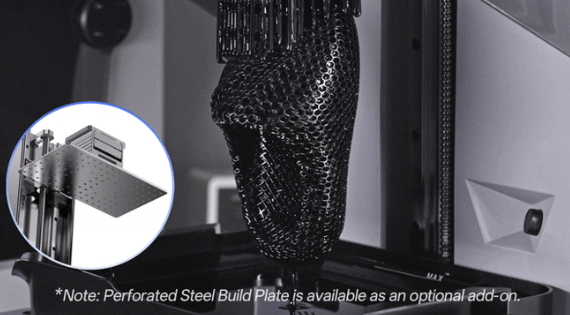
Crucially, the P1 elevates resin viscosity compatibility to an impressive 8000 cps (compared to typical consumer models which support only around 2000 cps). This means users can directly print high-strength engineering resins, red wax casting resins, and even elastomeric materials without the need for pre-heating or dilution. This innovation directly addresses key pain points for professional applications such as figurine studios, manufacturing jig and fixture production, and dental clinics.
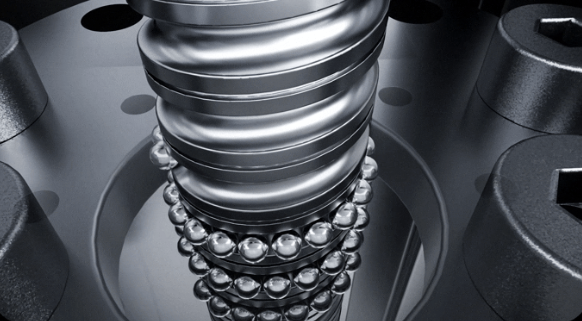
**Industrial-Grade Precision and Smart Temperature Control System** The device emphasizes precision, featuring a 14K resolution screen paired with a ball screw for ±0.01mm repeatable positioning accuracy. Unlike the T-screws found in common consumer machines, this industrial-grade combination aims to eliminate Z-wobble, ensuring consistent layer accuracy and resulting in prints with surface flatness comparable to a single layer, even for multi-layered objects.
An integrated smart temperature-controlled resin vat can heat the resin to 40°C. This solves the classic challenge of drastically reduced success rates for resin printing in colder environments, where increased resin viscosity and reduced flow often lead to print failures. The constant temperature design further ensures stable flow for high-viscosity resins, enhancing print success predictability.
**WaveRelease Technology** To improve the success rate of large-scale models and complex structures, the P1 introduces WaveRelease technology. By employing a specially textured release film and a micro-airflow control system, it claims to reduce peel force by 60%. This significantly lowers the risk of models detaching or breaking during the printing of large cross-sections or thick-walled objects, while also extending the lifespan of consumable release films and reducing operational costs.
Anycubic's Strategic Play
Anycubic (Shenzhen Anycubic Technology Co., Ltd.), headquartered in Shenzhen, China, is a leading player in the global consumer 3D printing market. As a hardware company that has moved beyond the startup phase to establish a mature market presence, Anycubic's Photon series boasts a large and stable user base and community ecosystem overseas.
The brand's decision to launch the Photon P1 on Kickstarter serves primarily as an early marketing strategy to gauge market acceptance for its high-end product line. It also leverages the crowdfunding platform's enthusiast-driven nature to gather extensive user feedback for optimizing firmware and user experience. Anycubic's parent company holds hundreds of patents and possesses robust supply chain integration capabilities. This mature vertical integration allows it to offer industrial-grade configurations—such as ball screws and precision temperature control modules—at a consumer-friendly price point in the thousands of dollars, creating a formidable cost advantage that is difficult to replicate.
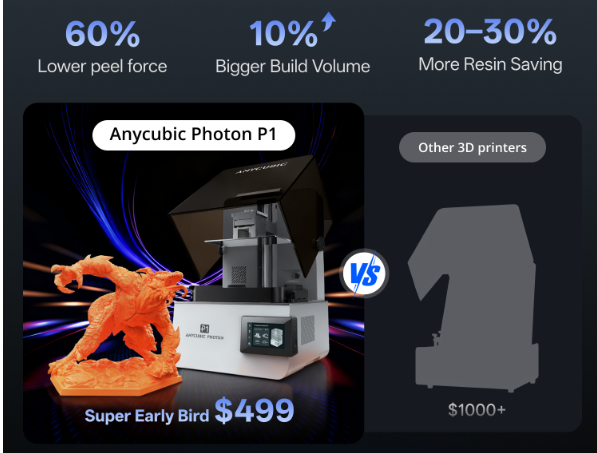
Market Analysis and Differentiation
The resin (SLA/LCD) 3D printer market is currently undergoing a clear segmentation, with established competitive landscapes in both the low-end and mid-to-high-end segments. The low-end market ($200-$400) has become a red ocean, dominated by price wars from series like Elegoo Mars and Anycubic's own Photon Mono, where product margins are razor-thin, sustained primarily by sales volume and consumable revenue.
The mid-to-high-end market is the P1's target battleground. Key competitors include Elegoo, which focuses on print speed and AI defect detection, and the Phrozen series, known for ultra-high resolution and detail retention.
Anycubic P1's competitive strategy demonstrates a clear tactical shift. Instead of continuing to compete on print speed—a dimension where diminishing returns are already evident—it has chosen material adaptability and dual-material printing as its core differentiators. This holds strong appeal for professional consumers who require not only the ability to print small figurines but also functional components such as precision seals, jigs, fixtures, and dental prosthetics.
This positioning precisely targets a significant market niche: the professional upgrade needs of consumer-level users. Compared to the high costs and complex operations of traditional industrial equipment, the P1 offers a cost-effective solution that is easy to integrate into small studios or factories. It represents a rational shift from simply pursuing parameter stacking to optimizing for specific application scenarios.
The Anycubic Photon P1 signals the official entry of consumer-grade resin printers into a new era of multi-material integration and industrial application downscaling. If its dual-material printing software experience proves sufficiently user-friendly and reliable, it has the potential to redefine resin printing production workflows, much like Bambu Lab disrupted the FDM market, pushing the entire category from enthusiast tools to professional production instruments.