LightMake L4: Ex-Anker 3D Print Lead's Quad-Nozzle FDM Printer Raises $2.6M in a Week
Campaign Teardown · · PledgeRadar Editorial
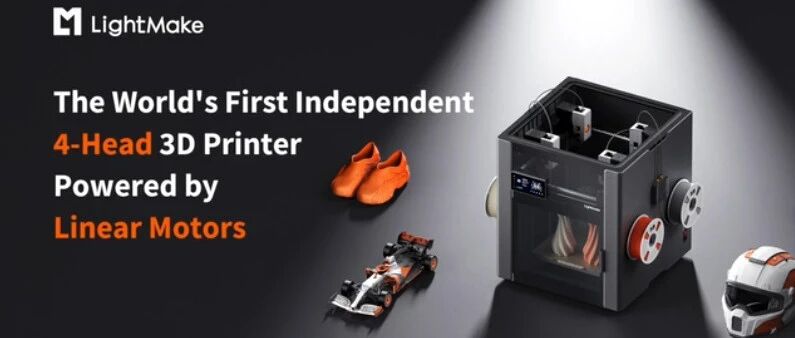
The LightMake L4 is a quad-independent-nozzle FDM 3D printer from Shenzhen-based LightMake. It addresses material waste in multi-color printing and efficiency in small-batch production through its eight XY linear motors, four always-on preheated nozzles, and a closed-loop position control system. The L4 is designed for 3D printing studios, small print farms, and professional creators with batch production needs.
Kickstarter Launch and Strategy
The L4 launched on Kickstarter on August 31, 2026, with a 45-day campaign running until October 15. In its first week, it raised approximately $2.6 million. This machine, priced at nearly $1,300, is conservatively estimated to reach around $5 million by the campaign's end. For a production-oriented printer priced over a thousand dollars, this initial funding pace is remarkably fast.
Its pricing structure offers valuable insights, potentially relevant for other hardware projects. On Kickstarter, the Super Early Bird price is $1,299, compared to an official MSRP of $2,399. VIP users who paid a $50 deposit before the campaign receive a refund of their deposit and the price difference after the campaign, bringing their final cost down to $1,099. Additionally, those who backed within the first 48 hours received an extra four rolls (4kg) of PLA. This strategy—using a deposit to secure the lowest price combined with a first-day bonus—effectively pre-engages high-intent users before the official launch, funneling them into the Kickstarter campaign to boost initial rankings.
A key community concern currently revolves around whether a new company, founded in 2025, can reliably mass-produce such a complex motion system at the $1,100 to $1,300 price point. Reddit users have already tested the accompanying LightMake Slicer, confirming it's based on the Orca system, though the beta version still has minor issues with automatic layout and parallel printing mode detection.
Key Product Features
**Four Always-On Independent Nozzles**
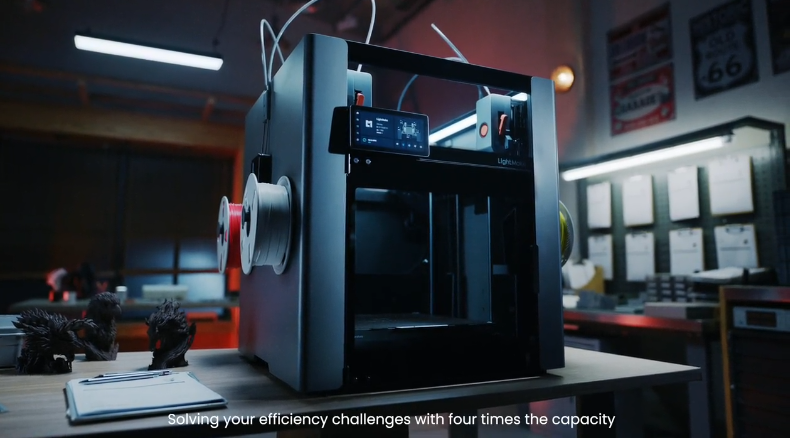
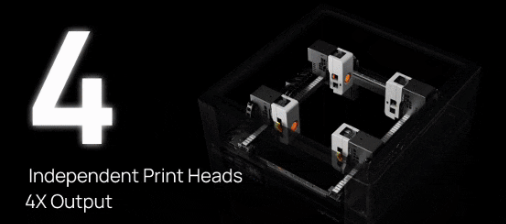
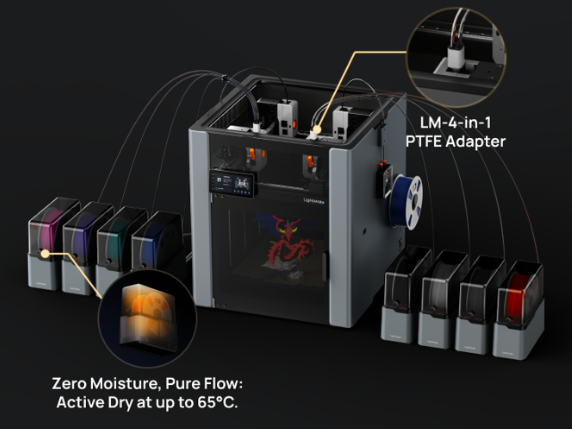
The L4 features four always-on independent nozzles, eliminating the need for tool changes. Each of the four complete print heads housed within the L4 can be pre-loaded with different colors or materials. During multi-color printing, one nozzle stops, and another preheated nozzle immediately takes over, with an official mechanical handover time of 1 second. This differs from the tool changer logic of devices like the Snapmaker U1 or Prusa XL, which require parking the current tool and retrieving a new one. The L4's four heads remain inside the machine, avoiding any removal and re-insertion process.
It's important to note that the 1-second figure refers only to the mechanical time for a single nozzle switch. The official claim of saving 79% of multi-color printing time is based on internal tests with specific four-color models. Actual results will vary significantly depending on nozzle wiping, prime tower usage, and slicing paths.
**Quad-Nozzle Parallel Production**
Where the L4 truly distinguishes itself from conventional multi-color printers is its ability for all four nozzles to operate simultaneously, not just sequentially. In batch mode, the print area is divided into four sections, with each nozzle responsible for its own zone. This allows for the simultaneous production of four identical or different parts, with the currently announced single-zone print space being approximately 178×195×360mm.
If the print times for four products are similar, one L4 machine can theoretically complete in a single task what a traditional single-nozzle device would require four rounds to achieve. This approach is ideal for print farms, small e-commerce sellers, and batch production of components. Its utility is limited for single, large models, where only one full print area remains available, and quad-nozzle parallel operation would be constrained by part size and path conflicts.
**Near-Zero Material Waste**
Traditional AMS-style multi-color printing systems require extruding old colors from a single nozzle before loading new ones, leading to significant material waste with frequent color changes. The L4 keeps four base colors in four separate, independent nozzles, eliminating the need to purge old material from the same hotend during a color change. Official data claims up to an 80% reduction in waste and approximately 8 times less waste during color changes.
However, this isn't truly zero waste. The machine still requires a small prime tower, and residual material from idle nozzles must be managed. LightMake has designed a mechanical NozzleBlocker for inactive nozzles to prevent molten material from dripping onto the active print. A more accurate description is 'near-zero' rather than 'completely no' material waste.
**Eight Linear Motors for XY Motion**
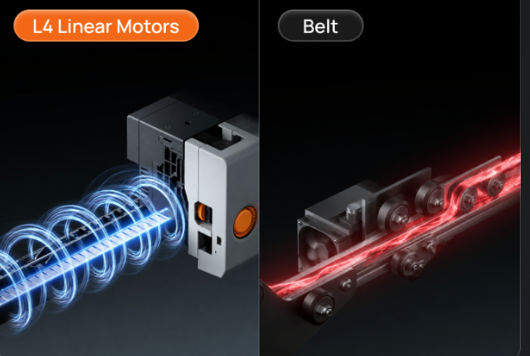
Another uncommon hardware design in the L4 is its XY motion system, which foregoes the common synchronous belt drive found in most desktop FDM printers. Instead, it employs eight linear motors to directly drive the print heads. Official specifications claim a maximum print speed of 500mm/s, a travel speed of 1000mm/s, and an acceleration of 20m/s².
Linear motors eliminate issues like belt stretching, slipping, and the need for periodic tension adjustments, making them theoretically better suited for long-term, high-frequency reciprocal operation. For a consumer-grade printer, the true significance of this technology isn't just a marginal increase in speed parameters, but rather a reduction in maintenance costs for print farms operating continuously over extended periods. The trade-off, however, is a significant increase in cost and control complexity. Four nozzles moving rapidly simultaneously mean the machine must handle greater inertia, heat, and collision risks, which explains LightMake's inclusion of a die-cast frame, load monitoring, and vibration compensation algorithms.
Engineering and Design Insights
**Closed-Loop Positioning Accuracy**
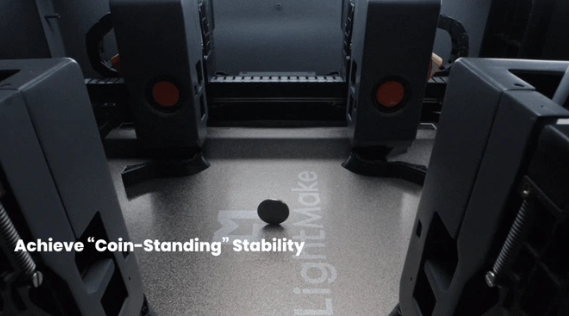
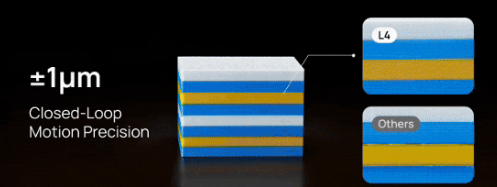
The ±1 micron closed-loop positioning is arguably the most easily misinterpreted parameter of this project. LightMake utilizes 12-bit magnetic encoders with a 4mm pole pitch, yielding a theoretical resolution of approximately 1 micron. The team states they achieved this repeatable positioning design goal after five iterations.
It's crucial to clarify that the advertised ±1 micron describes the closed-loop positioning capability of the linear motion system, not the dimensional accuracy of the final printed part. Actual FDM printing is influenced by numerous factors, including nozzle diameter, extrusion flow, material shrinkage, temperature, and slicing algorithms. LightMake's own stated XY print calibration accuracy for its quad-nozzle system is actually 30 microns. This figure is far more realistic than a 1-micron print accuracy claim and represents a more relevant parameter for potential buyers.
**Independent 5mm Z-Lift Nozzles**
A potential issue with four hot nozzles constantly remaining within the print area is that idle nozzles, if at the same height as the active one, could easily scrape already printed parts. The L4 addresses this by equipping each print head with an independent 5mm Z-axis lift mechanism. When an idle nozzle disengages, it automatically lifts, and the active nozzle descends to its working height. Before startup, the machine also automatically calibrates the Z-height and XY offset of all four nozzles. While this mechanism may seem less striking than the linear motors, it is critical for the long-term stable operation of a quad-nozzle system. The primary concern for multi-nozzle devices is often not slow speed, but rather height differences between nozzles leading to part scraping and tool misalignment.
**Generous Build Volume and Material Support**
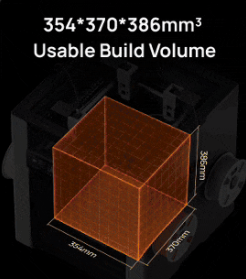
The L4 offers a maximum single-color print volume of 354×370×386mm, which only slightly reduces to approximately 354×350×386mm in four-color/multi-material mode. It features a 395×395mm PEI print platform, a maximum nozzle temperature of 320°C, and a heated bed up to 110°C. It is compatible with PLA, PETG, TPU, ABS, ASA, PVA, PET, and some carbon fiber-reinforced materials.
This contrasts sharply with the Snapmaker U1's 270mm cubic print space, positioning the L4 more towards large prototypes, cosplay components, and small-batch commercial production scenarios. It's important to note that the base model is not a fully enclosed, actively temperature-controlled machine. For printing temperature-sensitive engineering materials like ABS, ASA, or PA, an additional ThermoTop kit is required, which is scheduled for delivery in December.
Company Background
LightMake is a brand under LightMake (Shenzhen) Technology Co., Ltd., established in April 2025, with its headquarters and R&D team located in Shenzhen. Founder and CEO Wang Zhiyu previously served as the head of Anker Innovations' 3D printing business. Industry records indicate he also held positions at companies such as Huawei, Sany Heavy Industry, and Creality. The company team comprises nearly 40 individuals, with many core members originating from the former Anker 3D printing team.
Market Landscape and Competition
Data updated by Grand View Research in July 2026 indicates that the global desktop 3D printing market, valued at approximately $7.2 billion in 2026, is projected to reach around $20.9 billion by 2030, growing at a CAGR of approximately 23.8% from 2025 to 2030. Market growth is no longer solely driven by individual enthusiasts; rapid prototyping, small-batch functional parts, customized products, and SME production are becoming increasingly significant application areas.
The desktop FDM market in 2026 has clearly entered a multi-nozzle arms race. The Snapmaker U1 uses a four-interchangeable-tool-head system, with tool changes taking about 5 seconds, offering a 270mm cubic print space, and an official price of approximately $849 to $999. It has already achieved large-scale sales, with over 100,000 units shipped. The Prusa XL supports up to five complete tool heads, with a professional version priced at approximately $4,190 in the US, benefiting from years of accumulated mature software and a commercial production ecosystem. The Sovol M1D features an IDEX plus 1+6 tool head architecture, raising HK$25.42 million from 2,063 backers on Kickstarter, with an Early Bird price of approximately $1,299 for the Essential version and a current official pre-sale price of $1,499.
The LightMake L4 occupies a rather delicate position. At its standard crowdfunding price of $1,299, it directly competes with the Sovol M1D. However, at the VIP price of $1,099, it is only two to three hundred dollars more expensive than the Snapmaker U1, yet offers a larger print space, quad-nozzle parallel capability, and a linear motor motion system. Its true differentiation isn't merely the number of colors it can print. While Snapmaker and Prusa address how to quickly change tools for a single model, the L4 attempts to solve a different problem: whether a single desktop machine can simultaneously handle a portion of the capacity of four smaller printers. This is why LightMake has consistently targeted print farms, e-commerce sellers, and small to medium-sized businesses, rather than just general makers.
However, a system comprising four independent nozzles, eight linear motors, independent Z-lift mechanisms, automatic optical calibration, collision detection, and the new LightMake Slicer means that any single poorly tuned component could degrade the overall machine's performance. Among its competitors, the Snapmaker U1 has shipped over 100,000 units, Prusa boasts a mature tool-changing platform, and Sovol itself has years of experience in 3D printer mass production. LightMake's real challenge isn't proving that an engineering prototype can run four nozzles simultaneously, but rather demonstrating whether those four nozzles can maintain consistent height alignment and motion stability long-term, once 1,000 or 5,000 machines are in users' hands.
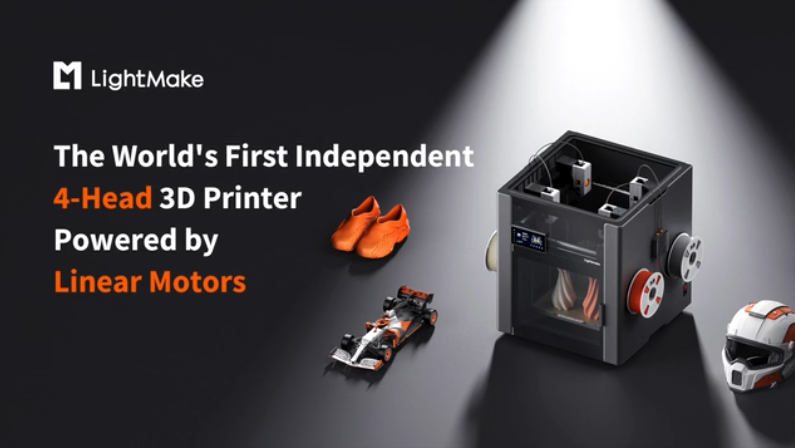
The L4 attempts to solve a different problem: whether a single desktop machine can simultaneously handle a portion of the capacity of four smaller printers.