M5Stack's Cardputer Zero: A Pocket-Sized Linux PC Raises $1.6M on Kickstarter
Campaign Teardown · · PledgeRadar Editorial

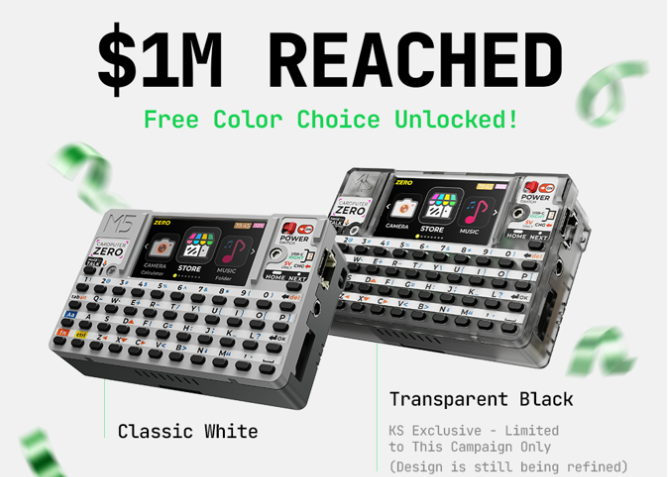
M5Stack has transformed the Raspberry Pi CM0 into a pocketable development terminal. This handheld Linux computer, centered around the CM0, integrates a quad-core Cortex-A53 processor, a 1.9-inch display, a 46-key keyboard, an 8MP camera, Wi-Fi/Bluetooth/wired Ethernet, HDMI output, GPIO expansion interfaces, and a 1500mAh battery into an 85×54×23.1mm credit card-sized body. It targets makers, embedded developers, hardware enthusiasts, and engineers requiring a portable Linux terminal.
Rapid Crowdfunding Success
Launched on Kickstarter on May 26, 2026, the Cardputer Zero secured $1 million within its first day and reached $1.6 million in half a month. The product's launch generated an exceptionally strong response, positioning this project as a rare large-scale crowdfunding success in the maker tools category.
Kickstarter project updates indicate the community is currently voting on rewards for a $2 million stretch goal, suggesting the project remains in a high-growth phase. Tech media outlets such as CNXSoftware, Hackster.io, and It'sFOSS published detailed reviews during the crowdfunding period, fueling sustained discussion among professional technical communities and Linux enthusiasts alike.

Core Technology: Raspberry Pi CM0
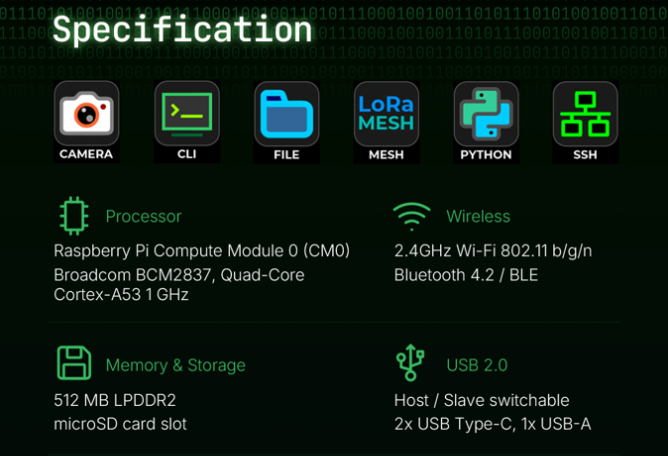
The Cardputer Zero's most significant technological leap is the replacement of the previous Cardputer series' ESP32-S3 microcontroller with the CM0. The CM0 features the same Broadcom BCM2710A1 quad-core Cortex-A53 processor (up to 1GHz) as the Raspberry Pi Zero 2W, along with 512MB LPDDR2 memory and a VideoCore IV graphics processor, supporting H.264 1080p30 hardware codec.
This architectural shift means the device can run a full Raspberry Pi OS and the entire Linux software ecosystem, rather than ESP32's real-time firmware. Users can execute Python scripts, connect to remote servers via SSH, run Docker containers, or lightweight AI inference frameworks—tasks impossible on a microcontroller platform. Furthermore, by leveraging the CM0, the Cardputer Zero directly inherits the Raspberry Pi community's years of accumulated software stack, requiring no porting efforts.
Integrated Design and Connectivity
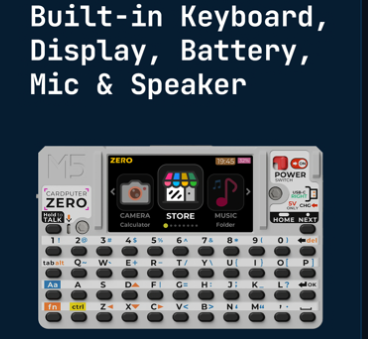
Measuring 85×54×23.1mm, the device is highly portable. Its body integrates a 1.9-inch 320×170 pixel color LCD, a 46-key matrix keyboard, an optional Sony IMX219 8MP camera, a built-in microphone, a 1W speaker, and a 3.5mm audio output jack.
Traditionally, achieving similar functionality would require combining multiple independent modules, with displays, keyboards, and camera modules connected separately. The Cardputer Zero encapsulates all these hardware components within a single credit card-sized body, showcasing M5Stack's multi-generational hardware integration capabilities within the Cardputer series. While its 23.1mm thickness is noticeable when pocketed, it represents a significant volume reduction compared to equivalent multi-component solutions.
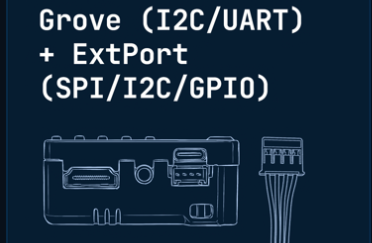
The device offers HDMI 1080p/30fps output, a 10/100M Ethernet port, two USB 2.0 Type-C interfaces, one USB Type-A interface, and a 14-pin expansion header exposing I2C, SPI, UART, USB, GPIO, and 5V power. It also includes a Grove interface, supporting direct connection to over 100 sensors and expansion modules within the M5Stack ecosystem.
Standardized Linux I/O interfaces mean users can integrate the Cardputer Zero into existing development workflows, connecting external displays, camera modules, LoRa wireless modules, or any Raspberry Pi ecosystem peripheral without needing additional adaptation layers.
The device is equipped with Wi-Fi 4 (802.11n), Bluetooth 4.2 LE, and 10/100M wired Ethernet, allowing flexible switching between these three network interfaces for various deployment scenarios.
For engineers needing to access wired internal networks for server debugging, Ethernet provides a more stable, low-latency connection. Wi-Fi ensures wireless flexibility in environments where cabling is impractical, while Bluetooth supports peripheral connections and near-field data exchange. The wired Ethernet interface, absent in previous Cardputer models, is a crucial addition to the Cardputer Zero for professional network debugging scenarios.
The device features a built-in 1500mAh LiPo battery and can also be powered directly via a USB-C port, supporting flexible deployment with power-off resume. Battery life is estimated to be limited in full-power Linux scenarios (the CM0's Cortex-A53 consumes significantly more power than the ESP32). Actual battery runtime is one of the most anticipated real-world parameters for the community and review media post-delivery. The standard version includes a 32GB microSD card with pre-installed software, while the Lite version does not include a microSD, requiring users to provide their own.
Company Background and Reliability
M5Stack was founded by Jimmy Lai in Shenzhen in 2016 and received seed funding from US hardware accelerator HAX in 2017. Since then, it has grown into a globally recognized provider of modular IoT development platforms, with products distributed through global channels like Digi-Key, reaching over 170 countries.
In 2018, M5Stack established a strategic partnership with Espressif, which completed a majority equity acquisition in May 2024. M5Stack is now integrated into the Espressif ecosystem (Shanghai Stock Exchange: 688018, market capitalization approximately $4.25 billion). Espressif's backing significantly strengthens M5Stack's supply chain, mass production capabilities, and global technical ecosystem reach, adding crucial confidence to the Cardputer Zero's production reliability. M5Stack has a history of successful crowdfunding campaigns and deliveries on Kickstarter, establishing itself as a reliable hardware brand on the platform with no record of delivery failures.
Market Landscape and Outlook
The market for single-board computers (SBCs) and embedded Linux development boards is a moderately sized but highly loyal niche. The global SBC market was valued at approximately $1.07 billion in 2024, projected to grow at a 14.6% CAGR to about $3.82 billion by 2033, driven by the proliferation of AIoT applications, expanding edge computing demands, and STEM education. The Raspberry Pi Foundation is the most significant player in the SBC ecosystem, with its Raspberry Pi 5 and Zero 2 W series products directly defining market standards for consumer-grade Linux SBCs. The Pi Zero 2 W sells for about $15, and the CM0 for about $10, but neither includes an independent display, keyboard, or battery, requiring users to assemble accessories themselves.
In the more specific sub-segment of handheld Linux computers, the closest competitors include Clockwork's uConsole (priced around $219–$259, based on Raspberry Pi CM4 or RK3399, with an upgradable modular design but larger body), the DevTerm (from the same manufacturer, similar positioning, but larger volume), and earlier Psion series traditional PDA devices.
M5Stack's own previous Cardputer and Cardputer-Adv series (based on ESP32-S3) have a substantial user base within the maker community, and the Cardputer Zero represents a significant platform upgrade for these existing users. The Cardputer Zero's differentiation lies in its three-dimensional combination of a full Linux system via CM0, credit card-sized all-in-one integration, and M5Stack's ecosystem of over 100 modules. At this functional intersection, no existing mature product offers a complete solution. Key market risks include the actual battery life of the 1500mAh battery in full-power Linux scenarios, and the CM0's 512MB RAM constraint when running heavier Linux workloads. These two points will be the most concentrated discussion topics after community real-world testing and reviews.
The handheld Linux development terminal is a niche that makers and embedded engineers have long sought but consistently lacked a mature, integrated solution. The Cardputer Zero, leveraging M5Stack's modular ecosystem accumulation and Espressif's mass production endorsement, is pushing this segment from DIY assembly to an out-of-the-box experience.
The Cardputer Zero is pushing the handheld Linux development terminal segment from DIY assembly to an out-of-the-box experience.