MoonBox: Manual Rotary Litter Box Defies Trend, Raises Over $700K on Kickstarter
Campaign Teardown · · PledgeRadar Editorial
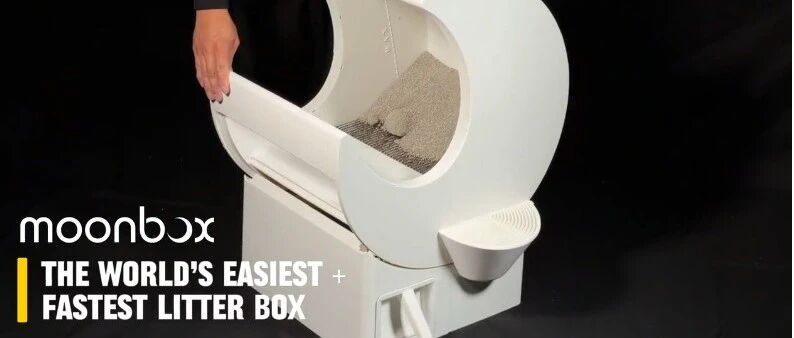
MoonBox, a patent-pending manual rotary litter box from San Diego pet supplies startup MoonBox, offers a simple, non-electric solution to daily litter box cleaning. Users rotate an internal chamber, allowing a built-in grate to separate clumps from clean litter, which are then deposited into a pull-out waste drawer. This entire process takes approximately 5 to 10 seconds, requires no electricity, and contains no electronic components, aiming to replace the daily manual scooping of traditional litter boxes. The company was founded by Isaac and Ana Rams, a cat-owning couple.
A Successful Launch and Pre-Campaign Buzz
MoonBox launched on Kickstarter on August 11, 2026, with a funding goal of $250,000. It reached its target in less than 10 hours and raised over $300,000 within the first 24 hours. By the project's close, it had secured a total of $700,000, marking a significant achievement.
This success was largely built upon extensive social media groundwork laid before the launch. Since its public debut on July 5, 2026, the brand accumulated over 73 million organic views across TikTok, Instagram, and Facebook. According to company data, nearly 25,000 pre-launch registrations were secured, including over 21,000 general waitlist sign-ups and more than 3,500 VIP reservations with paid deposits. This strategy—leveraging short-form video content for organic virality, then using paid pre-orders to identify high-intent users, and finally concentrating the buzz at the campaign launch—was central to the explosive growth of this crowdfunding round.
Key Product Features
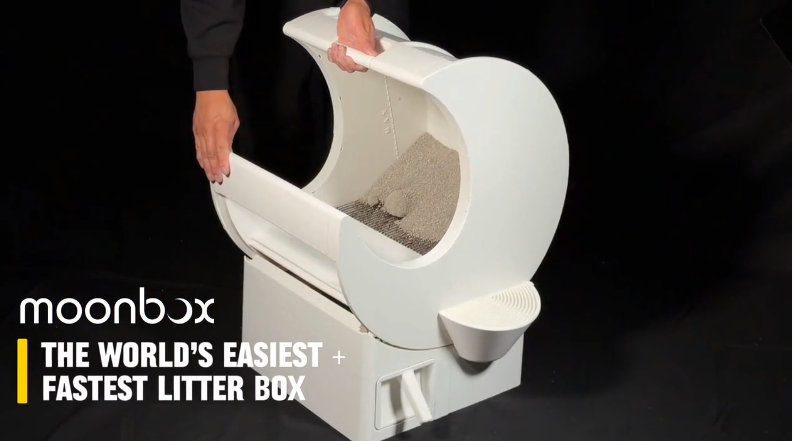
The core mechanism of MoonBox is a patent-pending rotating chamber design. When users manually rotate the chamber, an internal grate automatically separates clean, unclumped litter from waste clumps. The waste is directed into a pull-out drawer below, while clean litter remains in place for continued use. This entire process takes approximately 5 to 10 seconds.
The value proposition of this design is straightforward: traditional litter boxes require daily manual scooping, which is time-consuming and can be messy. MoonBox simplifies this action into a single rotation. However, questions remain regarding the long-term durability of the mechanical separation structure, such as whether the grate will become clogged with fine litter or how the rotating components will withstand the weight of litter over months or years. These are issues that can only be verified with extended real-world use. Current market feedback is primarily based on early user experiences, and long-term reliability still lacks sufficient time for accumulation.
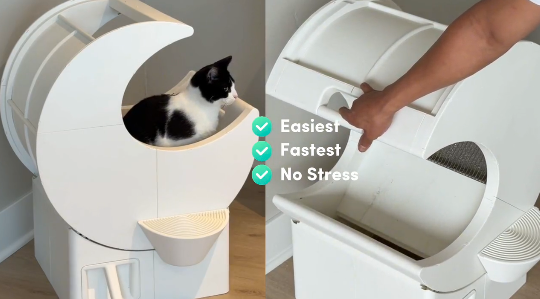
MoonBox operates entirely on mechanical principles, requiring no power plug-in and containing no electronic components. It is positioned as a simple, washable litter solution free of motors or electronic devices. This positioning directly addresses a recurring pain point for automatic litter box users: many electric self-cleaning litter boxes on the market suffer from electronic malfunctions such as sensor misreads, motor jams, or software freezes, often requiring customer service contact or even full unit repairs.
By employing a purely mechanical design, MoonBox fundamentally avoids these sources of failure. For cats, it also eliminates potential noise and safety concerns associated with operating electric devices. The trade-off for this selling point is clear: the lack of automation means users still need to actively operate the device, unlike electric products that can offer true unattended operation.
All components of the MoonBox are directly washable, meaning users don't need to carefully avoid circuit boards and sensors during cleaning, as is often the case with electric self-cleaning litter boxes. Instead, the entire unit can be thoroughly rinsed and disinfected. For cat-owning households, the hygiene and odor control of the litter box itself are central to the long-term user experience. The ability to fully wash the unit without concern is a practical advantage of a purely mechanical structure over electronic products, and it also reduces the risk of component damage due to improper cleaning.
Global Market Analysis and Competitive Landscape
The automatic and semi-automatic litter box market is a moderately sized but steadily growing niche. Various institutions estimate the 2024 market size to range from approximately $560 million to $1.94 billion, with a general consensus that it will reach $870 million to $1.26 billion between 2030 and 2033. Key growth drivers include the deepening trend of pet humanization and the rising proportion of dual-income households. According to industry data, about 66% of U.S. households owned pets in 2024, and busy pet owners are increasingly willing to pay for time-saving and labor-saving solutions.
Looking specifically at the U.S. market, its size was approximately $125 million in 2024, projected to grow to $182 million by 2030. Industry leader Whisker's Litter-Robot series has accumulated over 1.5 million global users and more than 65,000 five-star reviews, making it the most consumer-validated product in this segment.
In terms of the competitive landscape, the automatic litter box market is currently dominated by electric self-cleaning solutions. Products like Whisker's Litter-Robot, PetSafe ScoopFree, CatGenie, and SmartyPear's Leo's Loo Too typically integrate sensors, motors, and app connectivity, with prices generally ranging from $400 to $700. These products emphasize a fully automatic, hands-free user experience but have long been associated with user feedback regarding mechanical failures, noise disturbing cats, and high repair costs. There is also a segment of pull-lever semi-automatic litter boxes, similar to those sold at Walmart, which are lower-priced and share a similar principle with MoonBox: they are non-electric and rely on mechanical structures for litter separation. However, these products often feature simpler designs, and user reviews frequently cite quality issues such as loose gears and screws.
MoonBox's differentiated positioning places it squarely between electric solutions and cheaper pull-lever products. It aims to avoid electronic component failures while distinguishing itself from low-cost competitors through a more refined, patent-pending mechanical design and a washable, all-metal option. A primary market risk lies in the fact that a manual solution ultimately requires active user operation, which creates some tension with the overall industry trend towards less human intervention in automatic litter boxes. MoonBox's long-term user retention will depend on its ability to convince convenience-seeking consumers that a manual but reliable option is superior to an automatic one that may be prone to failure. Additionally, the 'patent-pending' status means the core mechanical design has not yet received formal intellectual property protection, which is a potential risk point the team needs to address.
While the automatic litter box industry has continuously added motors, sensors, and app connectivity in recent years, MoonBox takes a counter-trend approach. It uses a purely mechanical rotation to achieve a 5-second cleaning process with no electronic failure points. The 73 million organic views demonstrate that this anti-trend narrative resonated with many. However, the ultimate test will be whether this mechanical structure, including its grate and rotating components, remains reliable and effective after months or even years of continuous use in users' homes.
MoonBox takes a counter-trend approach, using a purely mechanical rotation to achieve a 5-second cleaning process with no electronic failure points.