Sharge Launches Pocket SSD Hub, Raises $270K in First Week on Kickstarter
Campaign Teardown · · PledgeRadar Editorial
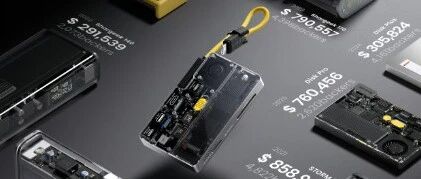
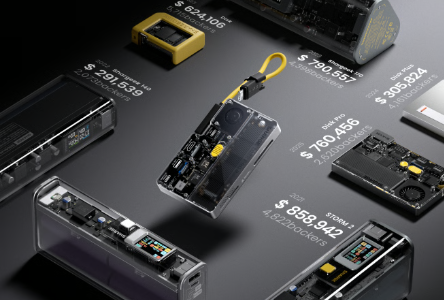
The Sharge Disk Pro 2 is a pocket-sized SSD hub, measuring approximately 90×61×11mm. It integrates an M.2 NVMe enclosure, USB-C dock, SD card reader, HDMI video output, PD power delivery, and active cooling. Users can install their own 2230, 2242, or 2280 NVMe SSDs, supporting up to 8TB of storage. This device is designed for users who shoot video on phones, back up camera footage, expand handheld gaming consoles, work remotely, or frequently transfer large files between multiple devices.
Overview and Campaign Performance
It is not a portable SSD with built-in storage; users need to install an SSD separately after purchase. Nor is it a USB4 or Thunderbolt dock; its data interface is capped at 10Gbps, with actual speeds generally staying within 1GB/s. The product's true innovation lies in consolidating an SSD enclosure, card reader, HDMI adapter, and power hub—items typically carried separately—into a single pocket-sized device.
The Disk Pro 2 launched on Kickstarter on July 7, 2026, with the campaign running until August 16. Within its first week, it raised approximately $270,000 from 2,833 backers, averaging about $38,800 in new funding per day. At this pace, the final funding amount could approach $600,000. Early bird tiers started as low as $49, while current crowdfunding prices are $55 for the Lite version and $75 for the Ultra version. Shipping is estimated to begin in October 2026.
NASCompares completed performance tests on an engineering prototype, noting that the Disk Pro 2 addresses the main issues of its predecessor, specifically fixed cables and storage capacity. During testing, NVMe sequential read/write speeds were approximately 960–970MB/s. In a simulated video workflow, speeds were around 860MB/s read and 850MB/s write. After about one hour of sustained high load, the SSD temperature remained stable at 42–44℃.
Key Product Features
**User-Replaceable M.2 SSD & Up to 8TB**
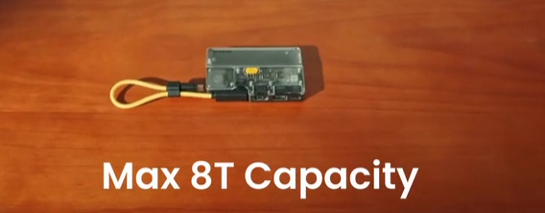
The previous Disk Pro featured a pre-installed SSD, limiting users to official 1TB, 2TB, or 4TB versions without the freedom to choose flash memory, write endurance, or capacity. The Disk Pro 2 eliminates the built-in SSD, supporting 2230, 2242, and 2280 M.2 NVMe specifications, with a maximum capacity of 8TB.
This means users can install existing SSDs or select high-endurance TLC or more affordable, high-capacity models based on their budget. If more capacity is needed later, users can simply remove one screw to swap the SSD, rather than replacing the entire device. For photographers and video creators, this modular design is more suitable for long-term workflows than fixed capacity.
The Disk Pro 2 utilizes a USB 3.2 Gen 2 link, meaning even high-performance PCIe 4.0 or PCIe 5.0 SSDs will be limited to approximately 1GB/s. When purchasing expensive SSDs for this device, users should prioritize capacity and endurance over internal sequential read parameters.
**Six Integrated Ports for Mobile Workflows**
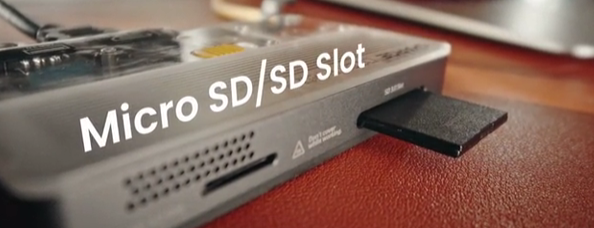
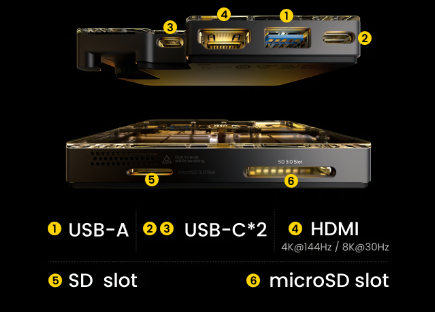
The Disk Pro 2 offers two USB-C ports, one USB-A port, one HDMI port, one full-size SD card slot, and one microSD card slot. The USB-C ports support data transfer up to 10Gbps, while USB-A supports up to 5Gbps. The SD card reader is officially rated at 180MB/s read and 120MB/s write, with independent tests showing approximately 170MB/s read and 100MB/s write.
For mobile video shooters, it can record or save video to an SSD while simultaneously connecting to power and an external display. Camera users can directly read SD cards and transfer footage to the internal SSD. For handheld gaming console users (like Steam Deck or ROG Ally), it can provide storage, video output, and peripheral expansion.
However, all storage devices share the same 10Gbps upstream bandwidth. When the SSD, card reader, and USB peripherals operate at high speeds simultaneously, individual ports may not achieve their stated maximum speeds. It is suitable for integrating mobile workflows but not as a replacement for multi-channel professional desktop docking stations.
**Ice-Storm Active Cooling**
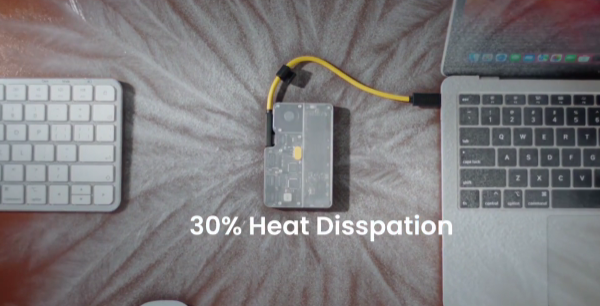
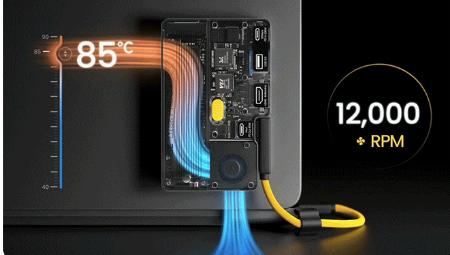
The Disk Pro 2 features a built-in active cooling fan with a maximum speed of 12,000 RPM, offering Off, Auto, and Turbo modes. Auto mode adjusts fan speed based on SSD temperature, actively dissipating heat generated by the controller and flash memory during high loads.
NVMe SSDs can experience speed throttling due to high temperatures during continuous ProRes video recording, batch transfers of camera footage, or copying hundreds of gigabytes of files.
The purpose of active cooling is not to make short file transfers faster, but to allow the device to maintain performance closer to its 10Gbps interface limit during sustained writes. In NASCompares' tests, the device's temperature remained at 42–44℃ after approximately one hour of continuous operation, indicating that this cooling structure is not merely cosmetic.
The trade-off is that the chassis requires vents, meaning it lacks the dust and water resistance of traditional sealed portable SSDs. A high-speed fan also means the device cannot be completely silent. The previous Disk Pro was noted by PetaPixel for its noticeable fan noise in Turbo mode; whether the Disk Pro 2's actual noise has improved will require further verification with production units.
**100W Input, 80W Passthrough Charging**
The Disk Pro 2 supports up to 100W power input and can deliver up to 80W charging power to connected laptops, tablets, or handheld consoles. Users can simultaneously charge their main device while reading from the SSD, connecting a display, and using USB peripherals, eliminating the need to choose between expansion ports and charging.
The 80W is a theoretical maximum output; actual power will be reduced by the consumption of the Disk Pro 2 itself, the SSD, fan, and external devices, and is subject to limitations from the charger, cable, and host protocol. The device packaging does not include a 100W charger, so the full cost of ownership must account for an external power supply and SSD.
**Magnetic Backplate & Detachable Lanyard Cable**
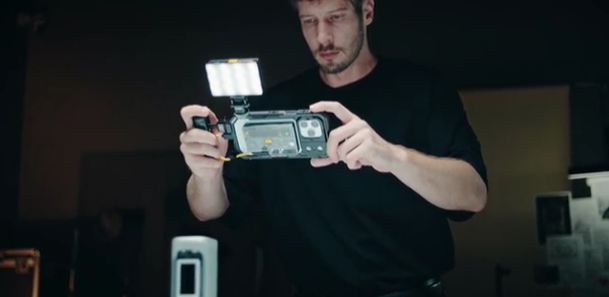
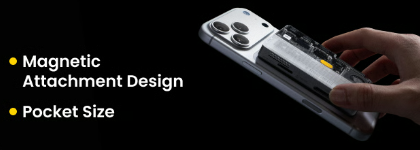
The Disk Pro 2's rear panel can magnetically attach to MagSafe-compatible phones and also includes a magnetic ring adapter for other devices. The previously fixed short cable has been replaced with a detachable lanyard-style USB-C cable, which supports 10Gbps data, charging, and video signals.
This change is particularly important for mobile phone external recording. The SSD and hub no longer dangle below the port, reducing the risk of stressing the USB-C interface during mobile shooting. The cable can also be replaced independently if damaged. However, after installing an SSD and connecting multiple cables, the overall weight will still increase noticeably, making it unsuitable for completely ignoring during prolonged handheld shooting.
**Four Independent Control Chips for Stability**
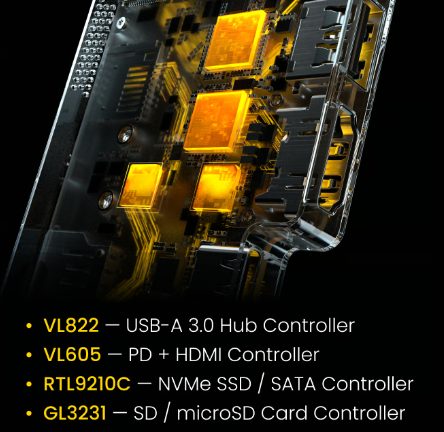
The project team uses four independent chips to manage the SSD, USB expansion, video output, and power delivery separately. Compared to a single hub controller handling all tasks, this architecture can reduce mutual interference when multiple functions operate simultaneously.
However, independent control chips do not break the 10Gbps total bandwidth limit, nor do they guarantee compatibility with all devices. Different operating systems, SSD models, display protocols, and PD charging combinations may still lead to handshake failures, sleep/wake issues, or drive disconnections. This is an area that will require extensive user validation after mass production.
Project Background and Market Analysis
Sharge was founded in 2020, initially gaining market share with transparent-designed power banks and fast-charging products, then expanding into magnetic charging, SSD enclosures, and mobile creator accessories. The brand has previously launched multiple overseas crowdfunding projects, and the team is not new to manufacturing storage products. The previous Disk Pro also underwent independent testing by Tom’s Hardware and PetaPixel, where its sustained write performance and active cooling were praised.
We assess that the mass production challenges for this project may lie more in compatibility. The Disk Pro 2 simultaneously involves M.2 SSDs, card readers, HDMI, PD power delivery, an active fan, and a magnetic structure. A firmware issue in any single controller could affect the overall user experience.
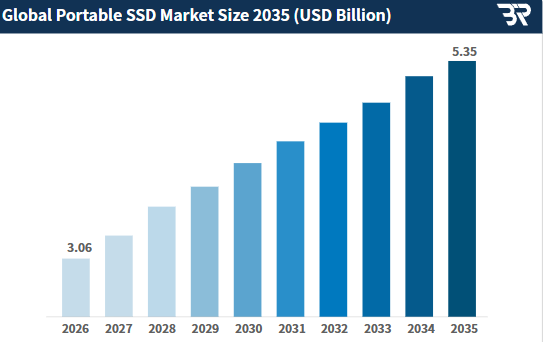
The global portable SSD market was valued at approximately $3.06 billion in 2026 and is projected to grow to $5.35 billion by 2035, with a compound annual growth rate (CAGR) of about 6.4%. The global docking station market is expected to grow from approximately $4.1 billion in 2026 to $7.8 billion by 2033, with a CAGR of about 9.4%. Remote work, professional mobile video, handheld gaming devices, and the reduction of ports on thin and light laptops are all driving demand for portable storage and USB-C expansion.
The Disk Pro 2's competitors are not a single, identical device, but rather a combination of three product categories: standard NVMe enclosures, USB-C hubs, and portable SSDs. Purchasing these products separately often offers lower prices, more ports, or USB4-level speeds, but requires carrying more devices and cables. The Disk Pro 2 sacrifices some speed and desktop expansion capabilities in exchange for compactness and integration.
Its core differentiator is its $55–$75 price point, offering user-replaceable SSDs, active cooling, SD/microSD slots, HDMI, magnetic mounting, and 80W power delivery. This combination has clear appeal for mobile creators and EDC (Everyday Carry) users. However, the 10Gbps interface is already behind USB4 and Thunderbolt products, and 8TB capacity doesn't fully match 1GB/s speeds. It lacks an Ethernet port, preventing it from replacing a full office dock. The active fan increases noise and the risk of dust ingress. Furthermore, the actual total cost, including an SSD and charger, will be significantly higher than the $55 displayed on the crowdfunding page.
The Disk Pro 2 is not the fastest SSD enclosure, nor is it the docking station with the most ports. Its value lies in consolidating mobile storage, media import, video output, and power delivery into a complete workflow within a card-sized device. Whether the project can maintain its reputation after large-scale delivery will depend on stable connectivity across different SSD, phone, and monitor combinations, and whether the 12,000 RPM fan can control temperatures while keeping noise and durability issues within an acceptable range for users.
The product's true innovation lies in consolidating an SSD enclosure, card reader, HDMI adapter, and power hub—items typically carried separately—into a single pocket-sized device.