TerraMow X AWD AI Robot Mower Raises Over $1M on Kickstarter in 24 Hours
Campaign Teardown · · PledgeRadar Editorial
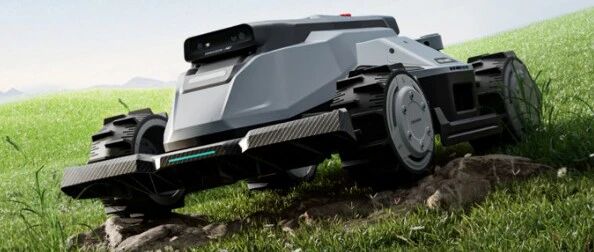
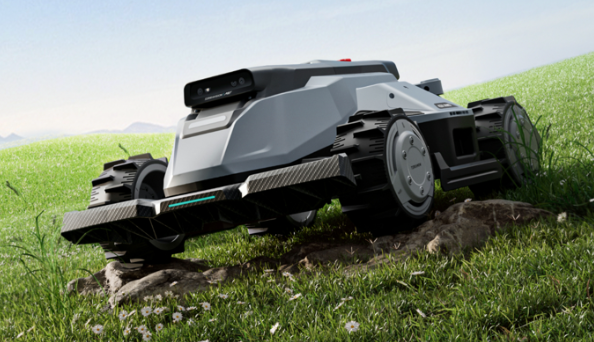
TerraMow X AWD is the latest generation of robotic lawnmower from TerraMow, designed for large lawns, steep slopes, and complex terrains. This advanced machine integrates bidirectional mowing, independent all-wheel drive (AWD), a six-camera front-and-rear vision system, nRTK positioning, and a 20-inch floating cutting deck. It aims to address common issues with high-end robotic mowers, such as turf damage from repeated turning, slipping on slopes, unstable positioning under trees, and extended operation times on large properties. Marketed as the world's first "turn-free" AWD AI robot mower, the "turn-free" designation doesn't mean the machine never steers, but rather that it can switch its direction of travel directly after completing a mowing path, eliminating the traditional 180-degree pivot. This design is particularly suited for homes with 0.5 to 2.7-acre lawns, significant topographical variations, or where existing two-wheel-drive robot mowers frequently get stuck. The TerraMow X AWD launched on Kickstarter on June 18, 2026, securing over $1 million within its first 24 hours. The official super early bird price was announced at $2,699. Backers who paid a $30 deposit during the pre-launch phase received a $200 discount, bringing the effective starting price to $2,499, compared to a suggested retail price of $3,599. As the project is still live, real-time funding figures are subject to rapid change, and this article does not cite instantaneous numbers.
TerraMow X AWD: A New Approach to Robotic Mowing
Core Technological Innovations
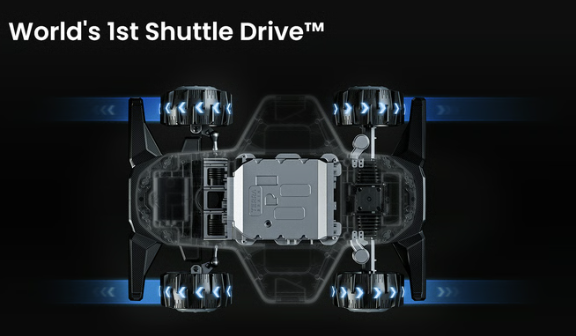
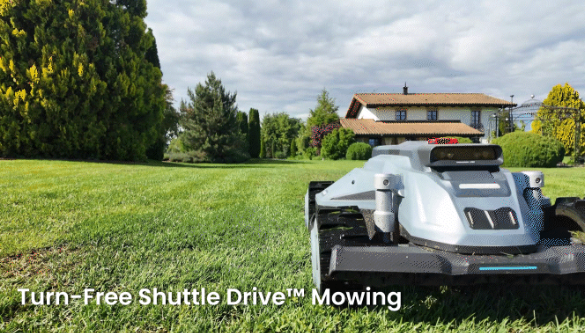
The TerraMow X AWD introduces **Shuttle Drive bidirectional mowing**, designed to reduce repeated friction on the turf caused by on-the-spot turns. Most robotic mowers use a unidirectional cutting deck and a fixed front-to-back structure, requiring them to rotate in place or make small turns after completing each strip. On soft, wet, or sloped lawns, repeated turning in the same spot can leave tire marks and even damage the grass over time.
By equipping both the front and rear with vision systems, the TerraMow X AWD can reverse directly into the next path without needing to turn the chassis. Theoretically, this not only minimizes turf friction but also saves significant time spent on turning maneuvers, increasing effective operational time on large lawns.
However, the "Turn-Free" concept primarily describes the operational logic at the end of regular paths. The machine will still need to turn when navigating around obstacles, entering different zones, or dealing with irregular boundaries. Its efficiency benefits will be more pronounced on long, regular lawns, while the improvement might be relatively limited in smaller yards with complex borders or dense trees.
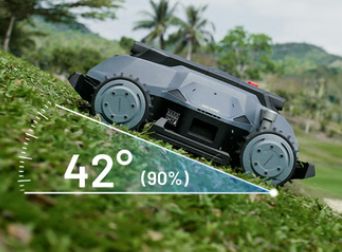
The TerraMow X AWD features **independent all-wheel drive (AWD)**, dynamic torque distribution, and a dual-suspension structure. The manufacturer claims a maximum slope capability of 90%, approximately 42 degrees, which is significantly higher than typical two-wheel-drive robot mowers. This capability is primarily aimed at environments prone to tire slippage, such as slopes, ruts, tree roots, potholes, and sparse grass.
A 42-degree slope is exceptionally steep, and this parameter is usually measured under specific conditions of grass height, soil moisture, and travel direction. Real-world factors like wet grass, loose soil, traversing slopes laterally, or sudden changes in slope gradient can all affect actual traversal capability. Therefore, this parameter is best understood as the chassis's upper limit, rather than an everyday working slope that can be consistently achieved on all lawns.
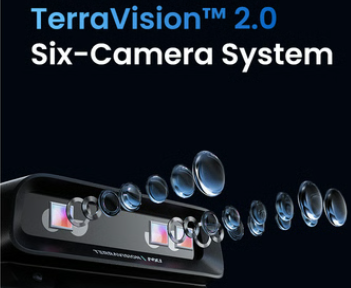
The mower integrates a **six-camera AI vision system with nRTK positioning**, featuring a TerraVision 2.0 system at both the front and rear. The vision system is responsible for constructing 3D environmental information and uses AI semantic recognition to distinguish between trees, fences, furniture, and other obstacles. In open areas, nRTK provides centimeter-level auxiliary positioning.
This combined system does not solely rely on satellite signals. When near buildings, fences, or under tree canopies, the vision system takes on more of the positioning tasks. Once in open lawn areas, nRTK helps maintain straight-line accuracy. Users can also establish virtual lawn boundaries with one-click automatic mapping, eliminating the need for traditional boundary wires.
It's important to note that "wireless installation" refers to not needing to bury perimeter wires, not complete independence from network and positioning services. The coverage of nRTK in different countries and regions, potential future service fees, and the impact of low light, rain, and lens smudges on the vision system will require long-term validation after mass production.
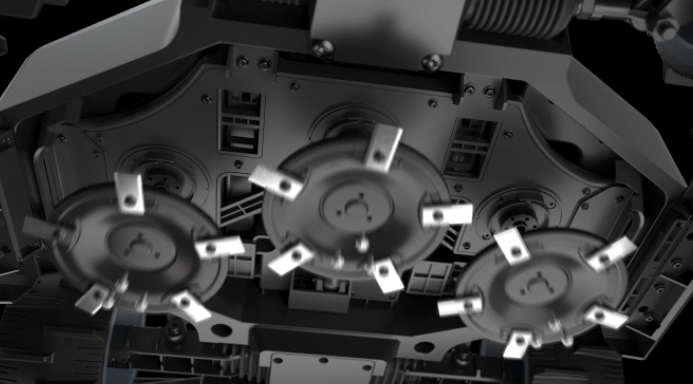
The TerraMow X AWD is equipped with a **900W three-motor cutting system** and a 20-inch (approximately 50 cm wide) floating cutting deck. Compared to many household robot mowers that use 20 to 40 cm decks, it can cover a wider strip of grass in a single pass, making it more suitable for large lawns and high-efficiency scenarios.
The floating cutting deck adjusts its position with ground undulations, reducing the likelihood of scalping raised areas. The product also offers two blade options: oscillating small blades for routine maintenance and straight blades for thicker, denser, or longer grass.
The 900W figure represents the rated capacity of the motor system, not that the machine will continuously operate at 900W. The impact resistance of straight blades against hard foreign objects like branches or stones, and the stability of the floating deck on severely undulating terrain, are aspects that warrant closer attention in future real-world tests.
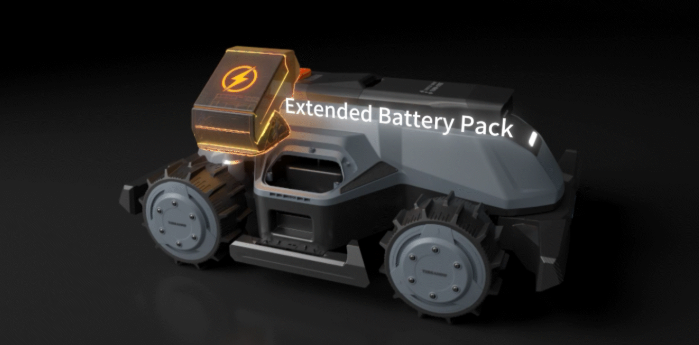
The standard battery provides up to approximately 3 hours of runtime per charge, which can be extended to about 6 hours with an optional expansion battery. The 300W charger is claimed to complete charging in 90 minutes. This configuration targets lawns larger than 1 acre, aiming to reduce time lost due to frequent returns to the charging station.
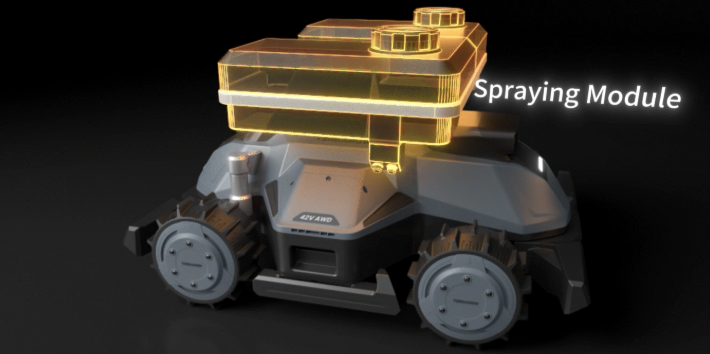
The product also features a **ModuleX expansion interface**, with plans to support additional batteries, independent trimming, and seeding functions. TerraMow states it will open mechanical design files and communication protocols on GitHub, allowing third-party or DIY users to develop modules.
However, based on currently available information, apart from battery expansion, modules for trimming and seeding are primarily planned ecosystem capabilities and should not be considered standard features of the initial production units. Whether open protocols can foster a genuine developer ecosystem will also depend on interface stability, documentation completeness, and product sales volume.
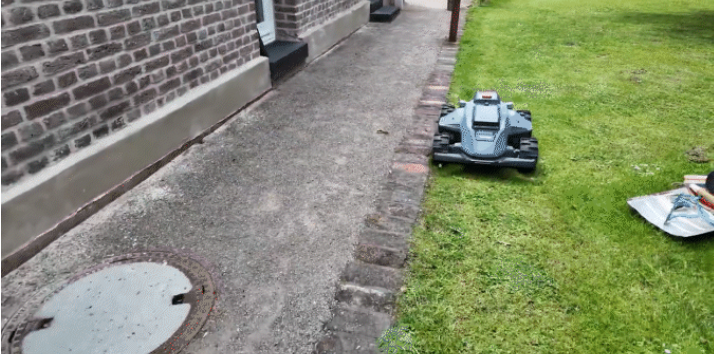
Users can divide their lawn boundaries into different segments and adjust the machine's distance from the edge within a range of plus or minus 15 centimeters for each segment. This design is suitable for yards with a mix of walls, flowerbeds, steps, and traversable paved surfaces, as different boundaries can utilize different safety distances.
This feature addresses the precise setting of edge paths; it is not a retractable side blade or a mechanical trimming arm. For vertical walls, fence bottoms, and narrow corners that the cutting deck cannot reach, users may still need to perform subsequent trimming with a dedicated tool.
TerraMow is a brand under Shenzhen Muxin Intelligent Technology Co., Ltd. This is not TerraMow's first crowdfunding robot mower; the company launched its first-generation wireless AI vision robot mower via Kickstarter in 2024.
Real-world tests of the V1000 acknowledged its automatic mapping, three-camera visual navigation, and small obstacle recognition capabilities. Tests of the V600 also found its installation process and app experience to be relatively mature. Therefore, TerraMow already possesses a foundation in visual algorithms, software, and delivery, distinguishing it from first-time startup projects with only concept images and engineering prototypes.
Nevertheless, the X AWD represents a significantly upgraded new platform. The four-wheel steering chassis, 900W cutting system, front-and-rear bidirectional vision, and modular interface have not undergone long-term validation of the same scale on previous products. Past product delivery success can mitigate risk but does not fully guarantee that the new model will achieve mass production at the same pace.
Market Context and Competitive Landscape
Grand View Research estimates the global robotic lawnmower market to be approximately $9.33 billion in 2025, projected to grow to $21.97 billion by 2033, with a compound annual growth rate (CAGR) of approximately 11.4% from 2026 to 2033. North America is expected to contribute about 38.2% of market revenue in 2025, making it currently the largest regional market.
Market competition has evolved beyond the need for boundary wires, shifting towards a comprehensive contest of vision systems, LiDAR, Network RTK, all-wheel drive, and complex terrain capabilities.
Competitors like the Mammotion LUBA 3 AWD utilize LiDAR, vision, and NetRTK triple positioning, featuring an approximately 15.7-inch dual cutting deck and claiming an 80% slope capability. The Segway Navimow X4 also boasts all-wheel drive, zero-turn front wheels, a 430mm cutting deck, and a maximum slope capability of approximately 84%. The Husqvarna 535 AWD EPOS, aimed at commercial lawns, supports a 70% slope and approximately 1 acre of working area.
The truly distinct differentiators for the TerraMow X AWD are not just its AWD, but its ability to perform bidirectional mowing without turning the chassis, its wide 20-inch cutting deck, and its open interface for third-party modules. Regarding the claim of being "globally first," this primarily originates from the brand itself, as there is no unified industry body that certifies such product features.
Currently, the crowdfunding price of $2,699 places it within the competitive range of established high-end brands. Consumers purchasing at this level are not just buying hardware specifications but also expecting ongoing software updates, spare parts availability, and local after-sales support.
The TerraMow X AWD is not simply a four-wheel-drive version of existing robot mowers; it redefines mowing paths, chassis, and expansion methods. Its Shuttle Drive indeed offers a technical route different from traditional on-the-spot turns. Whether it can become a true efficiency advantage will ultimately depend on the mass-produced machine's actual coverage area per hour on large lawns, its stability on slopes, and its ability to maintain accurate front-and-rear bidirectional navigation after several months of continuous use.
The TerraMow X AWD is not simply a four-wheel-drive version of existing robot mowers; it redefines mowing paths, chassis, and expansion methods.