Violoop: External AI Agent for Any PC Raises $1.4M in 5 Days
Campaign Teardown · · PledgeRadar Editorial
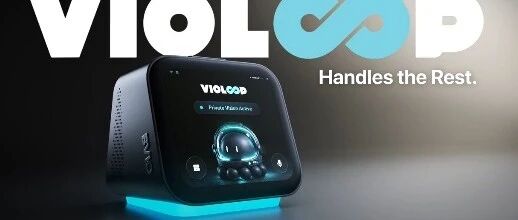
Violoop, a desktop AI hardware from BVIO, aims to transform how users interact with their computers. By reading screen content via HDMI, understanding it with local models, and executing tasks across software using USB keyboard/mouse and system interfaces, Violoop effectively adds an operable AI agent to Windows, macOS, and Linux PCs.
Campaign Launch and Performance
Violoop launched on September 15, 2026, quickly securing $1.4 million in under a week. The project saw rapid early success, surpassing $400,000 in its first hour and $1 million in approximately 20 hours, demonstrating a significantly faster pace than typical AI hardware crowdfunding campaigns.
The early bird price was set at $399, with a planned retail price of $699. A deposit model was also implemented, where users paying a $10 deposit would receive a refund plus an additional $30 rebate, bringing the effective price down to $369. Public reports before launch indicated that the brand had accumulated around 12,000 deposit-based pre-order users, providing a crucial foundation for its strong opening day performance.
Violoop was showcased at IFA 2026, garnering attention from media outlets such as Slash Gear, which awarded it "Best of IFA." The company states that the first batch of products has already been manufactured and is awaiting certification, with deliveries to initial markets including the US, Canada, Singapore, and Hong Kong slated to begin in November 2026.
Core Product Features
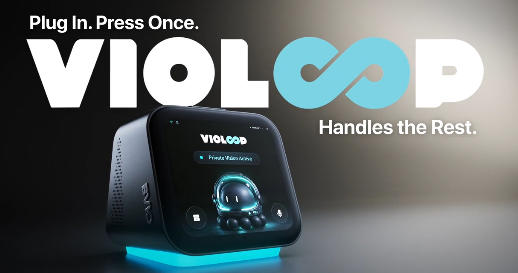
Violoop leverages HDMI 2.0 to read screen content at up to 4K@30Hz and uses USB-HID to simulate standard keyboard and mouse inputs. This design theoretically allows it to operate any software a human can, bypassing the need for specific APIs or plugins, even for legacy ERP systems, internal backends, or web tools. However, the official FAQ notes that a desktop CompanionApp is required for more efficient operations involving files, scripts, and Accessibility interfaces, and some functionalities may be limited if company PCs restrict new USB devices or Accessibility permissions.
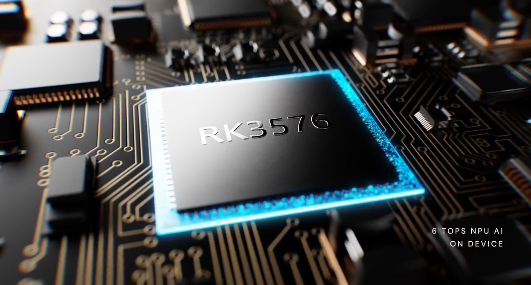
The device features an RK3576 octa-core processor and a dedicated AI accelerator, boasting a total compute power of 26 TOPS. This enables it to run models like Qwen8BQ4 directly on the device. Raw screen video and continuous visual understanding can remain local, with local mode and Local BYOK (Bring Your Own Key) even allowing for fully offline operation.
While "local-first," Violoop is not "local-only." When users opt to utilize cloud models such as Claude, OpenAI, or Gemini, relevant task context may still be sent to external models. Currently, Internet BYOK requests might even be routed through Violoop's servers. The system's primary privacy protection ensures the raw screen stream is not continuously uploaded, rather than guaranteeing all business data never leaves the local device.
Addressing a critical trust issue for AI agents, Violoop separates its AI processor from execution authorization. An STM32H563 secure MCU manages keyboard and mouse execution permissions, requiring users to press a physical button or provide encrypted confirmation via a paired phone for critical actions like sending, deleting, making payments, or overwriting files. The company has promised to release full security firmware and a ThreatModel before delivery, though independent security audits and real-world Prompt Injection attack testing are currently lacking.
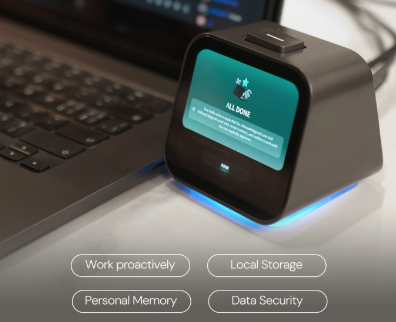
Violoop is designed for complex, multi-step tasks across applications, allowing it to read information from an email, then process it in a spreadsheet, CRM, or other software without manual copy-pasting. Its "AwayMode" enables the computer to continue running tasks while the user is absent, sending confirmation requests to a paired phone for critical authorizations. This capability significantly differentiates it from standard chatbots. However, the company advises treating the computer as a shared device or using a second PC during long tasks, as the AI might open windows, change focus, or even take over the mouse.
Violoop supports on-device models and Ollama local models, with plans to integrate LMStudio and OpenAI-compatible endpoints into its official firmware. Users can also provide their own API keys for cloud services like Claude, OpenAI, and Gemini. The hardware itself does not mandate a fixed subscription, and fully local operation can eliminate ongoing model fees. However, VioloopCloud will be an optional paid service, and its final pricing has not yet been announced, meaning the $399 price may not represent the complete long-term cost for all advanced features.

Company Background and Funding
Violoop is developed by Shenzhen Benwei Wujie Technology. CEO He Jialin is a UC-San Diego computer science graduate, a serial entrepreneur, and a Y Combinator alumnus. Co-founder and CTO Zhu Xianzheng holds an MIT EECS background and previously contributed to hardware R&D for Microsoft's Xbox, HoloLens, and Surface.
In September 2026, the company announced it had completed "hundreds of millions of RMB" in Angel and Pre-A financing rounds, with investors including Lenovo Capital, BlueRun Ventures, Genesis Capital, and Qifu Capital. This followed earlier Seed and Angel funding rounds totaling "tens of millions of RMB" in March of the same year. Lenovo is also collaborating with Violoop on supply chain, manufacturing, and AI PC development, indicating a stronger financial and team background than many typical Kickstarter startups.
Market Landscape and Future Outlook
Grand View Research projects the global Edge AI market to grow from $30 billion in 2026 to $118.7 billion by 2033, at a CAGR of approximately 21.7%. Hardware is expected to account for 51.8% of this market in 2025, with consumer electronics being the largest end-market. This growth is primarily driven by the demand for low latency, enhanced privacy, and the increasing shift of AI inference from cloud to device-side processing.
Violoop faces competition not only from other hardware solutions but also from a growing number of software-based agents capable of directly operating computers. For instance, Perplexity's latest local Computer Agent can run on Windows but requires an RTX GPU with at least 24GB VRAM. Another competitive path involves users simply purchasing new-generation AI PCs.
Violoop's differentiation lies precisely between these two alternatives: it allows users to enhance their existing computers without needing to replace them or invest in a high-end GPU. Instead, for $399, it provides an external, independent system for visual processing, inference, and execution.
A significant challenge for Violoop stems from the rapid pace of iteration in the AI industry. If Windows, macOS, and mainstream AI assistants integrate "Computer Use" capabilities directly into their operating systems, the necessity for independent hardware could diminish. Conversely, if users become increasingly hesitant to grant full screen permissions to purely software-based agents, then Violoop's combination of independent hardware, local vision, and physical authorization could become its strongest competitive advantage.
Violoop's true challenge isn't just understanding a computer screen, but maintaining high accuracy across dozens of real-world tasks, while ensuring users are always aware of its actions and when human confirmation is required.