VisaUltra 250W: Dual 140W USB-C Travel Adapter Raises $150K in Two Weeks
Campaign Teardown · · PledgeRadar Editorial
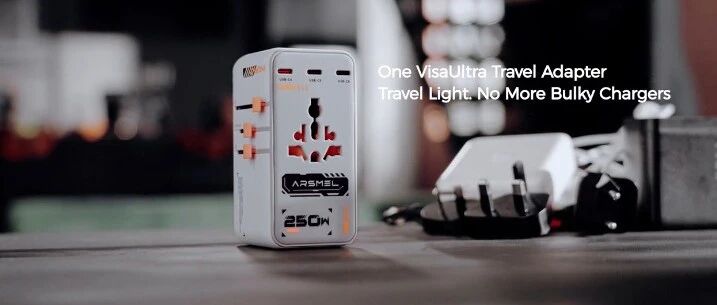
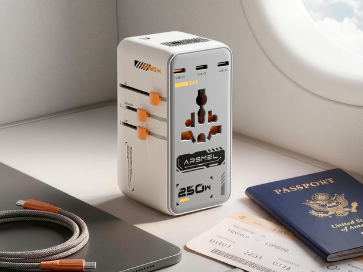
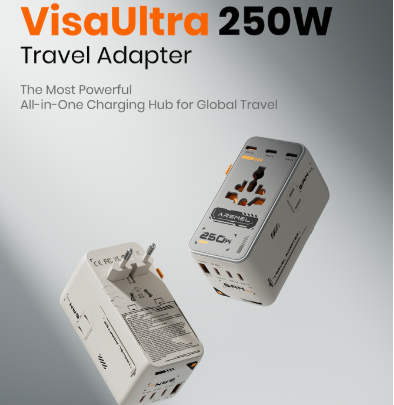
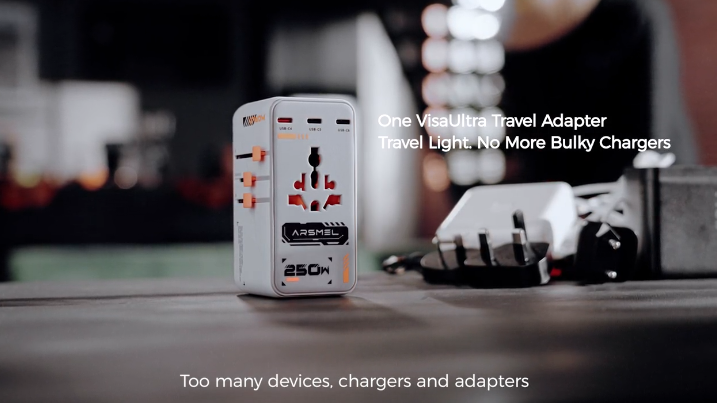
The VisaUltra 250W is a high-power global travel adapter designed for business travelers, digital nomads, and users with multiple devices. It integrates a 250W total USB output, 140W PD3.1 single-port fast charging, and global plug conversion into a single device, leveraging a dual-core GaN architecture.
Campaign Overview and Strategy
VisaUltra 250W launched on Kickstarter on August 18, 2026, with the campaign ending October 2, for a total of 45 days. The project's initial URL and pre-launch materials referred to a 235W version, which was upgraded to 250W upon official launch. This isn't ARSMEL's first crowdfunding venture; their 2024 VisaPro project secured HK$2.3893 million from 2,760 backers, followed by the 2025 VisaGo 100W, which raised HK$1.3787 million from 1,614 backers. The VisaGo is now available for direct purchase on their official website, and Reddit posts from spring 2026 confirm users receiving the 100W version, indicating the team has successfully managed production and cross-border delivery.
ARSMEL's marketing approach is well-established. They highlight easily digestible numerical parameters like "250W," "dual 140W," "9 devices," and "200+ countries" in their main visuals, while setting early bird pricing at approximately $100. Simultaneously, they directly promote new products to existing backers from previous Kickstarter campaigns. This strategy of re-engaging past supporters combined with a high-discount launch is demonstrably more effective for their third crowdfunding project compared to acquiring users from scratch.
Key Product Features
**250W Dual-Core GaN: Travel Adapter Becomes a Multi-Port Charging Station**
The VisaUltra utilizes what the brand describes as a dual-core sixth-generation GaN architecture, delivering a maximum total USB output of 250W. The value of GaN technology isn't merely about increasing power numbers, but rather enhancing power density and conversion efficiency within a smaller footprint. This allows the travel adapter to transcend its traditional role of merely changing plug shapes, effectively replacing multiple laptop and phone chargers.
The real challenge lies in heat dissipation. 250W enters the power range typically seen in desktop multi-port chargers; for instance, independent reviews of the similar TESSAN Voyager 205 noted significant heat generation under full load.
Whether the VisaUltra can consistently maintain near 250W output without frequent power throttling will require real-world testing of production units.
**Dual 140W PD3.1: Targeting Two High-Power Laptops Simultaneously**
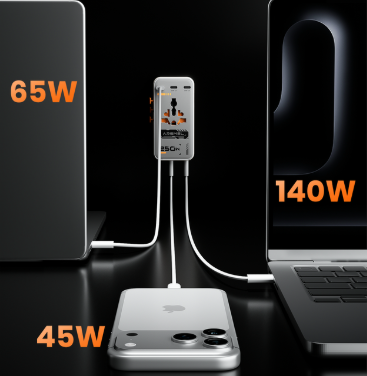
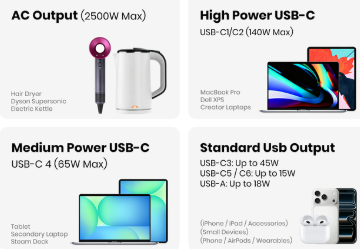
The product features six USB-C ports, with two primary USB-C interfaces supporting up to 140W PD3.1. This clearly positions it not as a phone travel charger, but for users of high-power USB-C laptops like the MacBook Pro. It also supports mainstream protocols such as QC4+, PPS, FCP, AFC, and BC1.2.
When using multiple devices, the two 140W ports should not be interpreted as simultaneously delivering 280W, as the total USB power for the entire unit is capped at 250W, leading to dynamic power allocation when multiple interfaces are connected. For professional users, the actual experience is more influenced by the power distribution logic when multiple ports are active simultaneously, rather than just the single-port peak output.
**6C+1A+Dual AC: Connect Up to 9 Devices with One Unit**
The VisaUltra offers six USB-C ports, one USB-A port, and two AC outlets, allowing for simultaneous connection of up to nine devices. Compared to typical travel adapters, which often feature one AC outlet and three to five USB ports, this design clearly targets individuals traveling with laptops, tablets, phones, cameras, headphones, smartwatches, and power banks.
The practical value of this design isn't necessarily that nine devices will always charge simultaneously, but rather that it reduces the need for users to carry power strips and additional GaN chargers. However, more ports also introduce greater complexity in power allocation, thermal management, and the weight stress on the plug itself—challenges that high-power integrated products must effectively address.
**Dual AC Up to 2500W: High-Power Appliances Supported, But No Voltage Conversion**
The two AC outlets support a maximum current of 10A. This translates to a total load limit of approximately 1000W in a 100V environment and a theoretical maximum of 2500W in a 250V environment, allowing it to connect some high-power devices like hair dryers and kettles.
This is also the area most prone to misunderstanding. The VisaUltra is merely a travel adapter, not a voltage converter. For example, an appliance rated only for 110V input cannot be used in a 230V country simply because the plug fits and the product states 2500W. The brand's FAQ explicitly requires connected devices to support 100-250V themselves.
**200+ Country Plug Coverage: Integrated Global Compatibility**
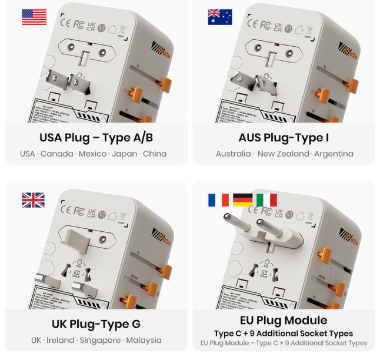
The VisaUltra integrates mainstream plug structures for regions like the US, EU, UK, and AU, with the brand claiming coverage for over 200 countries and regions and compatibility with 14 common plug standards. For individuals who frequently travel across Europe, North America, and Asia, one device can replace multiple individual adapters.
This integrated structure is already a mature market solution. The true differentiator isn't merely supporting 200 countries, but rather the ability to reliably house a 250W charging module while maintaining the integrity of the global plug mechanism.
**Dual 10A Fuses + Flame-Retardant Casing: Ample Safety Features, Awaiting Production Certifications**
The project's public documentation lists dual 10A fuses, child safety shutters, and a flame-retardant PC casing. In case of overload, the fuses can cut off the AC side current.
The public Kickstarter page and FAQ do not yet contain complete third-party laboratory test results or specific UL, ETL, or other certification numbers for the VisaUltra production version. For a product that involves both AC mains input and 250W high-power DC output, safety design on the spec sheet is one thing; final production certification and sustained full-load testing are another.
The ARSMEL brand first launched the VisaPro 160W travel adapter in 2024, with the subsequent retail version upgraded to 170W, currently priced at $79.90 on their official website. In 2025, they completed the VisaGo 100W crowdfunding, now retailing for $64.90 on their site. Their first two Kickstarter projects garnered 2,760 and 1,614 backers respectively, and existing products are continuously sold on their official website, with real user delivery records found in public communities. This suggests ARSMEL is not a temporary project team that disappears after a concept crowdfunding campaign.



Global Market Analysis
Travel adapters are a mature product category, but USB-C and GaN technology are significantly increasing the average transaction value for these products. Data from Global Industry Analysts estimates the global travel adapter market size at approximately $1.3 billion in 2024, projected to reach $1.5 billion by 2030, with a CAGR of about 2.5% from 2024-2030. It's worth noting that market definitions vary considerably among research institutions, depending on whether voltage converters, USB chargers, and similar products are included.
However, this market is already highly competitive. The Anker Nano, priced at $25.99, offers only 20W total USB power and is positioned for lightweight travel. Zendure's offering, around $59.99, supports 65W GaN. TESSAN's standard GaN travel adapters range from $40-60, while their Voyager 205, which is closer to the VisaUltra with a total output of 205W, sells for $119.
The VisaUltra's early bird price of approximately $100 positions it at the higher end of the market. However, its 250W total output, dual 140W USB-C ports, and nine device interfaces are significantly more aggressive than most mainstream products currently under 100W.
Its true competitors are not the $20-30 ordinary travel plugs, but rather combination solutions like the TESSAN Voyager 205 plus a separate GaN charger. This is precisely where challenges arise: higher power often means increased weight, higher temperature rise, and a more pronounced leverage effect on wall outlets.
Independent tests of the Voyager 205 have already highlighted issues such as its considerable weight, some plugs sagging, and significant heating under high load. After increasing the total power to 250W, the ultimate success of the VisaUltra will depend on whether it can strike a balance between size, temperature rise, plug stability, and actual multi-port output, which will truly differentiate it from established major brands.

For a product that involves both AC mains input and 250W high-power DC output, safety design on the spec sheet is one thing; final production certification and sustained full-load testing are another.