World's First Generative AI Guitar, Melo-D, Struggles to Hit $200K on Kickstarter
Campaign Teardown · · PledgeRadar Editorial

Melo-D, developed by music tech company TemPolor, is positioned as the world's first generative AI guitar. It features a built-in 2.4-inch touchscreen and an illuminated fretboard to guide finger placement. Powered by TemPolor's proprietary TemPolorAI music model, users can hum a melody, input text descriptions, or upload a favorite song, and the AI will transform it into an immediately playable guitar solo or a complete original song. The device targets beginners with no prior instrument experience who wish to express musical creativity instantly, as well as content creators and music enthusiasts looking to quickly convert ideas into demonstrable works.
Campaign Overview and Initial Performance
Melo-D has officially launched on Kickstarter, with a crowdfunding period from May to July 2026. Shipments are prioritized for U.S. backers, with deliveries expected to begin in September. The project is projected to raise approximately $200,000. Review outlets like GearDiary have explicitly cautioned that crowdfunding differs from retail purchases; even impressive product demonstrations and claims of savings should be viewed as campaign messaging rather than guarantees of future retail prices.
Prior to its launch, Melo-D secured several international design accolades, including the iF Design Award 2026, MUSE Design Award Gold, London Design Award Gold, New York Design Award Silver, and the Red Dot Award 2026 Best of the Best (Product Design category). Such early design endorsements are relatively uncommon for hardware crowdfunding projects and generated some media attention. However, the campaign's inability to achieve stronger results is attributed to several factors: the product's perceived pain points may not sufficiently resonate with users, and a lack of effective advertising prevented early trust-building from converting into significant funding. Consequently, the project is highly likely to cap out around $200,000.

TemPolorAI Music Model: Instant Playable Music from Various Inputs
Users can generate music through three primary methods. In AI Jam mode, users select timbre, style, and mood directly on the guitar's touchscreen, allowing the AI to generate a complete original piece for immediate play, all without needing a phone connection. Under Hum-to-Solo mode, users hum a melody into the companion app, and the AI converts it into a full fingerstyle solo, synchronized to the guitar. Alternatively, uploading any audio file enables Melo-D to transcribe it into fingerstyle tablature or chord charts within minutes.
These three input pathways address typical user scenarios, from those with no initial ideas relying on instant AI generation, to those with existing melodies needing conversion into playable forms, to users who want to immediately play a favorite song. However, core unverified questions for this technology are common across all consumer-grade generative audio tools: whether generation and transcription occur locally or rely on cloud inference, the accuracy and latency of hum-to-tab conversion, and how the system handles input content that overlaps with copyrighted music. Public materials currently do not disclose detailed architecture or model scale information.
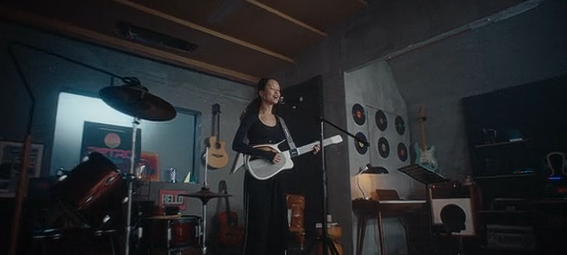
Illuminated Fretboard + Touchscreen: Play Like a Rhythm Game
The guitar features an illuminated fretboard and an integrated touchscreen, precisely indicating where and when fingers should press. A 7-key beginner mode allows anyone to produce authentic sounds on their first day, with most users able to follow the rhythm halfway through their first song.
The core idea behind this design is to leverage the interactive logic of rhythm games to replace traditional sheet music learning. Users don't need to understand music theory or practice fingerings; instead, they follow light prompts to play, much like a game. This positioning implies that Melo-D isn't intended to replace high-end guitars like Martin, Fender, or Taylor, but rather functions more as a smart music creation device resembling a travel guitar. The true test lies in whether the musicality of the generated content withstands repeated listening, an aspect still awaiting verification in reviews.

Authentic Playable Strings: Patented RainbowStrings for Traditional Feel
Despite its high level of intelligence, Melo-D retains an authentic strumming and plucking experience. TemPolor's independently developed RainbowStrings, made from a patented composite material, replicate the genuine feel of traditional strumming and picking. This was a conscious product decision by the team: to preserve the physical DNA of a traditional instrument rather than replacing the entire instrument with touch controls.
This design choice directly addresses a long-standing debate in the smart instrument market, where many smart guitars sacrifice authentic physical feedback for ease of use. Melo-D attempts to strike a balance between the two, though the actual string tension and tonal quality still require long-term hands-on testing for an objective evaluation.

Fully Standalone Operation: Built-in Sound System, No Phone Needed
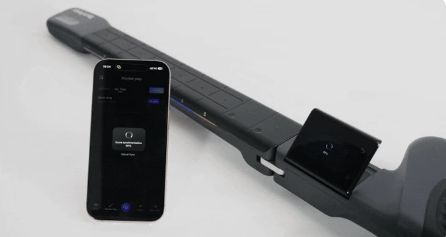
Thanks to its patented folding design and built-in 2.4-inch LCD touchscreen, Melo-D can operate as a completely standalone device, with its core experience requiring no connection to a smartphone or external app. The guitar integrates a professional-grade sound system with DSP processing, capable of outputting clear, full-bodied sound directly from the device.
Connectivity options include Wi-Fi 4 for cloud AI updates, Bluetooth audio for external speakers, USB-C OTG for real-time audio transmission, and a 3.5mm jack supporting microphone input and silent practice with headphones. The design for independent operation means users can access all core functions directly in various settings—from a coffee shop to a campsite or stage—without relying on an internet connection or additional smart devices. The official stated battery life ranges from 5 to 10 hours, depending on speaker usage.
Patented Folding Body: Portable for Practice and Creation
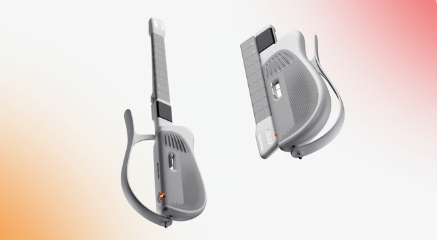
Melo-D is a foldable smart digital guitar, resembling a travel guitar, designed for individuals with musical ideas who may lack the finger strength, music theory knowledge, or patience to master traditional instruments.
The folding design directly supports the product's core positioning for on-the-go creation. Portability is a key factor for users who want to bring their guitar on commutes, during lunch breaks, or to outdoor settings. The long-term durability of the folding mechanism is a critical detail to monitor once these products are delivered at scale.
Team Background and Market Outlook
TemPolor is a brand under Guangzhou Huancheng Culture Media Co., Ltd. Before Melo-D, the team had already developed a TemPolorAI-driven, copyright-free music generation platform and Tunee, a conversational AI music product with over 100,000 creators globally.
The team leader, Jia Shuo, previously successfully developed the Changya APP during the mobile internet era—a social music application that enabled individuals without instrument experience to sing and play independently. Launched in February 2019, the app quickly reached over 2 million daily active users and earned annual app awards from major phone manufacturers like Huawei, OPPO, vivo, and Xiaomi, accumulating over 130 million user-generated singing and playing works. Interestingly, the interface of this six-year-old product bears a strong resemblance to the companion apps of popular smart guitars on the market today, suggesting that the team, in some ways, defined the prototype of the smart instrument category even before the hardware caught up.
The smart instrument market is a niche with widely varying size estimates but a highly consistent growth trajectory. Multiple agencies project the 2024 global smart instrument market valuation to range from approximately $3.5 billion to $19.3 billion, with a projected CAGR between 1% and 18%. These discrepancies primarily stem from whether digital pianos, electronic drums, and educational devices are included in the statistical scope. The broader overall instrument market is expected to grow from approximately $54.6 billion in 2026 to about $819.6 billion in 2035, at a CAGR of approximately 7.45%. In 2024, global e-commerce instrument sales exceeded 60 million units, a year-over-year increase of about 17%, with compact and portable designs accounting for approximately 33% of new product releases, targeting mobile musicians and small performance venues. The AI music market itself shows more aggressive growth, with a global market size of approximately $5.2 billion in 2024, projected to grow at a 27.8% CAGR to about $60.4 billion by 2034. This broader trend provides a genuine technological and market foundation for products like Melo-D that embed generative AI directly into hardware.
In terms of the competitive landscape, the traditional smart guitar sector already features products like FenderPlay and Yousician, which focus on app-based instruction, and MIDI smart guitars such as Zivix Jamstik. These products have accumulated a relatively stable but limited user base over the years, but their core positioning remains assisting with traditional playing techniques rather than generating original content. Melo-D's differentiation lies in making generative AI a core defining element of the product, not an add-on feature. The true breakthrough is using generative AI to reshape both playing and creation. Users no longer need to practice complex fingerings or master music theory; they can simply upload a favorite song, and the AI model will generate a fingerstyle arrangement within minutes. This positioning differentiates Melo-D from traditional smart instruments and purely software-based AI music generation tools like Suno and Udio, by physically embodying generative capabilities into a tangible, playable instrument.
Key risks include the potential reaction from the industry and copyright holders if a large number of users begin converting commercial recordings into playable segments. This is an industry-wide issue faced by generative audio tools, not one TemPolor's internal policies can solve alone. Additionally, as the team's first hardware product, mass production quality, the durability of the folding mechanism, and the execution capability of initial deliveries still need to be verified by real user feedback after the September shipment.
Embedding generative AI directly into instrument hardware, rather than keeping it at the software level, represents a clear but nascent new frontier in music technology. TemPolor, with its prior product validation and team experience in AI music software, has secured a first-mover advantage in this intersection. Whether it can truly succeed hinges on the actual accuracy of hum-to-tab conversion and the musicality of the generated content, and whether these can withstand the test of large-scale user play after delivery.

The true test lies in whether the musicality of the generated content withstands repeated listening, an aspect still awaiting verification in reviews.