ZERA mini: Can This Ultra-Compact Turbine Handheld Fan Hit $200K on Crowdfunding?
Campaign Teardown · · PledgeRadar Editorial
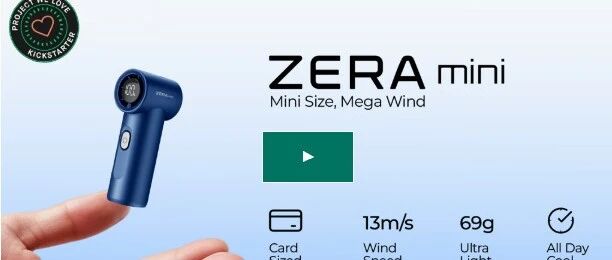
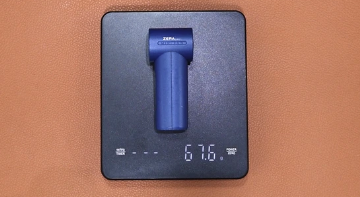
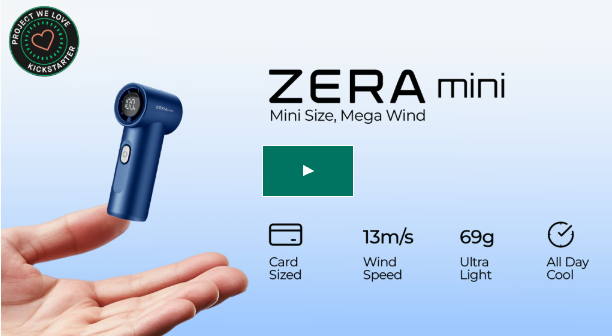
The ZERA mini is an ultra-compact turbine handheld fan, measuring 80×36×26mm and weighing just 69g. It features a 30,000 RPM brushless motor, delivering a maximum airflow speed of 13m/s, with 1–100 speed settings, USB-C charging, and a digital battery display. Optional accessories like a 360° rotating clip, lanyard, and carabiner allow for handheld use or attachment to collars, hat brims, belts, or backpack straps, making it suitable for commuters, travelers, music festival attendees, outdoor enthusiasts, and EDC users seeking to minimize carry weight. Launched on July 2, 2026, the ZERA mini campaign secured $130,000 within its first two weeks. The average pledge per backer was approximately $67–$70, with daily new funding averaging around $10,000 after launch. KICKSTARTECH conducted an engineering sample test, performing a desktop cleanup test with shredded paper. The ZERA mini effectively cleared the desktop in a short time, performing similarly to the larger ZERA MAX. However, the review also noted that the small air outlet produces a highly concentrated stream of air, ideal for spot cooling and cleaning crevices, but not suitable for covering the entire face or body.
Key Product Features
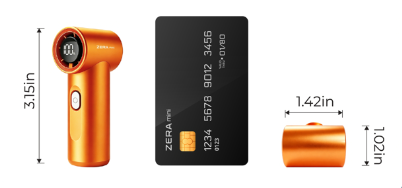
The ZERA mini's 80×36×26mm body and 69g weight make it genuinely pocketable for everyday carry. At approximately 80mm tall, its overall surface dimensions are shorter than the long edge of a typical credit card, and its 69g weight is about half that of most mainstream high-speed handheld fans. Users can carry it alongside items like earphones and keys without needing dedicated backpack space.
Its 26mm thickness is comparable to a small earbud case, fitting comfortably into a pants pocket, though not into a standard wallet card slot.
The true value of its small size lies in its potential for frequent use. While traditional high-speed handheld fans may offer more power, users might be less inclined to carry them daily if they weigh 150–250g.
The 69g body, however, is closer to a long-term everyday tool. This reduction in size does limit the air duct diameter, meaning it delivers a narrow, fast airflow rather than broad, gentle air circulation.
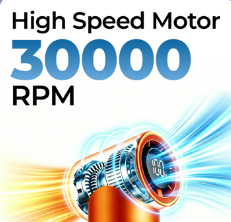
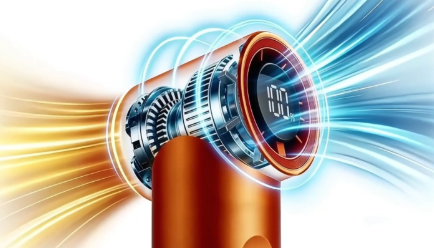
Equipped with a 30,000 RPM brushless motor, the ZERA mini boasts an official maximum wind speed of 13m/s, which the brand claims can extend airflow up to about 10 meters. This speed surpasses most entry-level handheld fans. Beyond targeted cooling for the face, neck, and lower back, it can also be used to clear desktop debris, clean device crevices, or provide auxiliary airflow for outdoor fires.
A narrower air duct allows for higher localized wind speeds with the same motor power, though the airflow tends to dissipate quickly after leaving the outlet. KICKSTARTECH's tests confirmed that its air column is noticeably narrower than the ZERA MAX, making it better suited for directed airflow to the face, neck, or inside clothing.
This is also the core distinction between the ZERA mini and typical desktop fans: it prioritizes high-speed, targeted airflow in a portable form factor, rather than circulating air throughout a room or desk area.
The device features a digital display showing the current fan speed and remaining battery. Users can long-press a button for continuous adjustment between 1 and 100 speeds, or single-click to quickly jump to 25%, 50%, 75%, and 100% settings. Compared to standard handheld fans with only three or five settings, the 100-speed adjustment is particularly valuable in the lower speed range. This allows users to find a more precise comfort level in an office, on public transport, or before sleep, avoiding situations where the lowest setting is still too strong or noisy. When rapid cooling or dust clearing is needed, users can jump directly to higher settings.
However, 100 settings do not necessarily translate to 100 distinctly different sensations. The wind speed differences between adjacent settings may be very subtle, primarily enhancing control granularity rather than offering 100 independent modes.
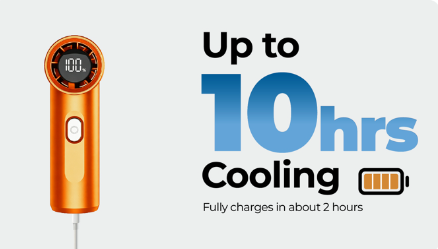
The ZERA mini includes a built-in 1200mAh battery, charging via USB-C in approximately 2 hours. Official runtime figures are: 10 hours at a low setting (approx. 9.5m/s), 6 hours at 10m/s, 3 hours at 11m/s, and 2 hours at the maximum 13m/s setting. High-speed operation significantly increases power consumption, meaning users will need to balance airflow and battery life during extended outdoor use in summer.
While the 1200mAh battery is notably smaller than the 3600–5000mAh batteries common in mainstream products like JISULIFE, the ZERA mini achieves its 69g weight through a more compact body. Its product philosophy isn't to maximize battery life, but to minimize weight while still providing sufficient power for a day's commute or short activities.
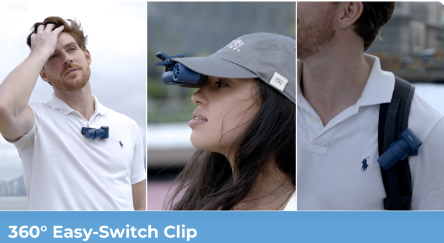
The combination kit offers a 360° rotating clip, a neck/wrist strap system, and a carabiner. The rotating clip allows attachment to collars, hat brims, backpack straps, or belts, with adjustable airflow angles to suit body position. The lanyard system enables the device to hang around the neck or be secured near the arm.
This design addresses the most apparent issue with handheld fans: requiring one hand. In scenarios like cycling stops, queuing, outdoor exhibitions, photography, or craft stalls, users can enjoy continuous localized airflow while keeping their hands free to operate phones or tools.
It's worth noting that the rotating clip is not included in all basic pledge tiers. When the device is attached to loose clothing, its angle may shift due to vibration and airflow reaction. If clipped near a hat brim, high-speed motor noise will be closer to the ear.
Engineering and Production Outlook
The ZERA mini is developed by the Hong Kong-based ZERA Sonic team, serving as a scaled-down version of their ZERA MAX. The brand has previously launched products like the ZERA MAX, ZERA MAX 2, and ZERA Sonic-X for personal cooling, portable drying, and oral care, and has also developed the Launbot portable clothing dryer under the same brand umbrella.
The project's core components—brushless motor, battery, air duct, display, and injection-molded casing—do not present significant mass production challenges. However, the combination of a 69g weight and high RPM introduces new engineering demands. Factors such as fan dynamic balance, bearing noise, body vibration, battery heat generation, and motor lifespan after prolonged high-speed operation are all mass production variables that engineering samples cannot fully validate.
Competitive Landscape
The global personal portable fan market was valued at approximately $640 million in 2026 and is projected to reach $1.23 billion by 2035, with a compound annual growth rate of about 7.56%. Factors like increasing high temperatures, a resurgence in outdoor activities, the widespread adoption of USB-C, and the promotion of portable cooling products on short-video platforms are collectively driving the evolution of high-speed handheld fans from low-cost seasonal items to EDC consumer electronics.
In the competitive landscape, the JISULIFE Handheld Fan 9 retails for approximately $29.99, offers a maximum wind speed of 10m/s, and features a 3600mAh or 5000mAh battery, weighing around 160g. Its strengths lie in battery life and established retail channels, but its size and weight are significantly greater than the ZERA mini.
In the premium market, the Dyson HushJet Mini is priced at approximately $99, weighs 212g, provides a maximum wind speed of 25m/s, and offers about 6 hours of battery life, emphasizing high airflow, low noise, and a refined air duct design. While its performance ceiling is higher, its price is roughly three times that of the ZERA mini's crowdfunding price, and its weight is also more than triple.
The ZERA mini's true differentiation isn't the highest wind speed or longest battery life, but rather its combination of a 69g weight, 13m/s concentrated airflow, 100-speed control, and wearable accessories, all starting at a $29 price point. It strikes a very clear balance between performance, weight, and cost.
The product's drawbacks are also apparent: the narrow air duct limits airflow coverage; maximum speed runtime is only about 2 hours; independent data on noise and vibration at high RPMs for the mass-produced version is not yet available; the 360° clip and lanyard require purchasing higher-tier packages; and numerous established handheld fans on the market already offer advantages in low price and long battery life.
With its 69g weight, 13m/s airflow, and $29 crowdfunding price, the ZERA mini is a clearly positioned summer EDC product. It doesn't aim to replace desktop fans or wearable air conditioners, but rather to make the experience of 'pulling out a strong burst of air anytime' as light and small as possible.
Whether the project can maintain its reputation after large-scale delivery hinges not just on achieving the 13m/s peak airflow, but on the stability of noise, vibration, battery temperature rise, and motor lifespan during prolonged 30,000 RPM high-speed operation over several months of continuous use.
The ZERA mini's true differentiation isn't the highest wind speed or longest battery life, but rather its combination of a 69g weight, 13m/s concentrated airflow, 100-speed control, and wearable accessories, all starting at a $29 price point.